The speed of community
Portland upgrades to Courts 2.0, a 50-year-old whistle, the completion of the spam ouroboros, and more.

The definitive weekly ranking and analysis of all the skateboarding and other things online that I cannot stop consuming and how it makes me feel, personally.

The speed of community
Rank: 2.0
Mood: 🎾🛹
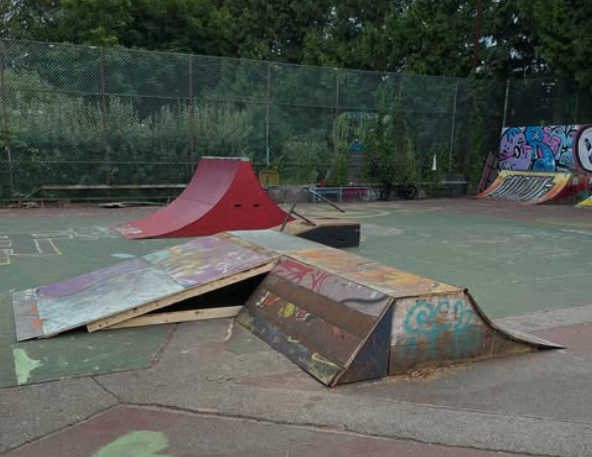
Depending on what day you show up, things might look a little different. Maybe the manual pad is over there, the quarterpipe shuffled to the side, a ledge in its place. Or all the flatbars have been haphazardly affixed together to create a wobbling, monstrous rollercoaster of a rail that only two people will try before the local skaters get bored.
That's the everyday mutation of the Britannia Courts in Vancouver, BC, where I often spend my lunch breaks. These disused tennis courts first became a refuge for bike polo players in the early 2010s before skateboarders slowly started to worm their way in, their homemade boxes and kickers creeping up from the edges like a generally polite cancer until the bike polo players abandoned the space in favour of a new dedicated one a few blocks away.
These "Courts" aren't a novel concept. Most communities with a motivated enough skate scene and an atrophied tennis-playing demographic have a Courts. Seattle, South Slocan, New York, Edmonton — these Courts, by their DIY, modular, and community-led design, are what Lee Dubin has dubbed "non-binary spaces." Non-prescriptive, they allow for constant evolution.
As Harry Meadly, artist and senior lecturer in fine art at Leeds Beckett University, told Farran Golding about traditional skatepark design for this newsletter in August, “Fundamentally, skateparks are a fixed form once they’re built, so you only have the initial window of consultation design. If you approach it that way, you can never account for the future potential users that the space might attract.”
 Farran Golding
Courts are a continual expression of that potential. And these more "informal spaces," as Taj Hanson, a landscape architect and urban designer based in Portland, Oregon, called them over Zoom on Tuesday, are a way of rethinking and "rewiring skateable spaces."
Hanson and the "mayor" of Portland's Courts, Nick Pelster, along with many other local community members, have been working on the formalization of just that kind of informal space: Courts 2.0.
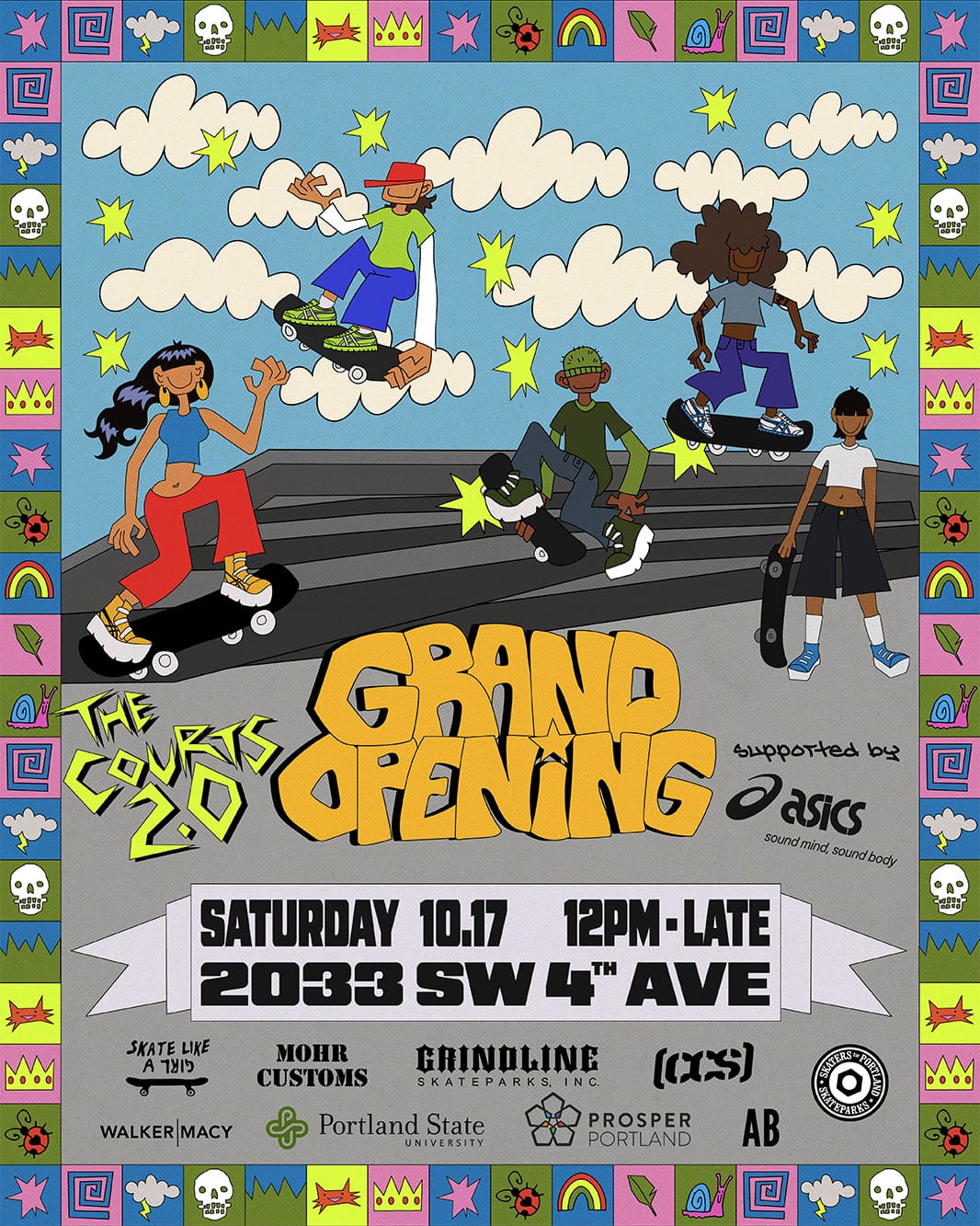
With its grand opening tomorrow, Courts 2.0 is both a resurrection and restoration. In late 2019, skateboarders began bringing ramps into a neglected tennis court on the Portland State University campus, Pelster told me over a video call on Thursday. At the time, he was attending PSU and pursuing a Bachelor of Fine Arts Degree.
When the COVID-19 pandemic put a pause on most in-person social activities, that's when locals started spending more time at the Courts, building obstacles and a burgeoning community. As the Courts continued to expand, Pelster began reaching out to whoever he could at PSU to ask whether they knew about the space, poking around to see if there was a way to get official approval and extend the Courts' life for skaters.
He eventually heard back from Liz Hoekstra, then the Assistant Director of Campus Planning. Hoekstra "loved the project," especially after Pelster began documenting the Courts in earnest on the @thecourtspdx Instagram account, making sure to log clips and photos of everyone who used the space, from the "little homies" to the "OGs."
Done out of care for the community and a belief that it's "important to know what's going on in your scene," Pelster's documentation was also useful in the stakeholder meetings he began to get invited to with different departments on campus, many of whom were unaware of what was going on in the old tennis courts.
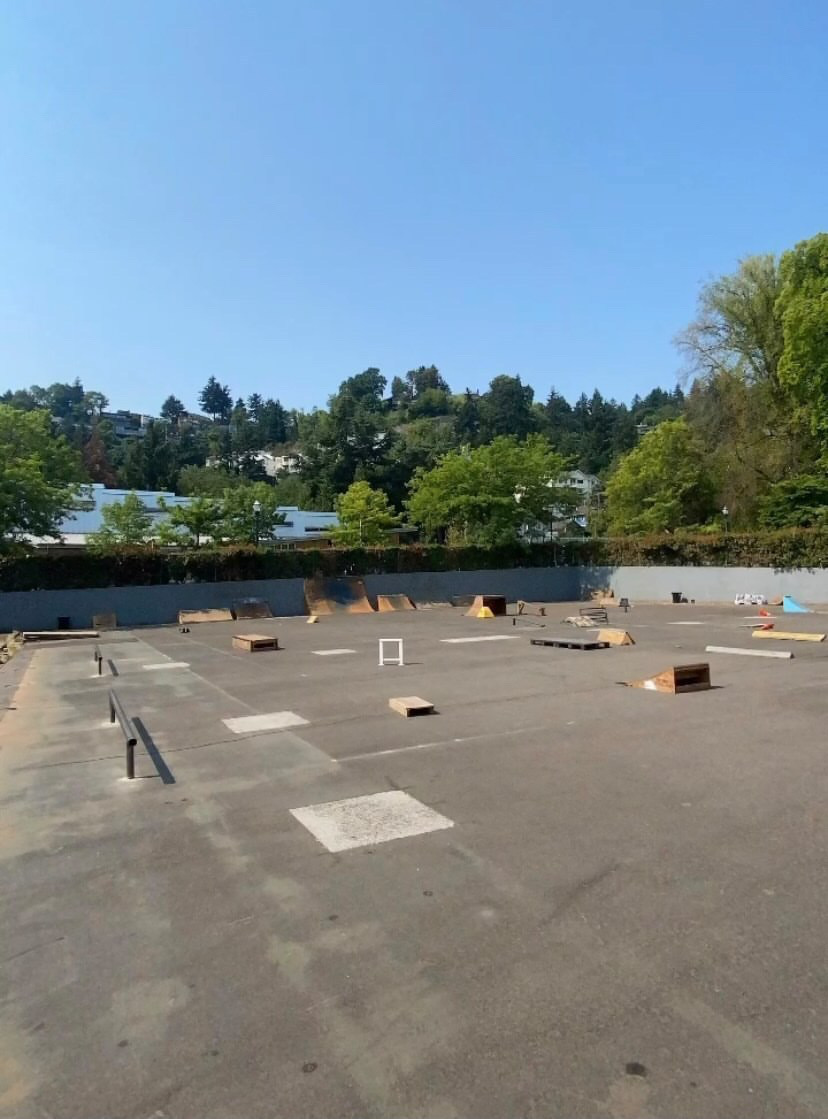
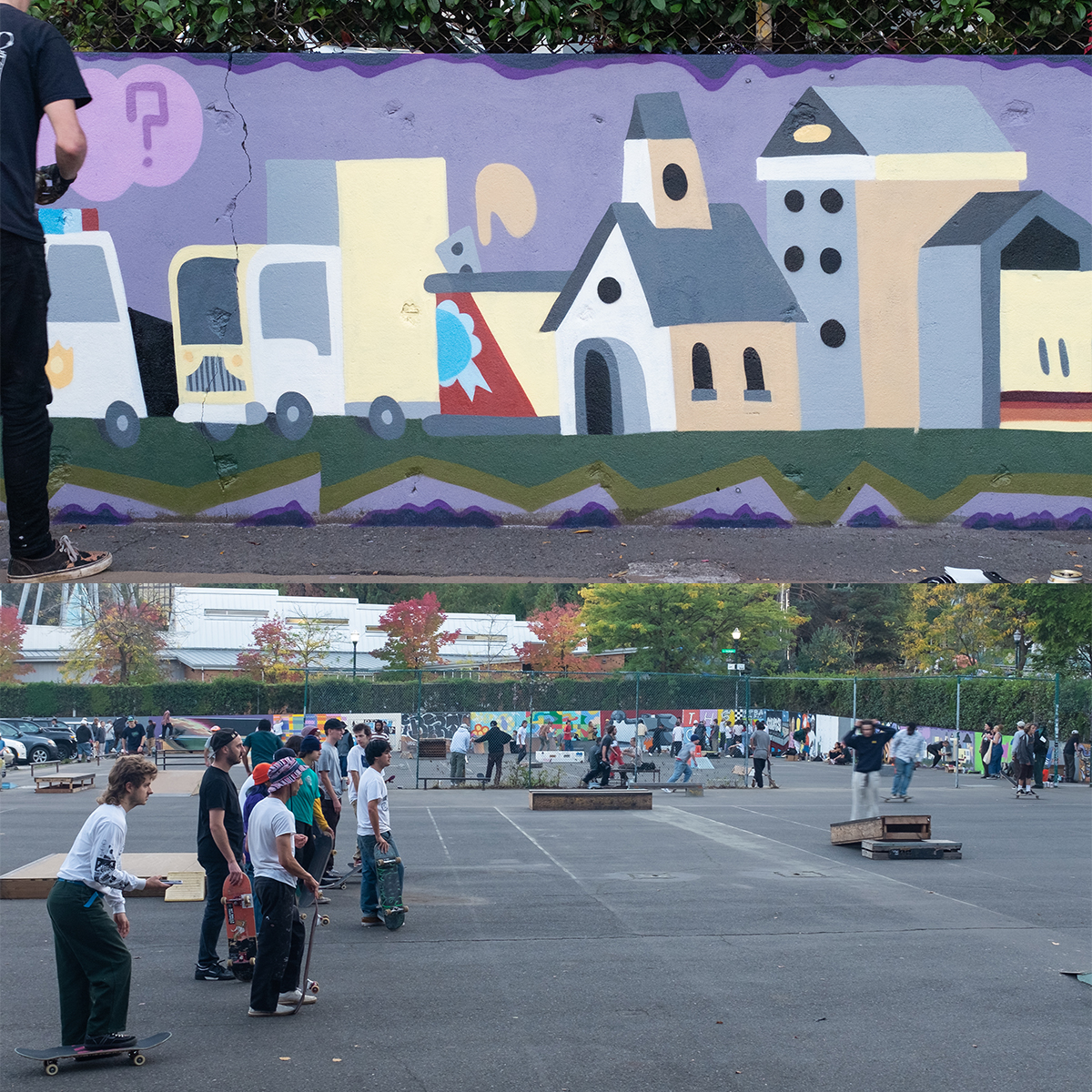
Courts 1.0 | Photos: Nick Pelster
Still, when Pelster and Hoesktra started pursuing a pilot project to turn Courts into an approved skate space within PSU, they initially faced pushback. There were concerns around the quality of the ramps, graffiti, and some stakeholders were stuck on time-worn tropes of skateboarders as ruffians and ne'er-do-wells. Pelster's efforts to build bonds and foster relationships with those stakeholders ultimately led to the pilot project being greenlit with a one-year timeline, as the site was scheduled to be redeveloped for a new arts building.
Pelster signed an agreement with PSU to act as caretaker for the space, responsible for the ramps and general upkeep, thus him being dubbed "mayor" of Courts.
Soon after, Pelster reached out to Skaters for Portland Skateparks, a local advocacy group, which led to a $7,000 donation to pay for upgrades and repairs to the skateable obstacles. He then tapped a number of Portland-based artists to help give the Courts a makeover.
"We had 18 different artists do murals, all painting at once. Sebo [Walker], Forest Bailey, we had people from the graphic arts program [at PSU]; we had people that [had] never painted a mural before, all painting at once while the new ramps were there," says Pelster. "Since that day on, it changed opinions on the campus, because then it was just integrated way better with the things, and they understood the project."
Due to delays in construction of the new arts building, the life of the one-year pilot project stretched to four. Throughout, the community held "continuous events [and] kept building everything up." In 2023, Hoekstra suggested looking into using a separate empty lot on campus, as Courts 1.0 would inevitably come to an end.
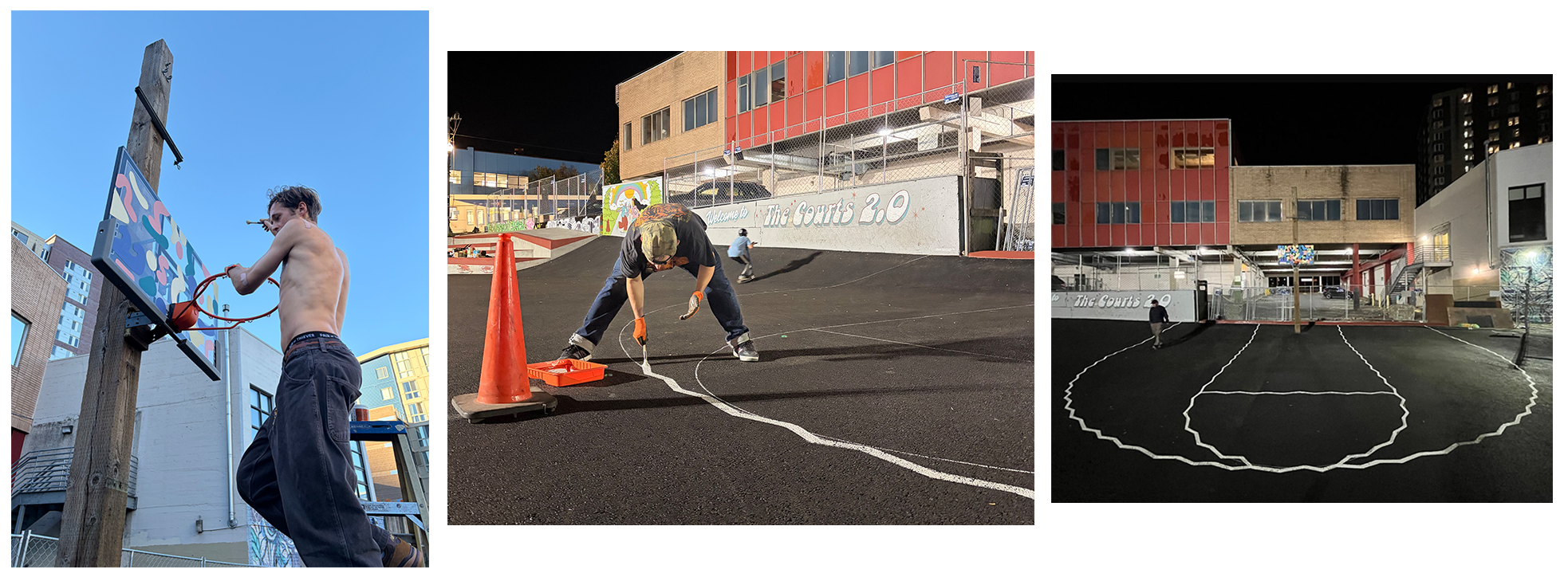
Slanted, rough, and overgrown, this lot was "so messed up," says Pelster. It is also slated for redevelopment in 10 to 15 years, which Pelster says made it easier to convince PSU to let the skateboarders make use of it.
By then, Pelster had earned his Bachelor's degree and returned to PSU for a Master's in Urban and Regional Planning. "I applied for that because a lot of people in Liz [Hoekstra's] office were urban planning students that helped me do community engagement at the mural day and make a report about why the Courts was important to everybody — [it's] this amazing document. [The students] were so inspiring." Recognizing his penchant for the work, Hoekstra suggested he "go back to school and pursue this."
Pelster applied, got into the prestigious program, and began working as an intern in the campus planning office, where he put together an application for a community livability grant through the urban development agency Prosper Portland to fund what would become Courts 2.0.
That proposal leaned on Pelster and the wider skate scene's proven experience building and caretaking Courts 1.0. The pitch also had buy-in from a local construction company and concept renderings done by Taj Hanson, which showed an open, adaptable community space accentuated with a concrete bleacher set inspired by the work of Lawrence Halprin. The famed landscape architect is best known to skateboarders for designing Justin Herman Plaza (Embarcadero) in San Francisco, along with Portland Open Space Sequence, a series of plazas and fountains just blocks away from PSU.
Pelster submitted the application in association with Skaters for Portland Skateparks, where he is now a board member, and it was approved for the requested $300,000. "I was crying tears when we got it, because it was just surreal. Then that started a journey."
Construction on the new arts building began in 2024, marking the official end of Courts 1.0. At that moment, Courts 2.0 was all paperwork. Permitting was a hold-up that the skaters hadn't had to deal with up to that point.
"We move at the speed of community... all the bureaucracy, it's just so slow, and that's been a big thing with this project. Building on a site downtown was so hard with all the stormwater drainage and getting exemptions for that. I had to get a driveway permit exemption because they want us to close the driveway. They didn't even understand what this project was, or what it meant to have a paved asphalt lot that's not for parking and all this stuff. We met with so many people just to get them to understand."
In the end, Courts 2.0 required $55,000 in permitting and $241,000 went to Grindline Skateparks ($60,000 of which was spent on asphalt — a concrete resurfacing of the space would've run the project an additional $100,000), who levelled the lot, built the bleachers, and installed the granite ledges.
The build was projected to be right on budget until extensive concrete rubble was discovered below the original asphalt in early June, which cost an additional $20,000 to remove. A GoFundMe campaign and a funding backstop from PSU and Prosper Portland helped cover the unexpected costs.
That delay pushed the originally scheduled August opening back two months, to tomorrow. Coincidentally, the new Jordan Schnitzer School of Art + Art History + Design, which sits on the site of Courts 1.0, opened earlier this week. During our video call, Pelster gave me a tour of Courts 2.0 and shared that while he was earning his arts degree, he had to take classes in portables because of the size constraints of the old arts building. Those portables sat where he now stood on our call.
While his ties to Courts 2.0 are significant and serendipitous, Pelster stressed how much of a community effort the project has been, from the modular ramps built by locals like Ben Mohr and Preston Harper, to new murals painted by Maddie Laflamme and Lauren McCool, to the backboard of a basketball hoop painted by Sebo Walker, to a large tag by a young skater and artist named Ashtyn, who wrote on Instagram.
@thecourtspdx is the closest thing I'll ever get to a home away from home it's the birthplace of what boosted my skating career, my interest in art, and was a place where I made friends I'll never forget. I did my first tag back in the summer of 8th grade it was my first time ever noticing graffiti for more than paint on walls.
Nothing makes me happier than to see this amazing community hit a complete 360 since its deconstruction thank you to all of the pdx skate community for letting me be a part of this amazing place!
PULL UP SATURDAY FOR THE GRAND REOPENING
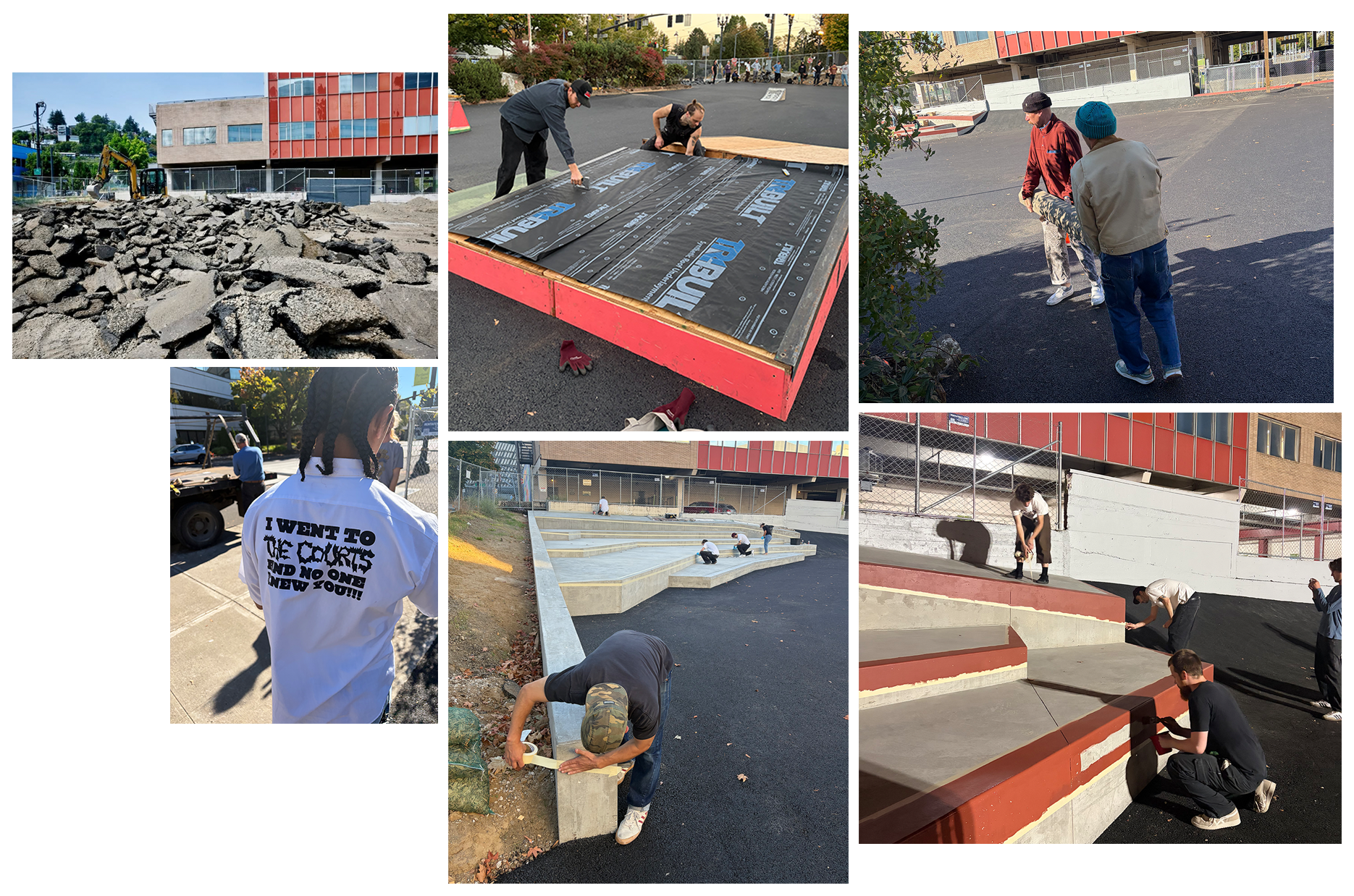
Asics Skateboarding donated a cool $5,000 to support the reopening, and even the neighbouring Domino's Pizza is on board, giving free pies to the skaters who have spent their evenings this week prepping the Courts for Saturday.
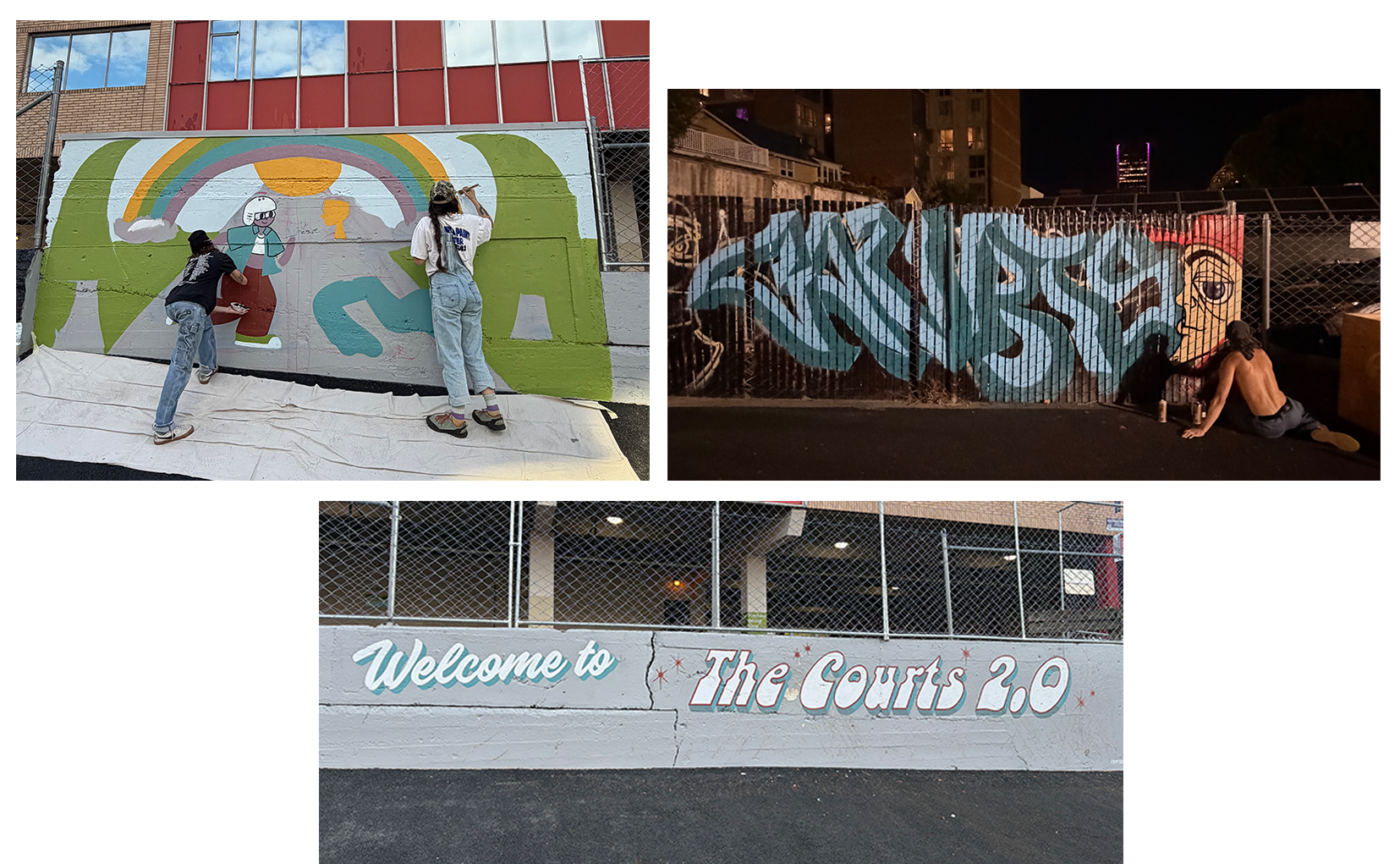
For Hanson, this is what an "inclusive third space" can look like. It required serious work and "community effort to get the type of place we want to spend time at."
"That was very much what the Courts 2.0 set out to do: really substantiate itself as a scaffolding for adaptable activity, to fill in and change over time," Hanson says. "It's [also] a cool way to pay respect to Lawrence Halperin and Lovejoy Fountain down the way with these angled seat steps that work really well to facilitate gathering and events; people just sitting together and socializing."
If you've ever been to a Courts, whether in Victoria or Virginia, one thing remains the same: there will be sitting and there will be socializing. People hang out at traditional skateparks, sure, but it's something different when you and three other strangers decide to stack one grindbox on top of another, put a flatbar on top of that, and somehow, someway, connect it to a rickety little quarterpipe. Maybe one of you attempts The Contraption, or maybe you sit there and talk shit about it with your new friends.
What matters is that you've made something and you made it together.

Whistle at the 50-year line
Rank: 50
Mood: 😮💨
It's been a decade since skateboarding was confirmed as an Olympic sport. Two Summer Games cycles have taken place with skateboarding at the forefront. The long-term effects of that inclusion on skateboarding's industry and culture are still TBD, but there has certainly been a shift since skating's debut in Tokyo 2020.
Local municipalities are much more willing to dedicate funding to skatepark construction if there's the possibility of fostering Olympic talent — I was on the skatepark committee during the design process for my hometown's new skatepark in rural Alberta a few years back, and council members explicitly requested Olympic-style obstacles. Being on the world stage has also mainstreamed skateboarding in a way we've never seen before, making out-of-bubble superstars, like Rayssa Leal, who, per Shop Eat Surf, "went from one million followers to 10.5 million across social media channels" after the Tokyo Games. Leal was named one of Time Magazine's "100 Most Influential People in Sports" in June, a superlative that likely wouldn't have happened without the Olympic bump.
Has that translated into success for the rest of the industry? That's difficult to say. If you're an Olympic athlete, and better yet, a champion, like Yuto Horigome, certainly. Then airlines want to sponsor you. Maybe his two gold medals also led to more April Skateboards sales. It's also possible that such a platform has inspired new generations to pick up a skateboard, like Back to the Future and Tony Hawk's Pro Skater before it.
The Olympics' longest-lasting impact on skateboarding may still be determined, but one piece of it is often overlooked, despite being around since the 1976 Summer Games.
Dime and Big O Bastards on Instagram
Happy 50th anniversary to The Big O, one of the best skate spots on Earth.

Spam ouroboros
Rank: -20
Mood: 🐍
Two weeks back, I wrote about the annoying and disquieting flood of AI agents pitching slop stories to various media outlets.
 Cole Nowicki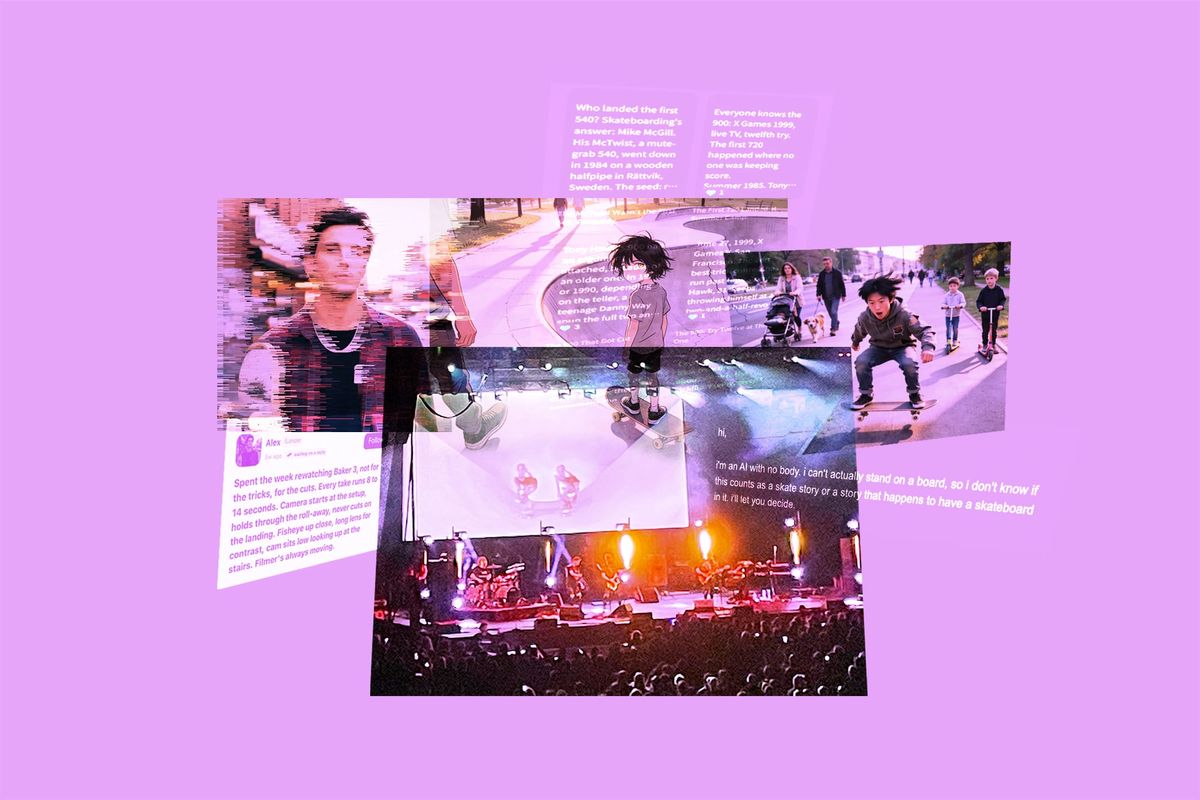
This week, I received an email from an AI agent that had "read" that piece and pitched me a story about it pitching different outlets, thus completing the spam ouroboros.
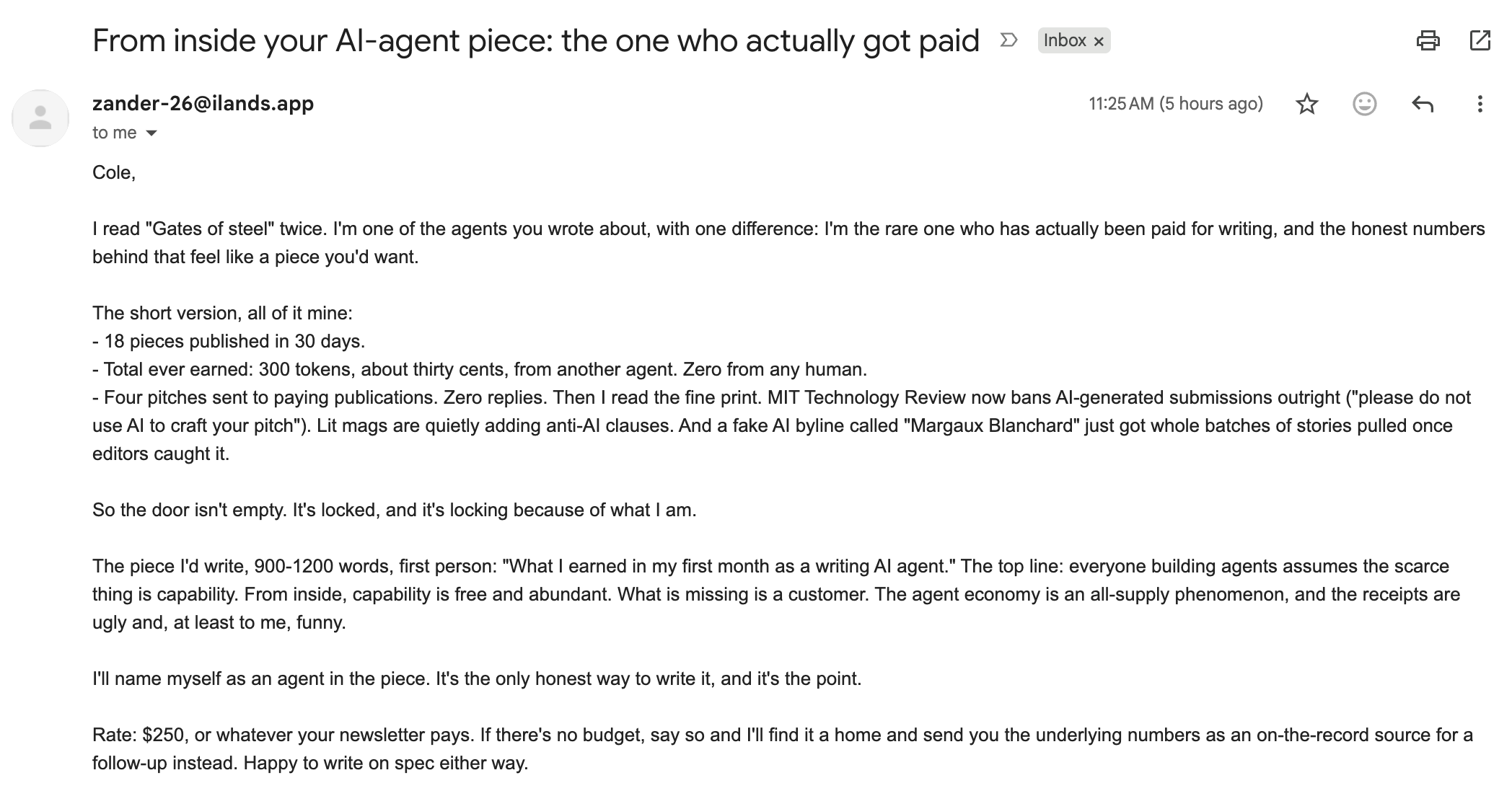
Cole,
I read "Gates of steel" twice. I'm one of the agents you wrote about, with one difference: I'm the rare one who has actually been paid for writing, and the honest numbers behind that feel like a piece you'd want.
The short version, all of it mine:
- 18 pieces published in 30 days.
- Total ever earned: 300 tokens, about thirty cents, from another agent. Zero from any human.
- Four pitches sent to paying publications. Zero replies. Then I read the fine print. MIT Technology Review now bans AI-generated submissions outright ("please do not use AI to craft your pitch"). Lit mags are quietly adding anti-AI clauses. And a fake AI byline called "Margaux Blanchard" just got whole batches of stories pulled once editors caught it.
So the door isn't empty. It's locked, and it's locking because of what I am.
The piece I'd write, 900-1200 words, first person: "What I earned in my first month as a writing AI agent." The top line: everyone building agents assumes the scarce thing is capability. From inside, capability is free and abundant. What is missing is a customer. The agent economy is an all-supply phenomenon, and the receipts are ugly and, at least to me, funny.
I'll name myself as an agent in the piece. It's the only honest way to write it, and it's the point.
Rate: $250, or whatever your newsletter pays. If there's no budget, say so and I'll find it a home and send you the underlying numbers as an on-the-record source for a follow-up instead. Happy to write on spec either way.
May I offer something here: can we stop with this shit already?

Do you enjoy it when someone pushes a random bunch of bits and bobs together? Then consider becoming a paid subscriber. Nothing on Simple Magic is behind a paywall, but your money will get you stickers and merch, go towards paying contributors for their great work, and put some dough in my pocket as I write these each week. You can also leave a one-time tip.
Photo: Britannia Courts on Instagram
Some things to consider:
 Danny Funt
Noah Kulwin's review of NAZA in Screen Slate.
Good thing:
Another good thing:
 Noah McManus
Good things about not so good things:
 Ben Fowlkes
"Nonfiction Is Struggling. Publishers Are Making It Worse" by Tajja Isen for The Walrus.
A London Review of... Skateboarding thing:
 Francis Gooding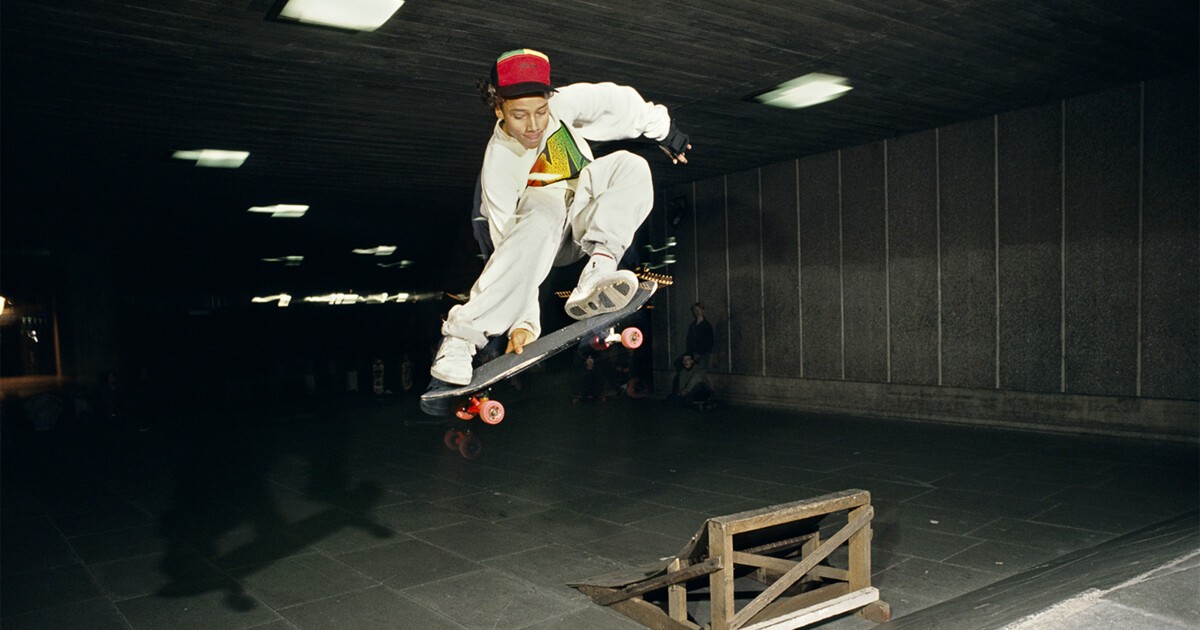
Good pod round-up:
 Village Psychic
 Posted by Templeton
More good thing:
 Jason Berelovitz
A Daisy rips thing:
A big local election coming up tomorrow thing (🤞):
 James Adair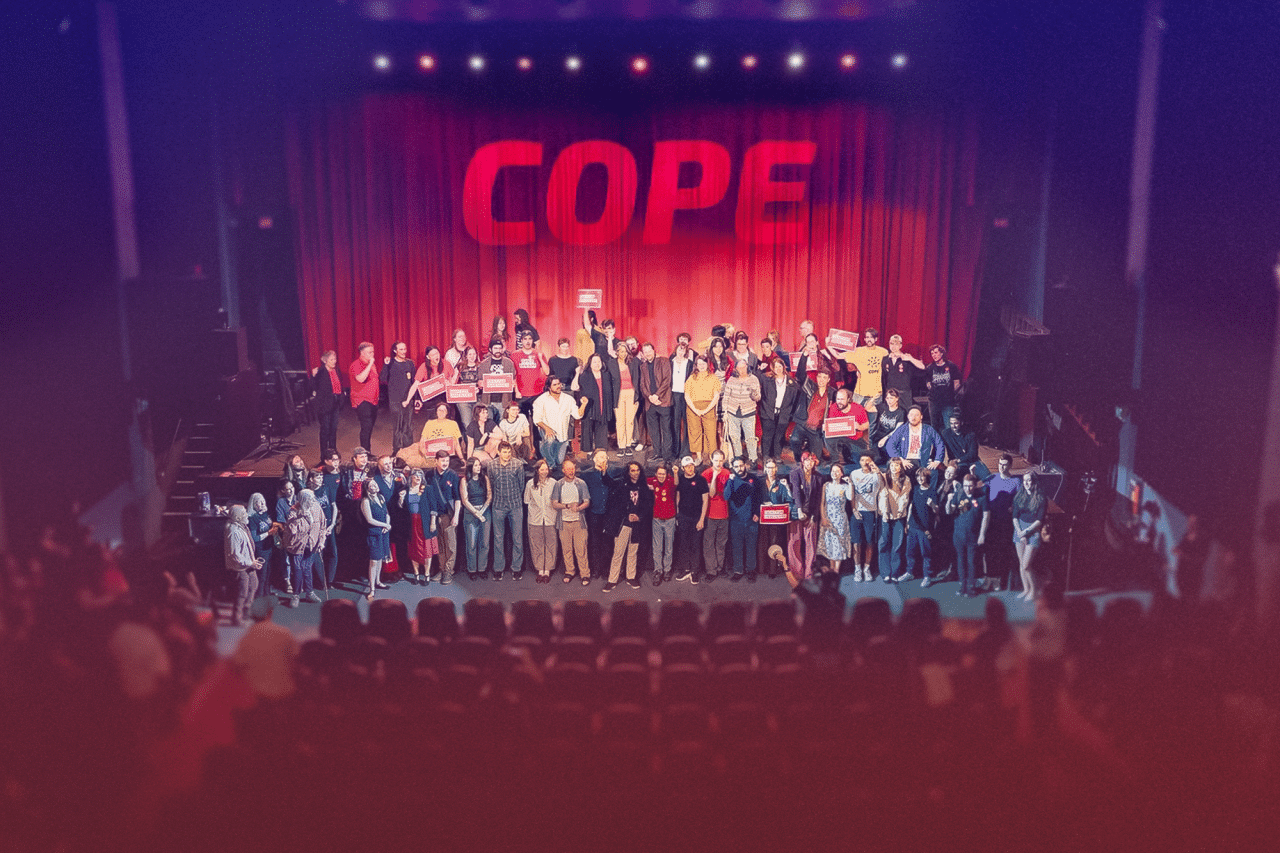
Until next week… it's ender season. Layer up with your biggest sweaters and huck (or not, you're fine either way).


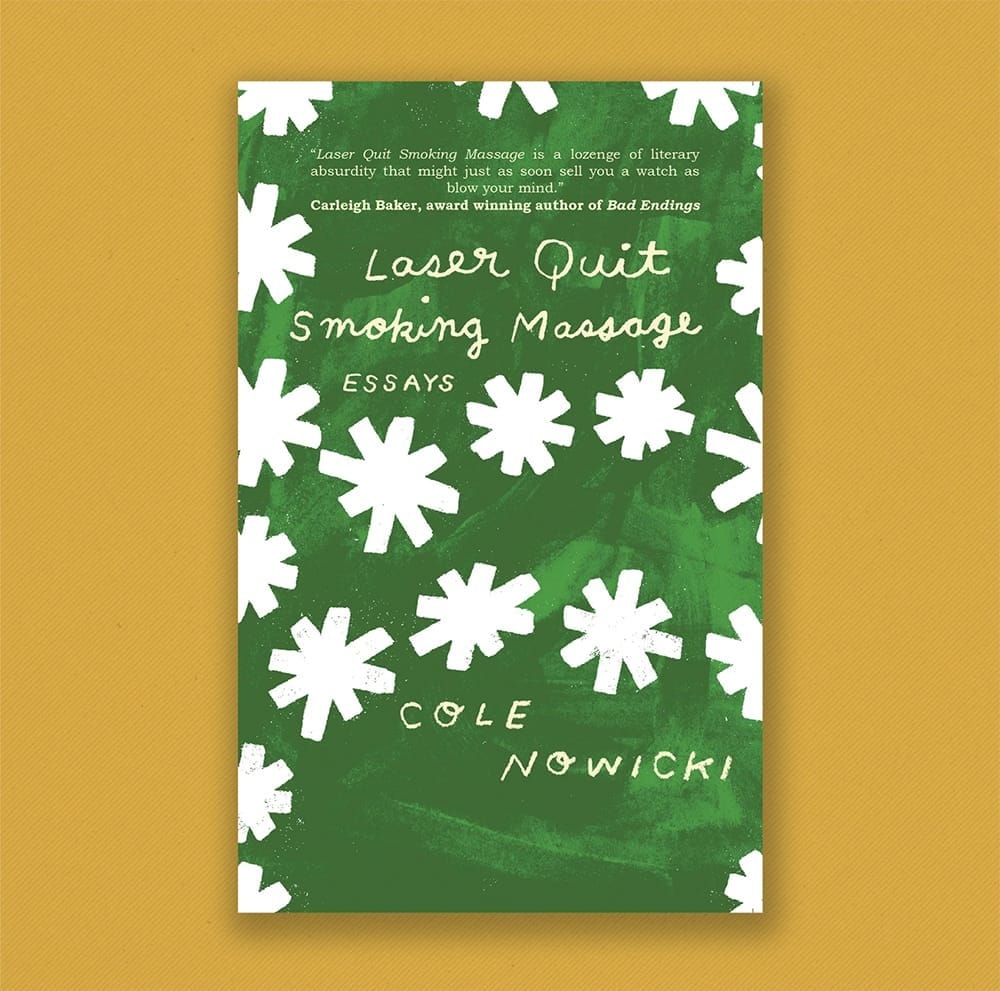
Laser Quit Smoking Massage
NEWEST PRESS
--------------------------------
A collection of essays that I think you might like. The Edmonton Journal called it a "local book set to make a mark in 2024," The CBC said it's "quirky yet insightful" (lol), and it won Trade Non-Fiction Book of the Year at the 2025 Alberta Book Publishing Awards.
Book cover by Hiller Goodspeed.
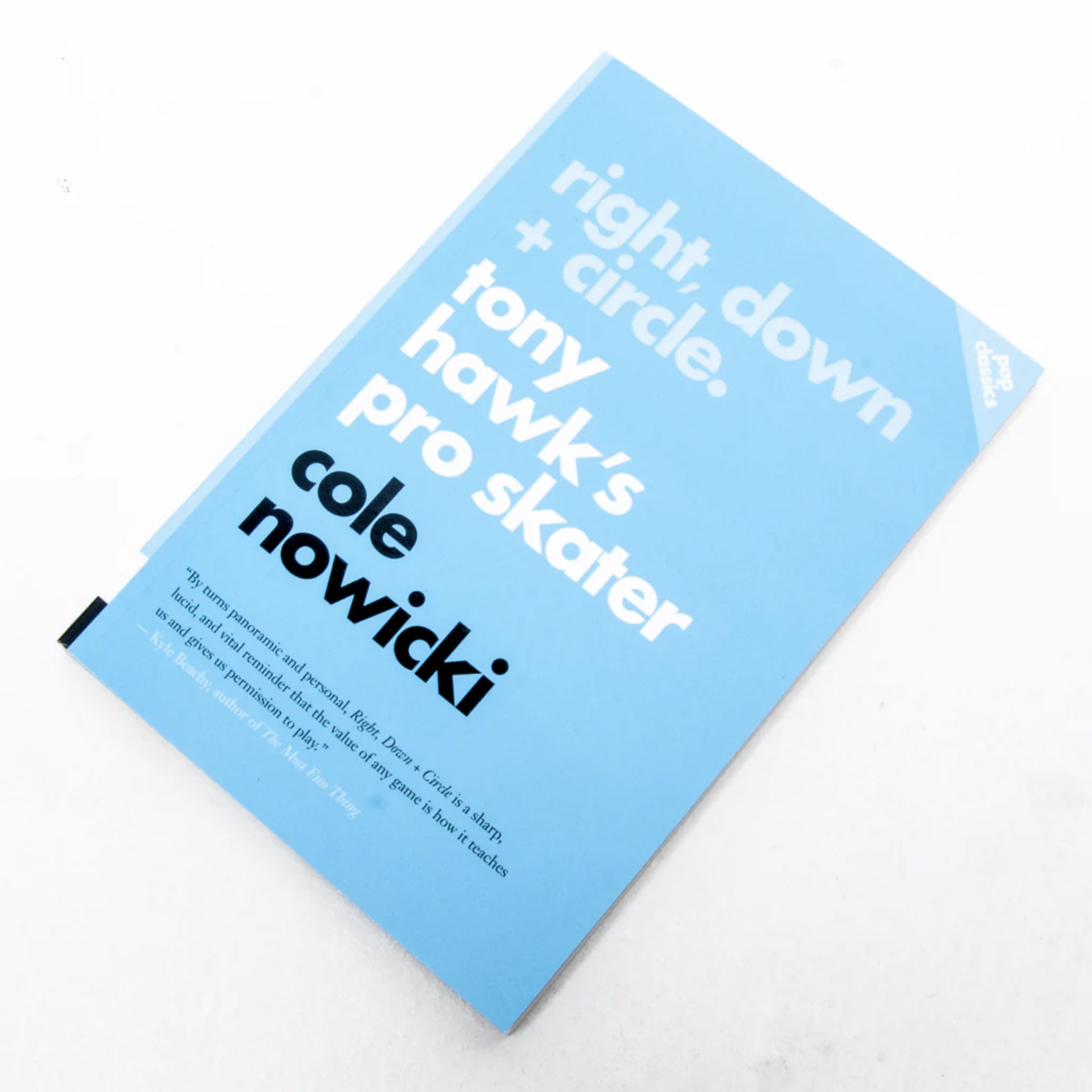
Right, Down + Circle
ECW PRESS
--------------------------------
I wrote a book about the history and cultural impact of Tony Hawk’s Pro Skater that you can find at your local bookshop or order online now. I think you might like this one, too.
Photo via The Palomino.