A great leveller
Farran Golding on reconsidering the skatepark, changing your approach, and embracing the MUSKA.

When was the last time you went skateboarding and skated only flatground? Not out of circumstance, say, like the skatepark was hectic, so instead you opted for the tranquillity of an empty basketball court. Or you got rained off and found refuge in that one patch of concrete that dries miraculously fast. When did you last skate with flatground as your sole purpose and destination? If it has been too long to remember, how long do you think flatground alone would keep you entertained?
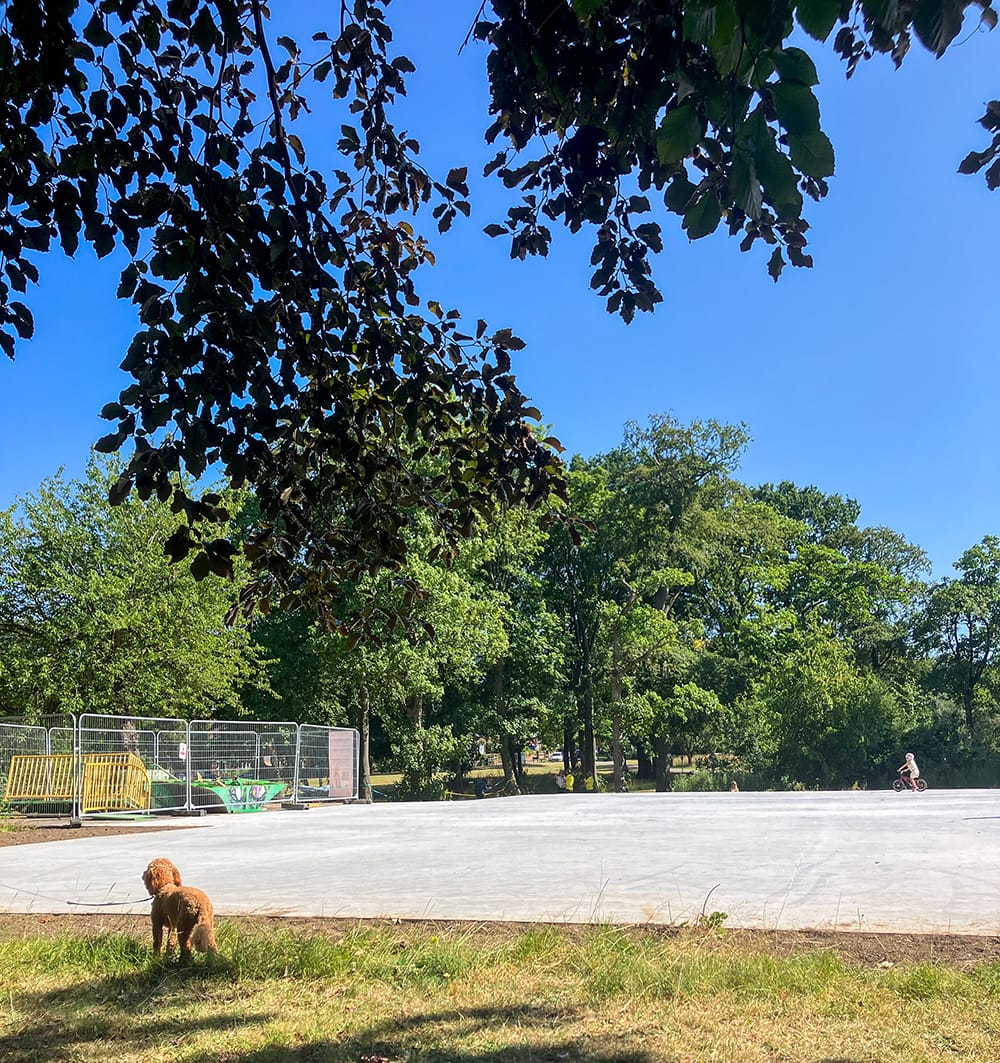
Last month, as I do most weekends, I drove 60 miles from Manchester to Leeds, the city where I previously lived, to visit friends. We were skipping our usual haunts to instead skate at a park I didn’t bother with once during the six years of it being the closest one to my house. It was the opening day of the new Beckett Park Skatepark: 1000 square metres of glossy, creamy grey concrete with not one obstacle on it, yet so much going for it.
Beckett Park Skatepark is in a large public greenspace next to Leeds Beckett University’s Headingley campus. Its renovation was led by skateboarders Laura Long, a local resident and town planner, and Harry Meadley, an artist and senior lecturer in fine art at Leeds Beckett University. Skatepark development in the UK usually takes years to come to fruition, requiring laborious efforts to get local councillors on side and hundreds of thousands of pounds in fundraising. By changing their approach, Long and Meadley made it happen faster than they ever anticipated.
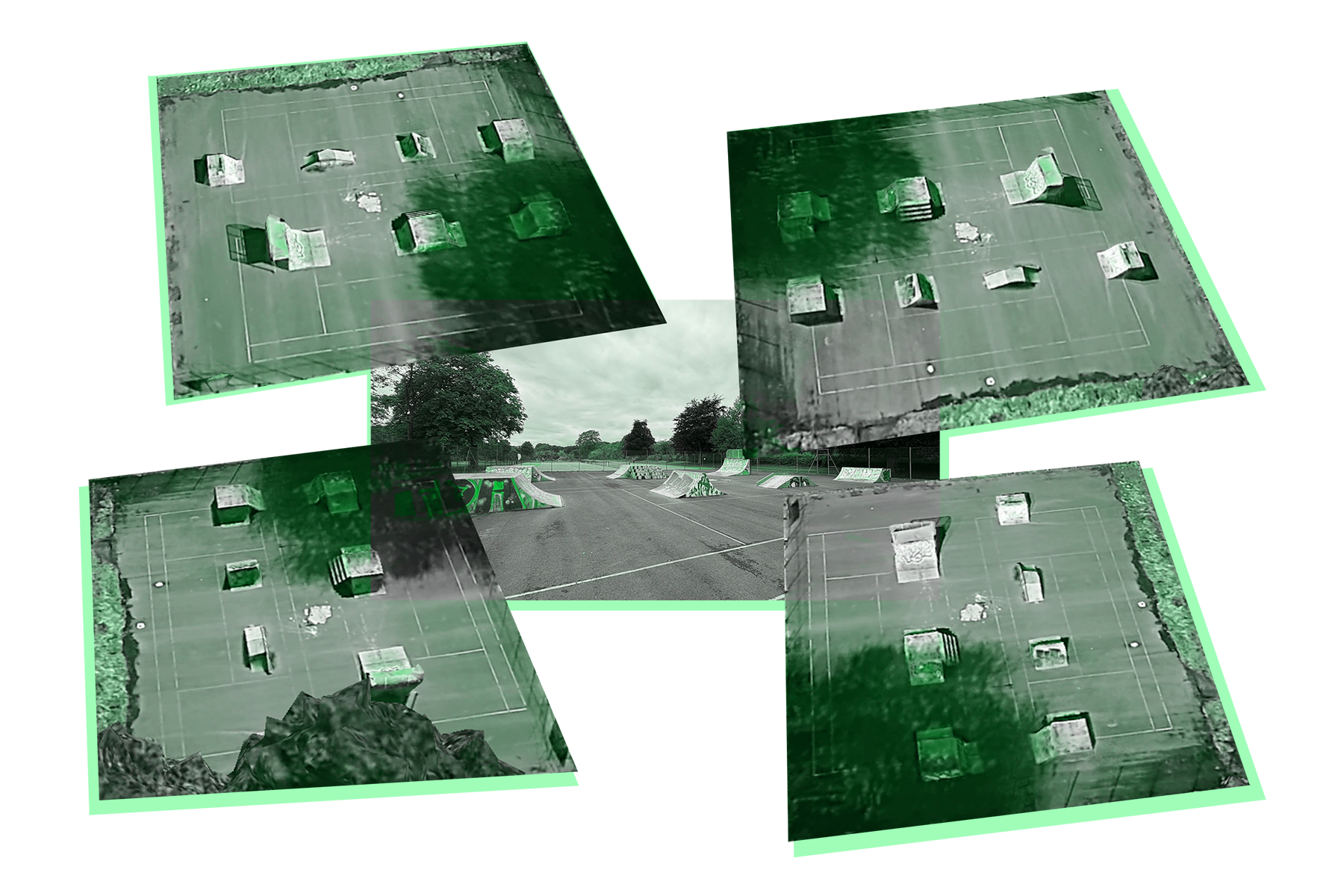
It’s the summer of 2025 and I’m standing at Beckett Park Skatepark, marvelling at what a shithole it is. The jagged asphalt ground is unrideable and waits to bite a chunk out of anyone naïve enough to bother. The ramps are metal and badly proportioned, the kind I’ve recently encountered in other areas of Yorkshire which somewhat inexplicably have skateparks. I deduce that this variety was put there in the early 2000s by councils as a quick fix to contain what they considered a new nuisance: a boom in local skateboarding activity thanks to the success of Tony Hawk’s Pro Skater. By the time I get to such skateparks two decades later, their use has tapered off, leaving locals unfulfilled and scenes not nurtured by the cost-conscious parks provided to them.
I can’t skate at the moment due to an injury, though this is of little concern considering the specimen before me. I’m visiting Beckett while on one of many tours around Yorkshire, surveying every skatepark in the region for the UK’s first “Skateable Spaces Audit,” which is led by Dr. Esther Sayers and George Nicholls at Goldsmiths, University of London, and Stuart Maclure, development manager of Betongpark, a leading and progressive skatepark builder (Maclure also worked on the Long Live Southbank campaign and is a co-founder of Pushing Boarders).
This audit of the UK’s skateparks, DIYs, and significant street spots has been commissioned by the national governing body Skateboard GB with funding from Sport England. It aims to understand how locations for skateboarding can be better designed and managed. I start filling out a Google Form on my phone, detailing the qualities of the park: what it's made of (asphalt ground and metal ramps — the constitution of over a third of UK skateparks), the features (small and medium quarterpipes, a four-stair with a no run-up and a minute handrail, some flat banks, a large but rough flatground area), its accessibility by public transport (pretty convenient), how visible it is (very), and the population of various wheeled-sports users: skateboarders, bladers, BMXers, wheelchair MX, and scooters. It’s empty.
I score it low for safety and note the disparity between its context and use. Beckett Park itself is regularly used for picnics, exercise, walking dogs, and so on. It is near a university campus which has security to safeguard its halls of residence and sits beside a pleasant residential neighbourhood with good visibility and street lighting. Goldsmiths will later evidence that “well considered, visible locations” are key to a good skatepark. “The area itself is welcoming,” I begin, “but as a skate park it is not ‘welcoming’ for the activity of skateboarding.” A question asks if the surface is “uniform,” to which I tick “yes” then jump to a section for notes and addendums. “It is uniformly bad.”
When Laura Long first visited Beckett Park in 2022, it was in no better condition and had been recently seasoned with smashed glass. As a town planner she knew the ins and outs of local municipalities, so she contacted Leeds City Council, thinking they would at least throw down some fresh asphalt to even the surface. After an inspection it was deemed fine in its current state. Long opted to skate the recently renovated tennis court beside it instead.
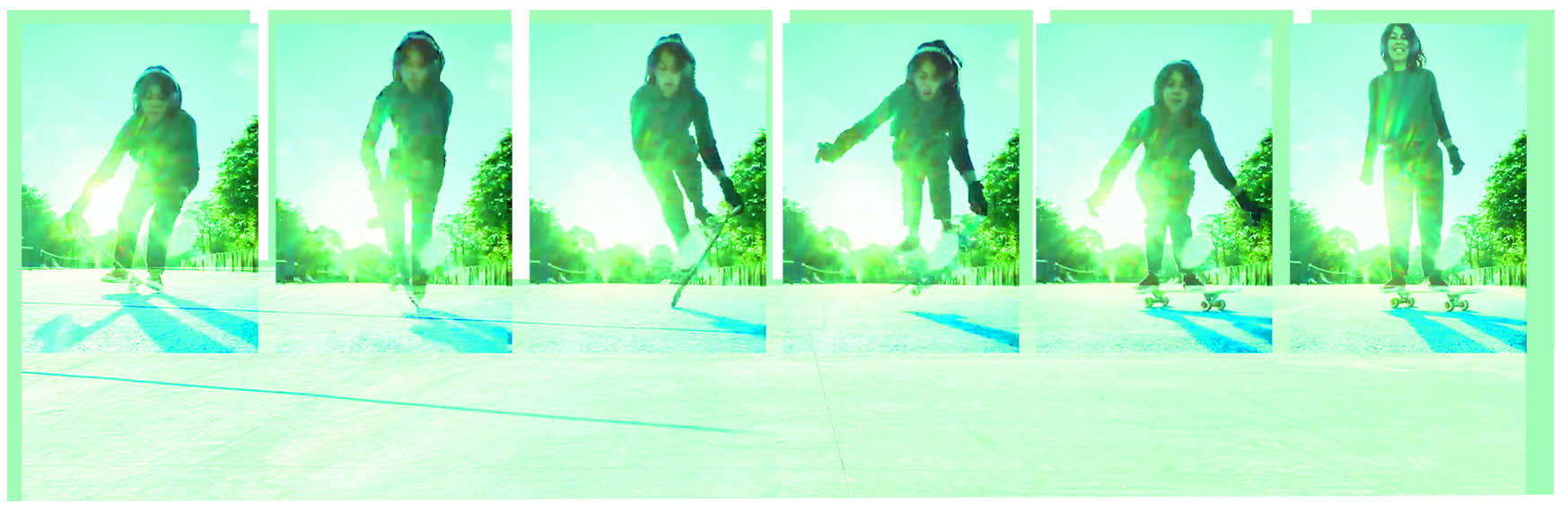
Long started skateboarding at age 39. In looking up tricks and advice for beginners, she discovered Jane Falconer-White, who started skateboarding in her 40s and became a competitive freestyler. Long gravitated to freestyle partly through finding inspiration in Falconer-White but also out of consequence due to Beckett’s poor quality. “I was looking for stuff I could do that didn’t necessarily need a skatepark,” says Long. “I thought ‘I can do [freestyle] in any old space that’s flat.’ I started a little skate diary and the freestyle community is very small, niche, and really supportive online.” She found a freestyle scene in Leeds and grew more confident as a skateboarder but generally avoided traditional skate spaces like parks and popular street spots. “I still have it now, to be honest. People who know what they’re doing are going quite fast and you’re not used to the flow. If you’re starting out, you just want to take your time. [Skateparks] felt quite gnarly and not a space to go if you’re a beginner. Not necessarily being a woman but just a beginner, I think.”
In summer 2023 she attended a ‘Street Skate Together’ session organized by Harry Meadley. These events sought to engage and encourage beginners, women, and gender-expansive skateboarders through inclusive sessions at spots around Leeds. Meadley’s practice is in socially-engaged arts; skateboarding has become central to it in recent years. His practice-based PhD thesis “The Art of Skating Institutions” aimed to elevate "non-traditional" skateboarders in tandem with developing relationships between arts organizations and Leeds’ skate community to create more progressive public spaces. (Meadley is a close friend and I worked as research assistant on aspects of his PhD during which we created Civic Leeds, a project which oversaw the “Street Skate Together” sessions). Significantly, Meadley’s PhD led to the renovation of a popular but heavily cracked ride-on ledge outside Leeds’ famed Henry Moore Institute. The gallery is classified as Grade II Listed, meaning alterations are near-impossible; however, Meadley’s renovation of the ride-on ledge was deemed permissible as a “sculptural intervention.” Titled “For SB” both “for skateboarding” and in memory of Sally Bagnall — a beloved figure in Leeds’ arts community who often sat on the ledge — the renovation also doubled as a formal acknowledgement of the Henry Moore Institute’s exterior as a skate-friendly space.
“I was impressed by the way Harry managed to unlock parts of the city that I had previously considered off-limits as an inexperienced female skateboarder,” says Long, regarding putting their heads together with Beckett. “While my day job has given me experience delivering urban development projects and balancing the competing interests of different groups, I felt that, as a beginner, I lacked the knowledge, confidence, and authority needed to redevelop the skatepark on my own.” Long recognized there could be local funding available through Section 106 planning obligations, agreements used to mitigate the impacts of new development by securing financial contributions or physical improvements to local infrastructure and community facilities. Together, renovating Beckett seemed feasible. “I was up for being involved because it always felt like somewhere that had a lot of potential,” says Meadley. “It was at Laura’s invitation that I got involved to think about how we can develop it in a cost-effective way. Equally, she knew a lot of what I want to do is how you prioritize and create more inclusive spaces, or those less dominated by traditional skateboarders.”
An early inspiration for Beckett was London’s Finsbury Park Plaza, which was redeveloped by Betongpark and opened in April 2024. This took the form of a giant patch of polished concrete populated with far fewer obstacles than a typical skatepark, especially one of such size. The low-impact obstacles can be removed from the skatepark to make way for other uses. This was actually a workaround due to the space being used to store heavy goods vehicles during music festivals in the park. Stu Maclure explains that the final product would have looked completely different otherwise, but navigating that aspect gave way to Finsbury Park Plaza’s defining trait: space.
“The response has been ridiculous. It’s one of our most referenced projects,” says Maclure. “All the incredible feats of engineering and sculptural concrete forms we do across the country are more challenging. Yet the thing that resonates with so many people is actually the most simple design. But that says so much about what people actually want to skate.” Maclure clarifies that the dynamic of Finsbury works in a city like London, which already has many other skateparks catering to different desires and needs for wheeled sports. Beckett exists in a similar context; there are three outdoor skateparks (and one indoor) easily accessible by foot and public transport from Leeds city centre. All are great in their own way and have ledges, manual pads, flatbanks, quarterpipes, rails, and other fun features, but none have ample flatground which is functional for that purpose alone.
Meadley and I visited Finsbury Park in May 2024. When he observed how many people were skating without interfering with each other’s routes, I pictured the park from above playing out like Frogger with skaters travelling on parallel paths, seamlessly passing each other by. More locally to Beckett, nearby Otley and Horsforth skateparks also had an influence. Both have council approval for community organizations to improve them through DIY additions and Horsforth’s community group is an extension of the park’s existing “Friends Of” group of local stewards. Beckett also takes cues from Perry Park Skate Plaza in Tempe, Arizona (another wide space with few obstacles and those present rarely exceeding a foot off of the ground), The Grove DIY (which includes a community garden; there are plans to add plant life to Beckett’s perimeter), and Joshua Dale Skatepark in Nottingham (another example of an outdated skatepark being removed and replaced with community-built additions).
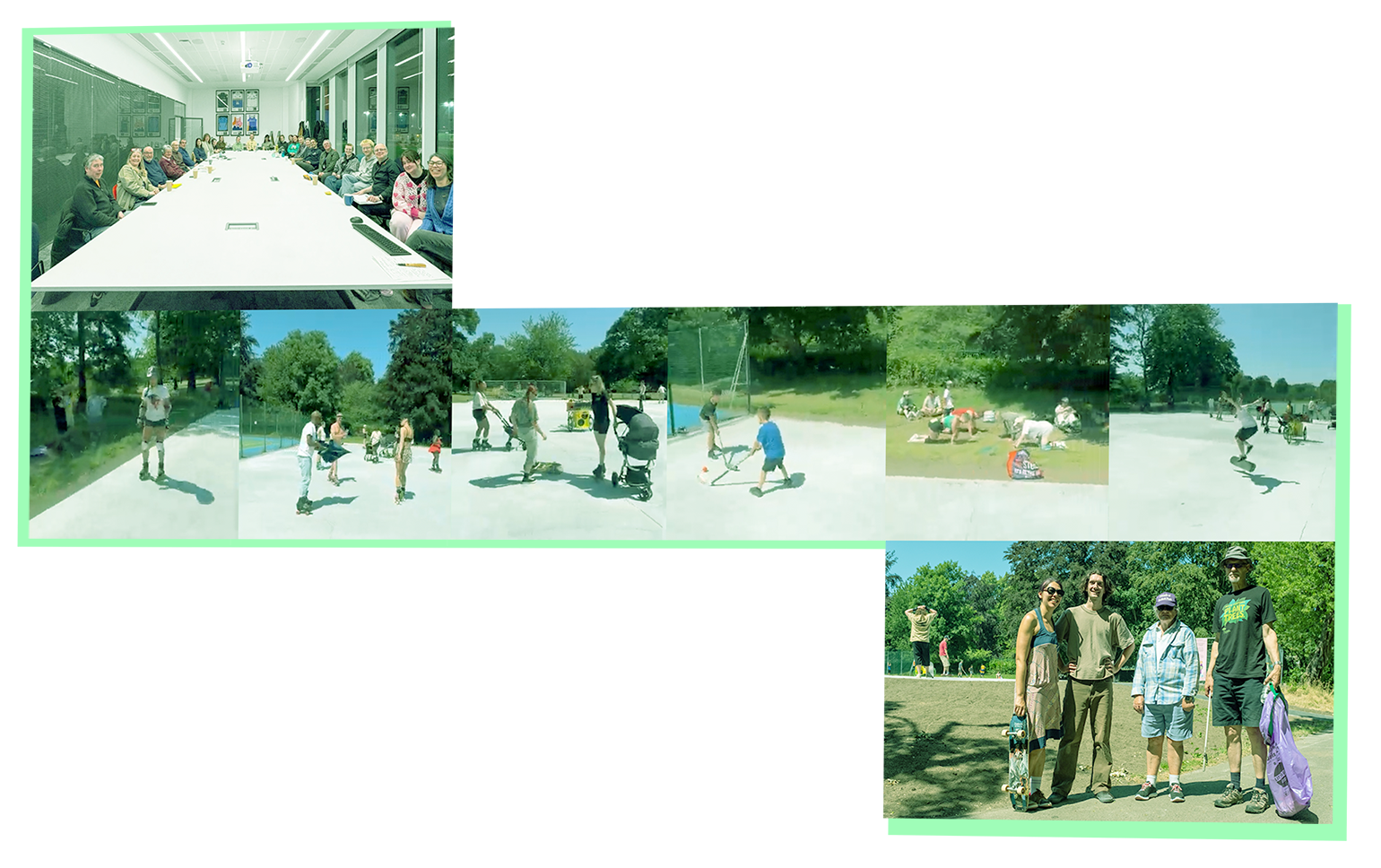
In February 2026, Long and Meadley held a consultation meeting with skateboarders, local Leeds residents, and city councillors to gain community input and propose a different purpose for Beckett. Rather than build a new skatepark in the conventional sense, they put forward having the existing space cleared and its floor resurfaced to a high standard. “Gustav Eden has advocated for blank canvases in terms of public spaces. We realized that beginning with a completely flatground area could actually achieve all sorts of our goals,” says Meadley.
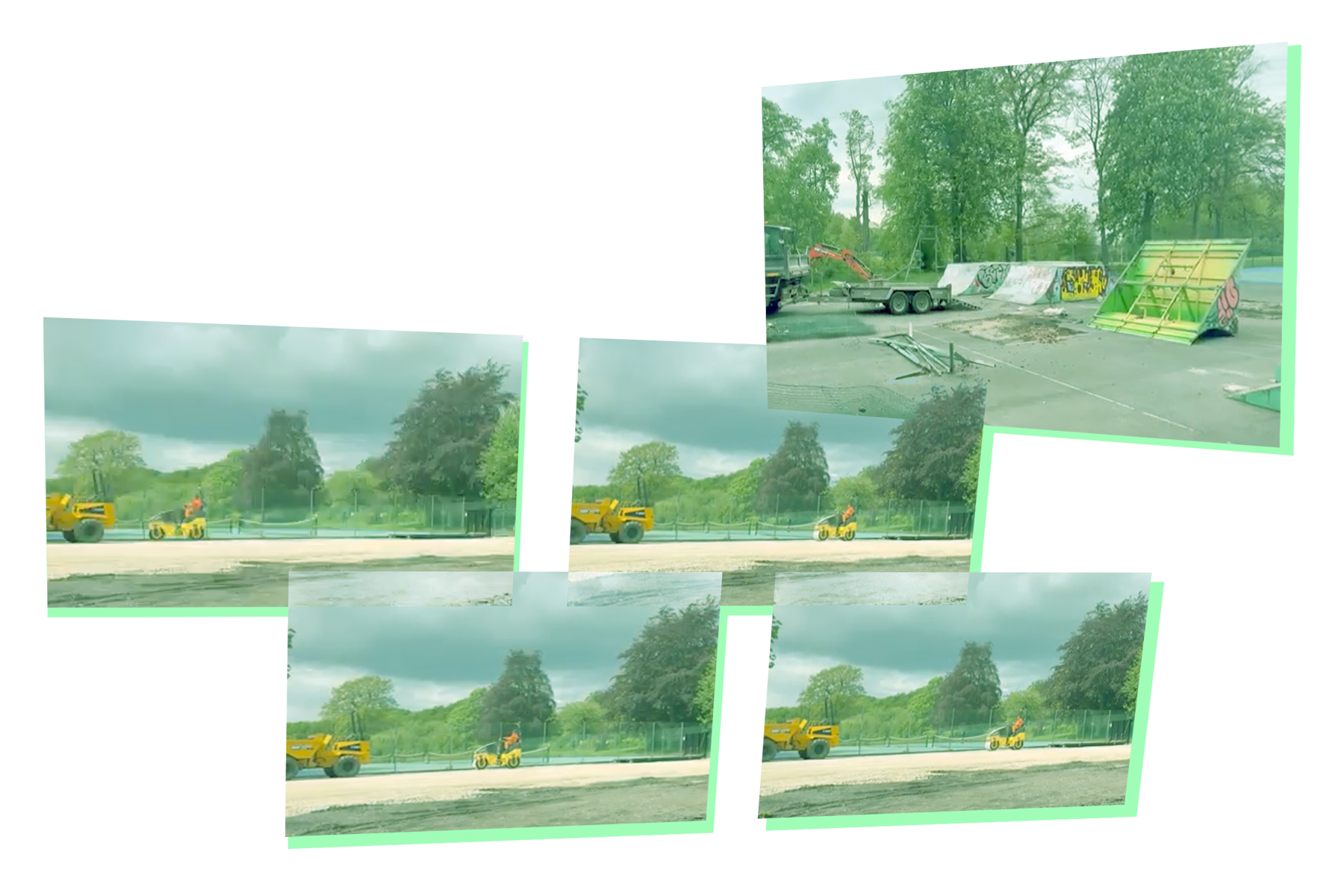
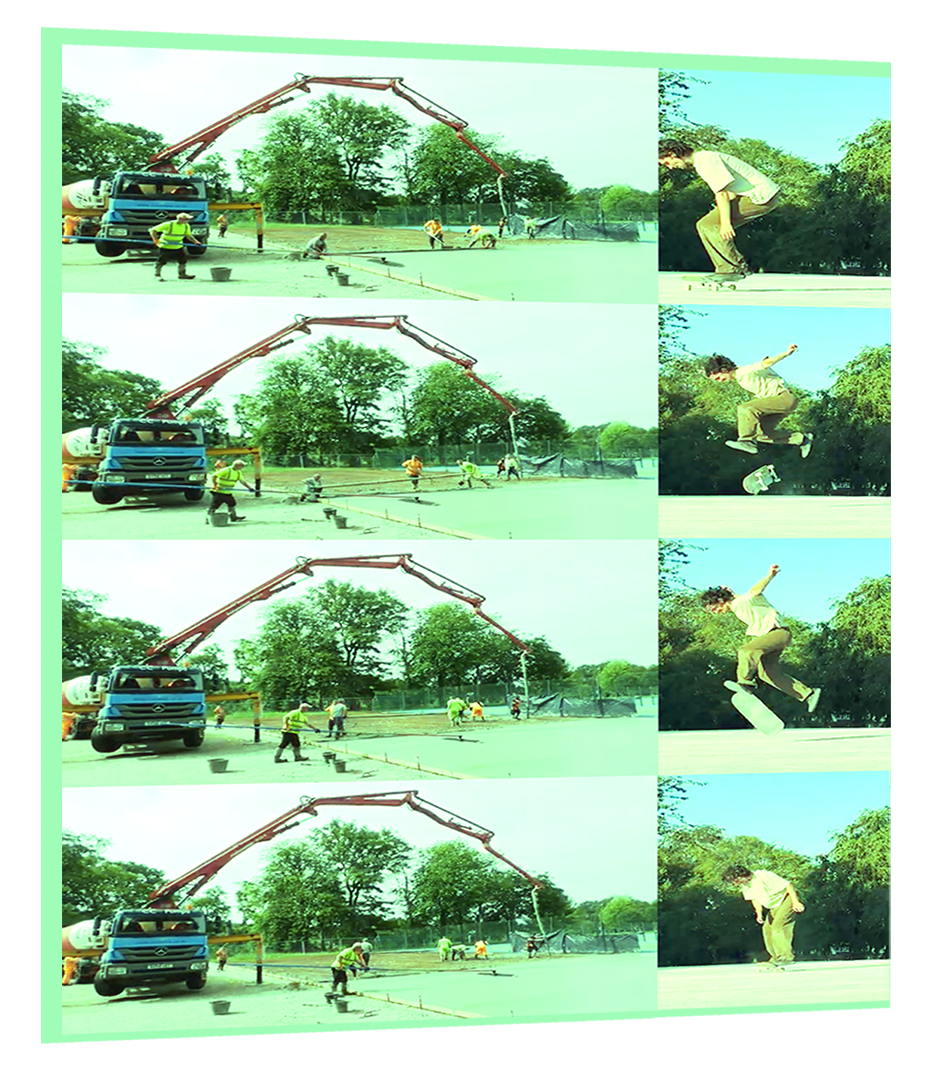
“At the same time, pragmatically, a resurfacing didn’t require planning permission, which massively speeds things up and reduces the cost. For most skatepark construction, I get the sense that a substantial cost is the labour of that process. We weren’t technically changing the use of the space or [having] to deal with anything heavy construction-wise, which meant it was more affordable and, as we came to discover, an incredibly fast way of doing it.” Work began on clearing the existing space less than three months after their first meetings. Resurfacing took place in mid-June and it opened to the public a month later.
Maclure explains that this form of skatepark design echoes a wider shift in architecture and urban planning, bucking the Modernist trend of single-use spaces. As space becomes more valuable and hard to find, presenting a multi-use case is easier to rationalize. “Also, programmable spaces are becoming more popular. It increases people’s sense of pride and possession when there are programmable activities going on there. So it lends itself to flexible spaces. I don’t think it’ll overtake [conventional] skatepark design but it definitely will be more popular."
Flatground, so it goes, is a great leveller. At Beckett, the absence of obstacles seemingly removes the skill-based hierarchy of skateparks and creates a more approachable space. Meadley and Long have met and spoken with many beginners, female, and gender-expansive skaters they’d never previously encountered who are attracted to the ample room Beckett offers to find your feet. “It was a matter of deconstructing or unlearning the usual way of thinking about not only how skateparks are made but what a skatepark is,” says Meadley. “Personally, I’m quite averse to the concept and even the term ‘skatepark’ because at this stage it has become a loaded thing where people have a vision of what they think it means. Knowing we needed to do something different means that people understand the space differently. That difference jolts assumptions of what that space is and, ultimately, who the key user group is.”
Meadley highlights that perhaps the strongest influence on Beckett is Lee Dubin, a documentarian and researcher based in Los Angeles, who presented on their concept of “non-binary space” at The Stoke Sessions (2024) and Slow Impact (2026). “You allow room for something to change and evolve and adapt and be altered,” says Meadley. “Fundamentally, skateparks are a fixed form once they’re built, so you only have the initial window of consultation design. If you approach it that way, you can never account for the future potential users that the space might attract.”
As such, adding features to the park will have a modular focus. Meadley and Long are keen to keep at least half of the space entirely flatground with the other half alternating through what Meadley calls “seasons” populated by different obstacles. Any permanent installations will be crafted as do-it-together projects, aiming to instill a sense of belonging and civic pride for locals. Ultimately, allowing the space to be continually reconfigured is key. There is an aspiration for Beckett to find use beyond skateboarding or wheeled sports, making it a broader community asset that skateboarders were instrumental in facilitating. Leaning into Dubin’s notion of non-binary space and putting a spin on the British acronym of MUGA (pronounced “mugger”, for ‘Multi Use Games Area’, effectively an asphalt patch for ball sports), Meadley coined an alternative for the misnomer of calling Beckett a “skatepark.” Instead, consider it a “Multi-Use Skate Area” or “MUSKA.”
I pull up my car on Batcliffe Drive, the road adjacent to Beckett Park. The neighbourhood, Headingley, is made up of beautiful old brick terrace houses, the rows lined by leafy trees. It’s a place best served in autumn or on a scorching July afternoon like today. I hop out, stretch, grab my board, and walk over to the newly renovated skatepark, which is nestled alongside the tennis court where Long used to skate.
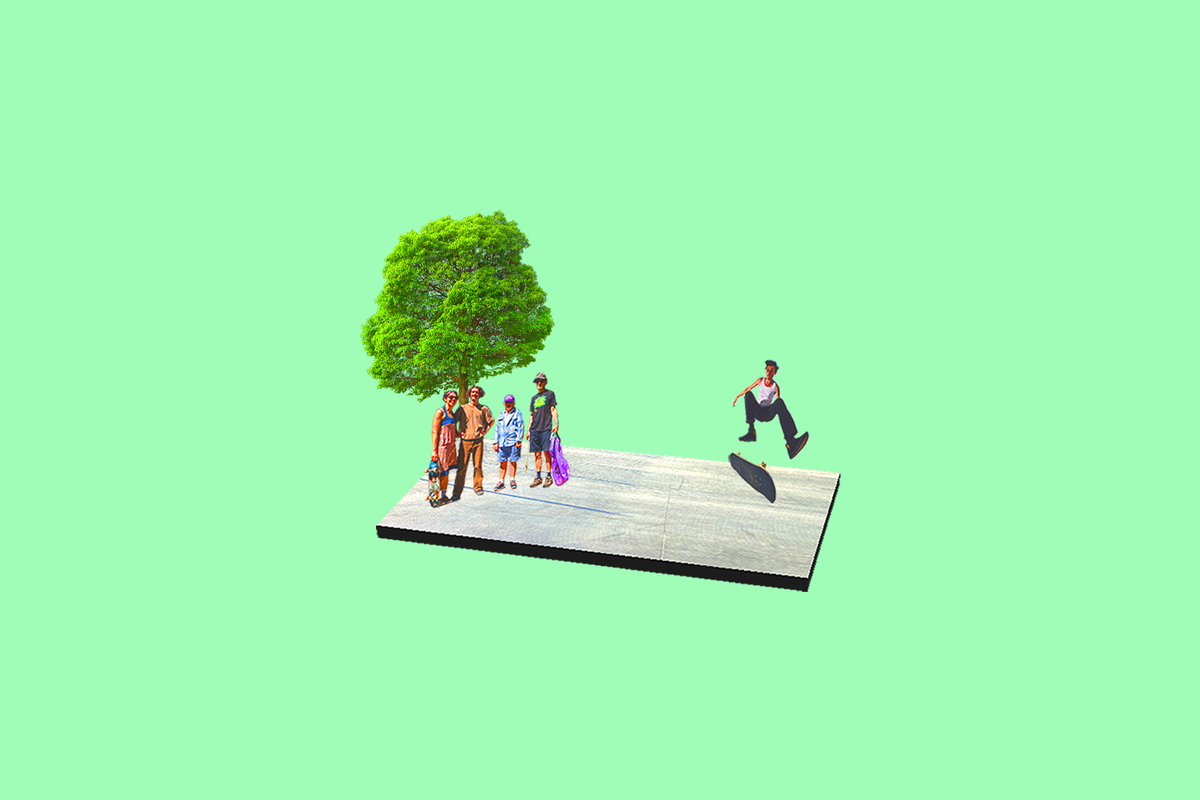
Beckett feels like a concrete baseball diamond. The vast, polished grey floor shines and catches the shadows of those riding over it. On one side of its perimeter, families sit and enjoy the sunshine, intrigued by those using the space. On the other edge, those who aren’t skating duck for shade under trees, enjoying ice pops dished out by Hayley Fitzgerald, a professor in sport at Leeds Beckett University who herself started skating in her 40s. On this giant slab of concrete there are skateboarders, quad skaters, and the occasional parent supervising their kid riding a bike, scooter, or playing roller hockey. An older gentleman is doing laps on a yellow bike with speakers attached courtesy of Roadblock, a local charity and a roaming sound system that provides music for community events. Skateboarders and quad skaters have each taken up their own half of the slab. There’s no formal division, but when the musical bike is parked in the center, whatever sense of separation there is vanishes. We are one big inclusive flatground ritual commanded by the vibey two-wheeler at our core.
The floor at Beckett Park is remarkable. Not only in comparison to its previous, of which sandpaper would be an improvement, but that of any skatepark or spot I’ve skated in 25 years of doing the thing. It is glossy but not glassy, smooth but not slippy. It offers a certain friction when you need it that vanishes when you slam. Beckett’s floor hugs urethane wheels, meaning one can take the sharpest corner and not slip out, yet if you were to fall you’d slide across the ground, dusted but effectively unscathed.
Three hours, it turns out, is how long I can be entertained by skating flatground alone, so I learned on Beckett’s opening day, skating non-stop in heat approaching 30 Celsius. I’m still remedying a lingering knee issue stemming from the injury I had just begun to recover from when I surveyed Beckett in 2025. That means some tricks are off the table. However, after acclimatizing to Beckett’s pristine floor, I found myself regaining confidence.
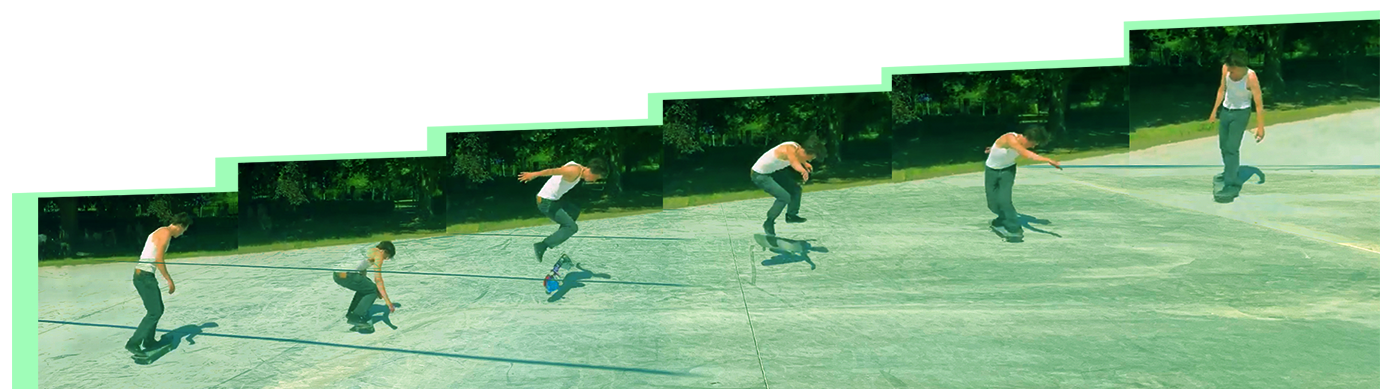
A childhood friend I grew up skating with, the first person who ever filmed me skateboarding, was now in pursuit of me with an iPhone in hand. I did various tricks in succession, trying to culminate in a backside kickflip. Popping and rotating backside from regular stance and landing fakie is what gives my knee trouble. Touching down and pushing too sharply on a backside revert, the kind which closes the rotation of a trick spun almost all the way, causes a sharp pain. So I tried to pop and flick differently, my board feeling as if it were almost somersaulting over itself.
When I finally stuck four wheels down, with a lighter touch on the landing, I rolled away to the grassy edge of the park, sprawled out, and emptied a canteen of water over my head. I was soon greeted with an ice pop. Tricks, like trying to make skateparks happen, can fall into habits that aren’t as effective as they could be. Sometimes you just need a little change of approach.
Enjoy the blank canvas of possibility? Consider becoming a paid subscriber. Nothing on Simple Magic is behind a paywall, but your money will get you stickers and merch, and go towards paying contributors for their great work. You can also leave a one-time tip.
Photo: Farran Golding