Scratching the surface
Jacques Talbot on board graphics, guest artists, and ideas for a richer world. Also, people are not valuing the goose, some good CanCon, and more.


The definitive weekly ranking and analysis of all the skateboarding and other things online that I cannot stop consuming and how it makes me feel, personally.


Scratching the surface: guest artists, board graphics, and ideas for a richer world
A special correspondence by Jacques Talbot
“Graphic design has always been integral to skateboarding,” writes Iain Borden in Skateboarding and the City (2019). While skateboard graphics in 2026 have come a long way from the designs of the early 1960s, their impact upon generations of skateboarders remains profound, encapsulated by Sean Cliver’s awed description of a late-‘80s skate shop board wall in The Disposable Skateboard Bible (2004): “I can still picture the exact location of a royal blue Zorlac John Gibson and the puke-purple Craig Johnson mini it stood beside; the one-color black tail logo on a turquoise Santa Cruz Jeff Grosso Demon.”
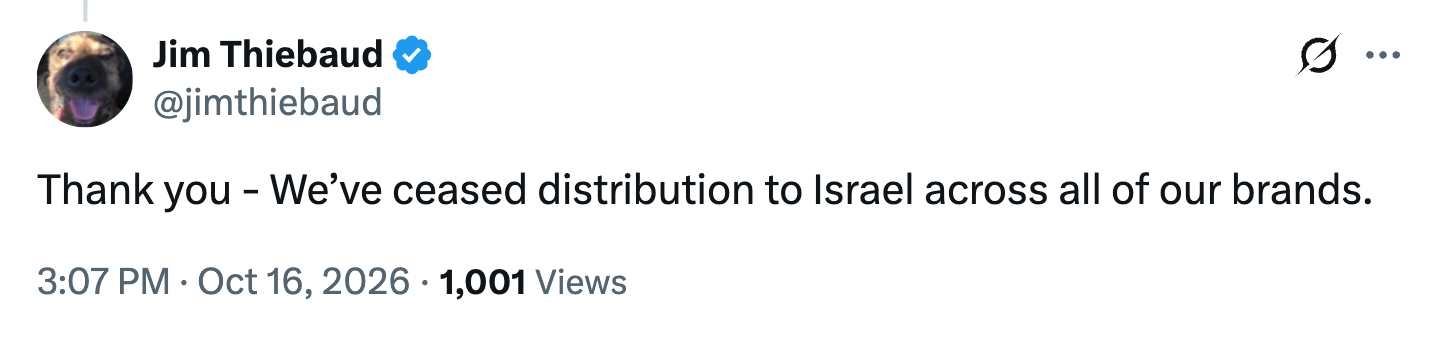
Beyond being a brand’s primary opportunity to establish its aesthetic vision, board graphics can also become unique cultural signifiers, provoke audiences, and carry resonant political messages, like Neil Blender’s “Coffee Break” (G&S, 1986), Quasi Skateboards’ “America Series” (2019), and Jim Thiebaud’s “Hanging Klansman” by Natas Kaupas (Real, 1990), respectively. In that sense, skateboarding has only benefitted from aesthetically diverse and progressive brands and their accompanying demographics. Guest artists have long shaped that growth and contribute significantly to skateboarding culture, expanding not just its visual lexicon but also the potential for meaning within and behind skateboard graphics.
As we find ourselves in a moment that can feel like an inflection point for freelance creative work and for skateboarding — continued economic uncertainty threatens brands and forces some to produce smaller seasonal runs of boards, while others awkwardly collaborate with non-endemic brands, get stuck reissuing graphics, and more recently, consider the Faustian bargain of AI-generated content — what motivates brands that are intentional with their graphic output and the artists they work with?
Andrew Durgin-Barnes and Polar Skate Co.
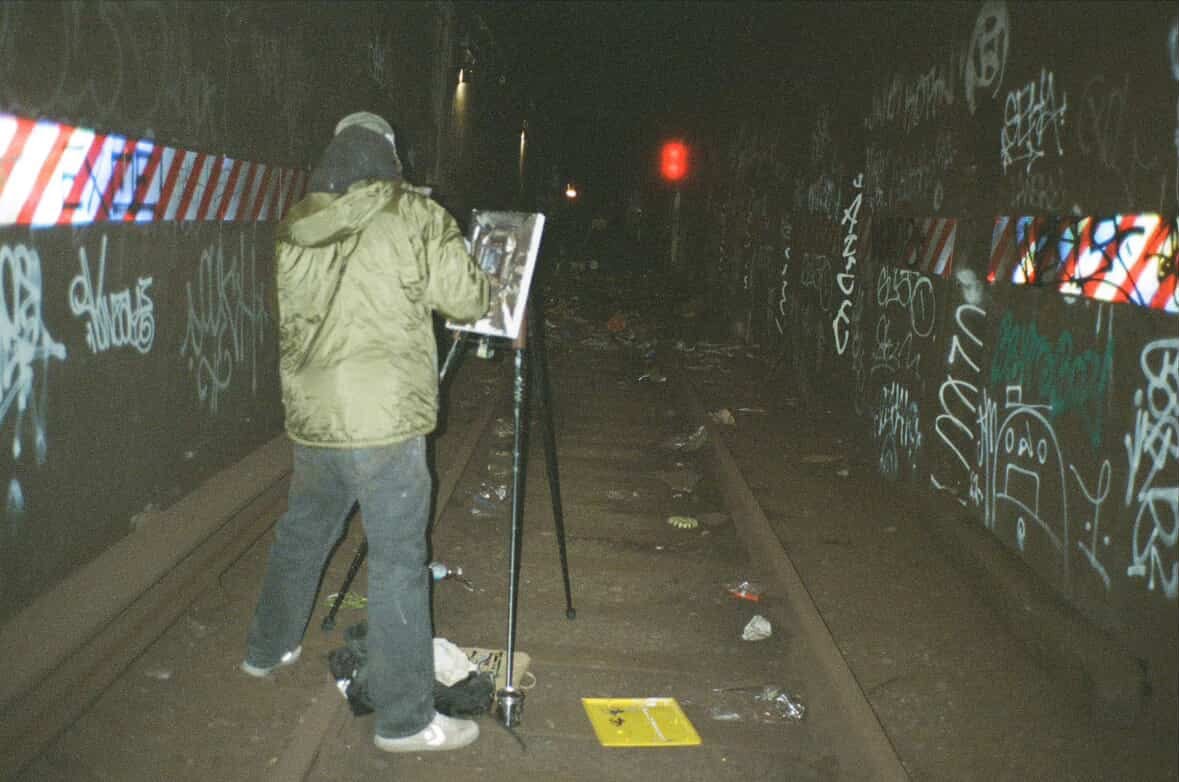
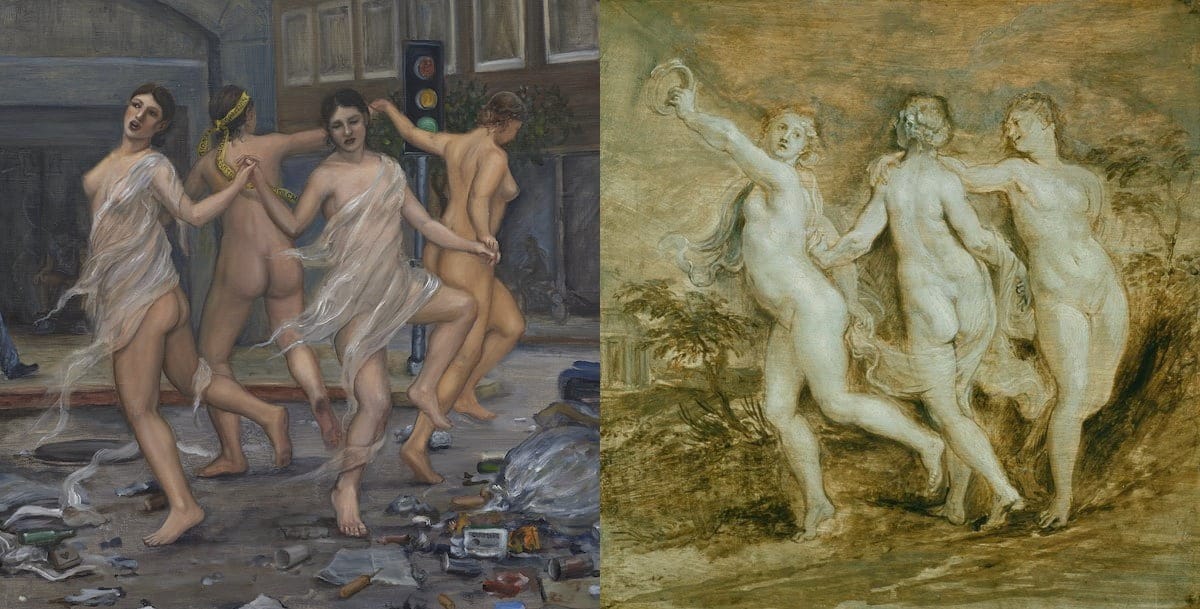
Andrew Durgin-Barnes and Polar collaborated for Emile Laurent’s pro debut board in 2024, depicting a post-Anthropocene Burnside overgrown and inhabited by wildlife and spectral skaters. An icon of 1990s skatepark architecture, Burnside represents a place of significance for Laurent, who arrived at the concept: “It was Emile’s idea; he created it together with [Barnes]. I made the layout and final touches, but Emile had the vision for it,” says Polar owner Pontus Alv.
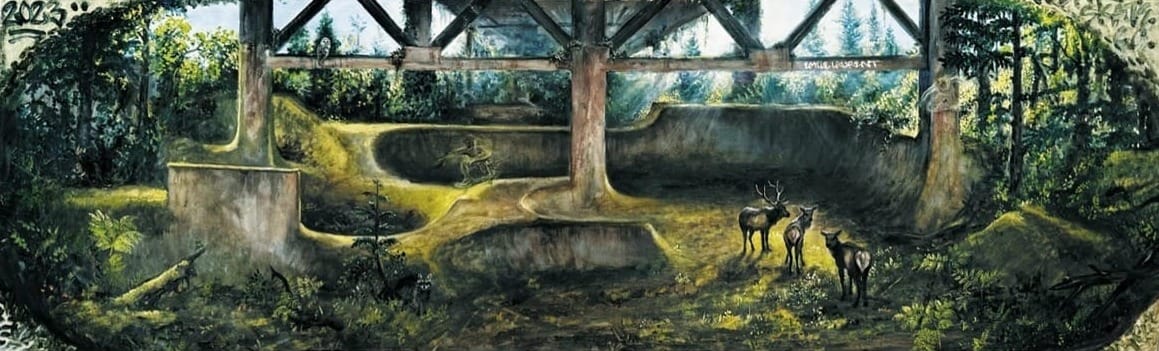
For Barnes, Laurent’s graphic was a natural fit: “I really liked doing Emile’s board for Polar. Emile is my friend, which made it special, but also the subject matter... I love the idea of nature reclaiming man’s creations.” On his process, Barnes shares, “There’s a lot of back and forth. Many times preliminary sketches are done… I try to ask questions to make sure I’m getting as close to their vision as possible.”
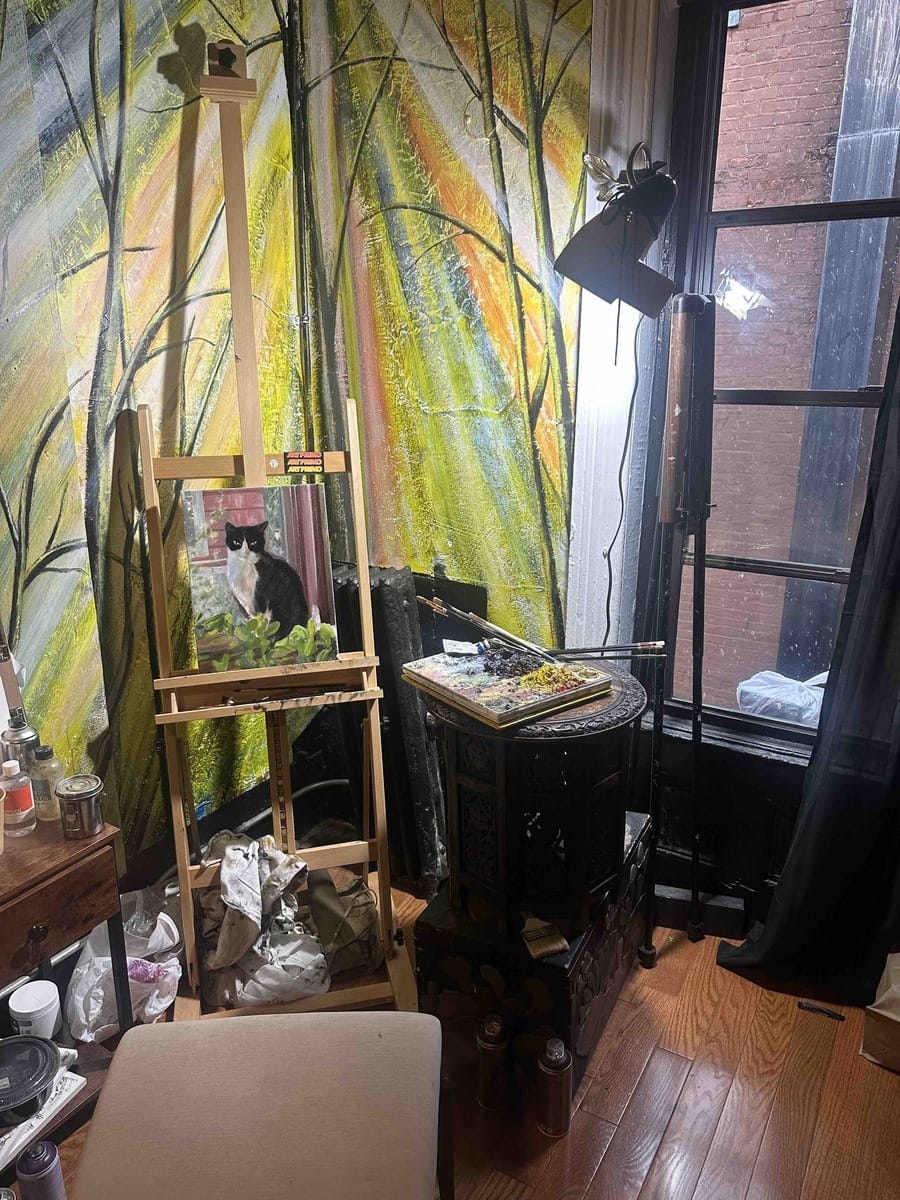
To fully appreciate Barnes’ unique aesthetic, however, it helps to know more about his early creative influences: “When I really got into oil painting I was heavily influenced by… old master and neoclassical painters: Ingres, Prud’hon, Velázquez, Delacroix, Rubens. I’m inspired by so much honestly.” While street scenes and their denizens are a recurring motif in skateboard graphics, including those by Barnes, art historical references can also be found in his work.
Barry McGee and Baker Skateboards
Barry McGee, also known by his graffiti tag Twist, developed his practice in the San Francisco Mission District during the late 1980s and 1990s, where making art was closely intertwined with other perceived subcultures including graffiti, independent music, and skateboarding, each driven by a similar DIY ethos. McGee is one of a group of artists collectively referred to as the Mission School, whose members include Thomas Campbell, Chris Johanson, and Margaret Kilgallen.
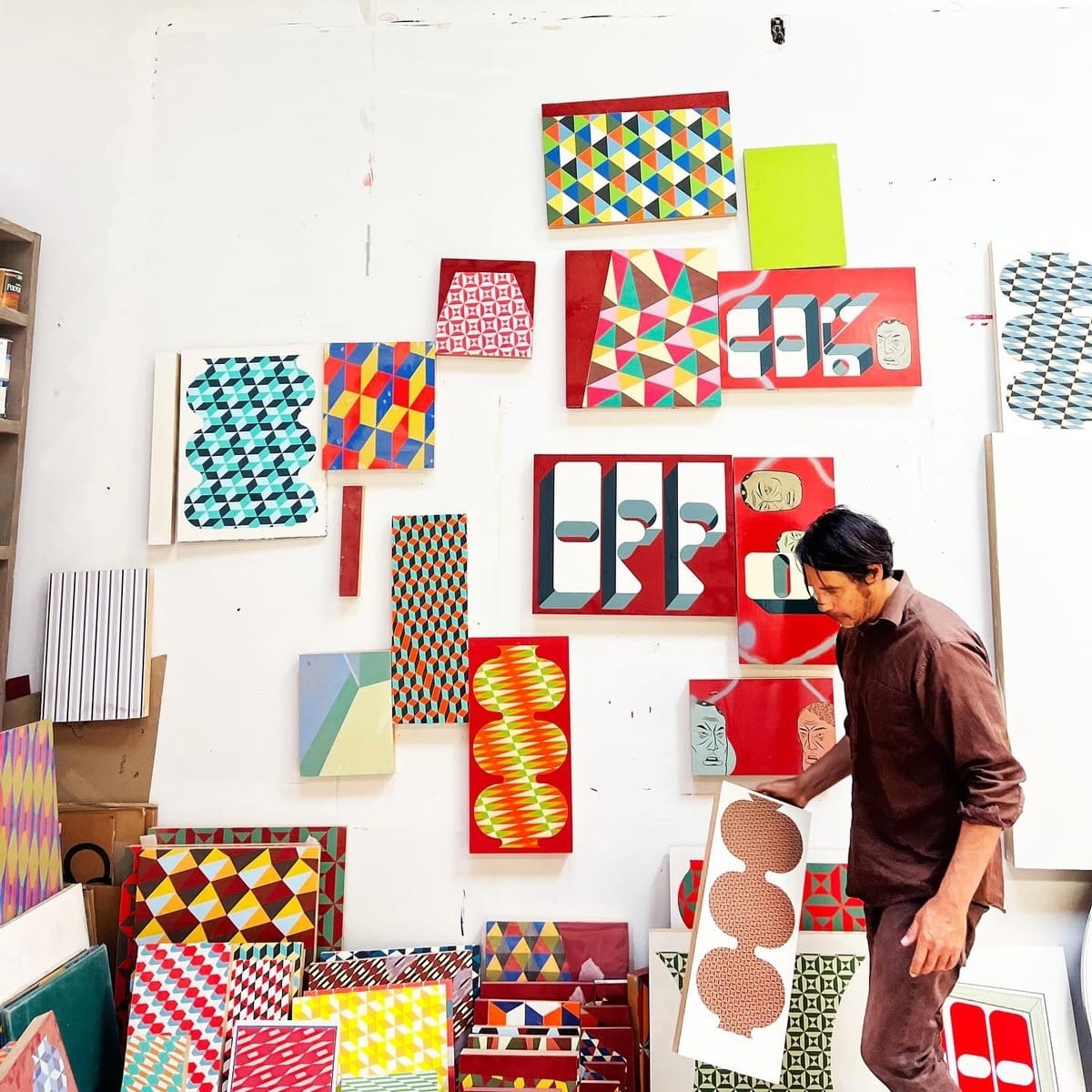
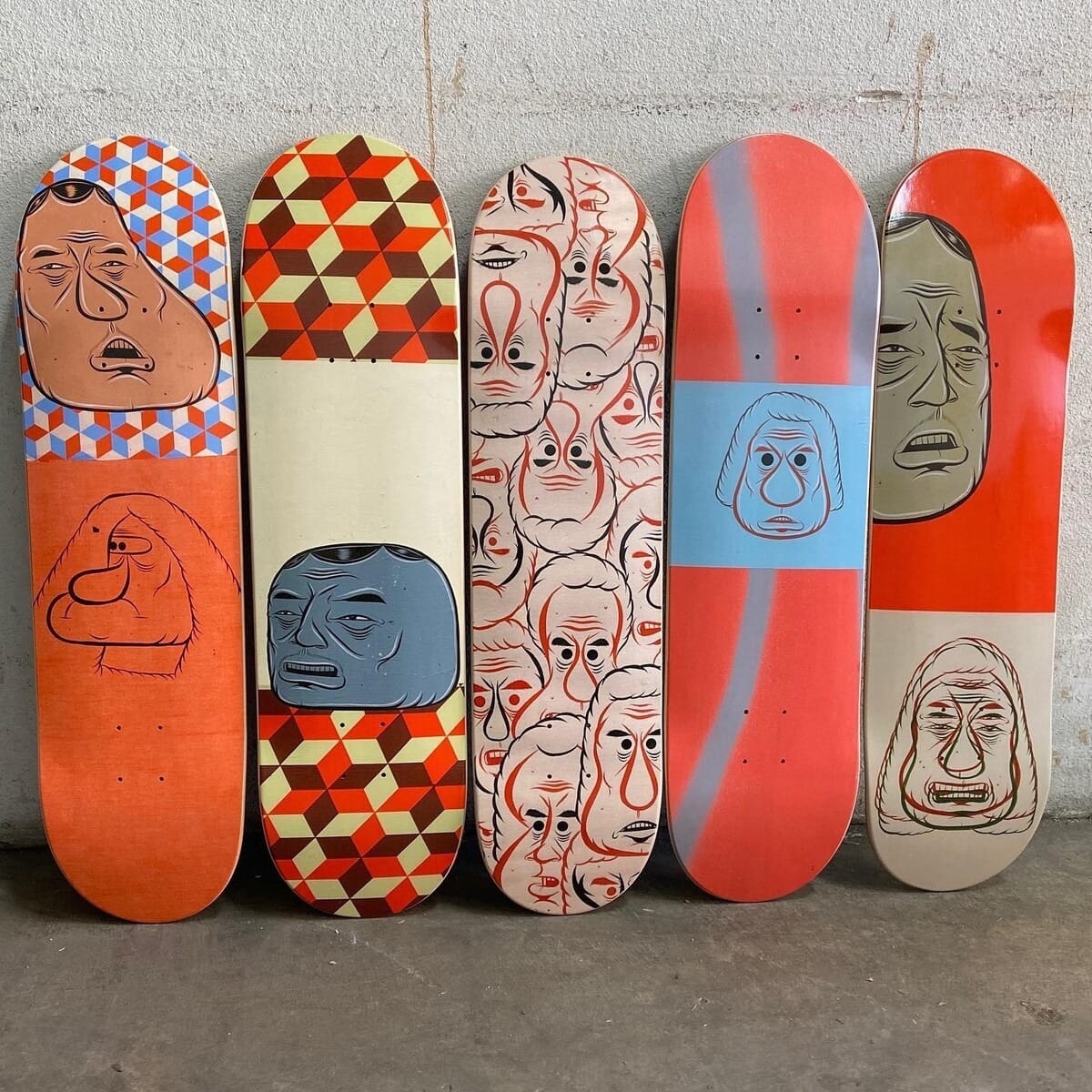
In 2021, McGee collaborated with Baker on a series of graphics featuring both geometric patterns and McGee’s classic disembodied heads. It “was initiated by Elissa Steamer, if I remember correctly… and then swiftly executed by Spanky with his great graphic sensibilities,” McGee says. “The graphics being destroyed almost immediately brings me so much joy. I’m not really interested in the wall hanging, collector [or] collecting aspect.”
The geometric forms, patterns, and lettering found in the work of Mission School artists resemble the textures of the city and are often juxtaposed with people appearing from, or within, streetscapes. Both motifs are recurring in skateboard graphics, including Kilgallen’s late 90s series for Toy Machine, Campbell’s creative direction for Uma Landsleds (later Umaverse) from 2020 through 2025, and Johanson’s ongoing Antihero graphics.
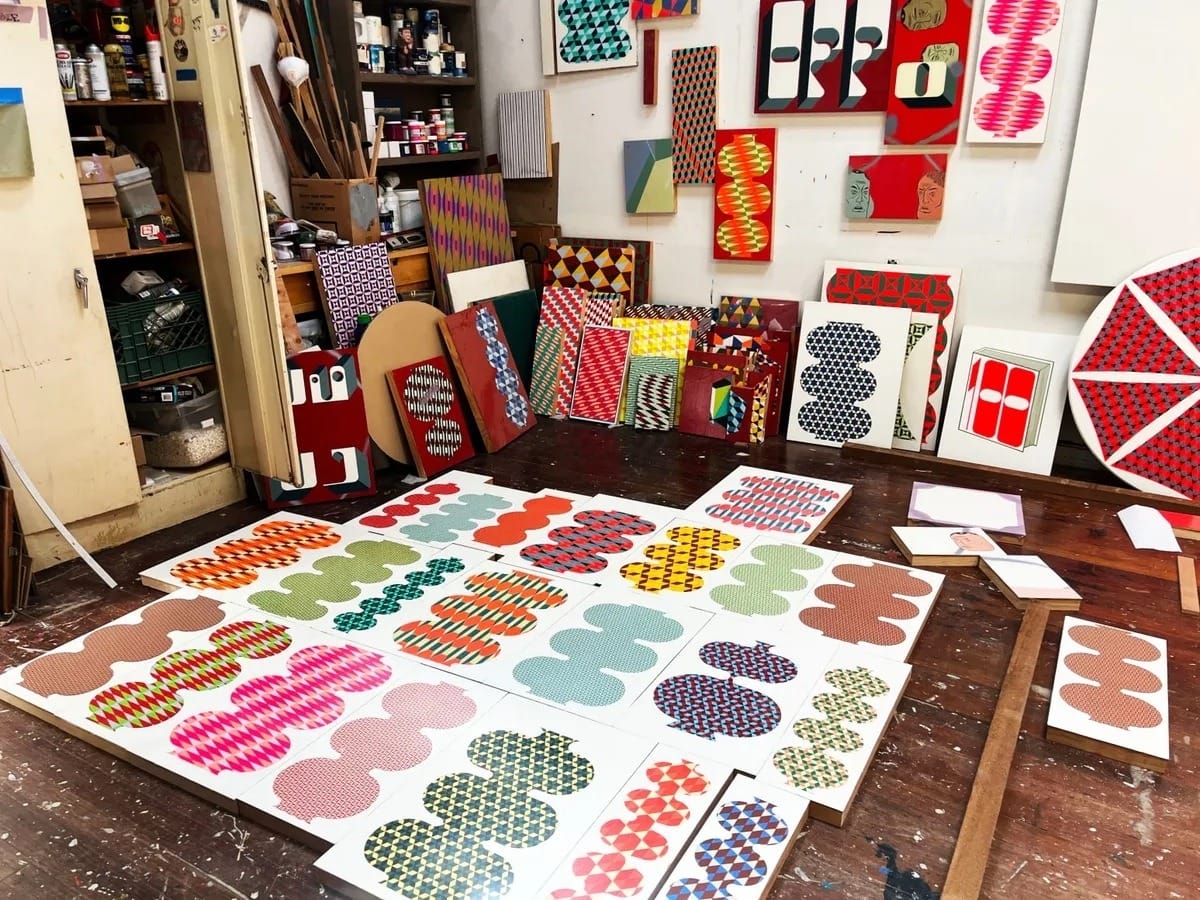
Collectively, Mission School artists have left a lasting impression on skateboarding’s visual culture. The shared DIY ethos of the 1990s is often cited as the connective tissue unifying skateboarding and adjacent countercultural movements, but McGee is adamant the same dynamic continues today: “There is an entire young artist [and] skateboard movement in the Bay Area now that is a million times better than we ever were. This is my favourite part.”
Rosie Archie and Colonialism Skateboards
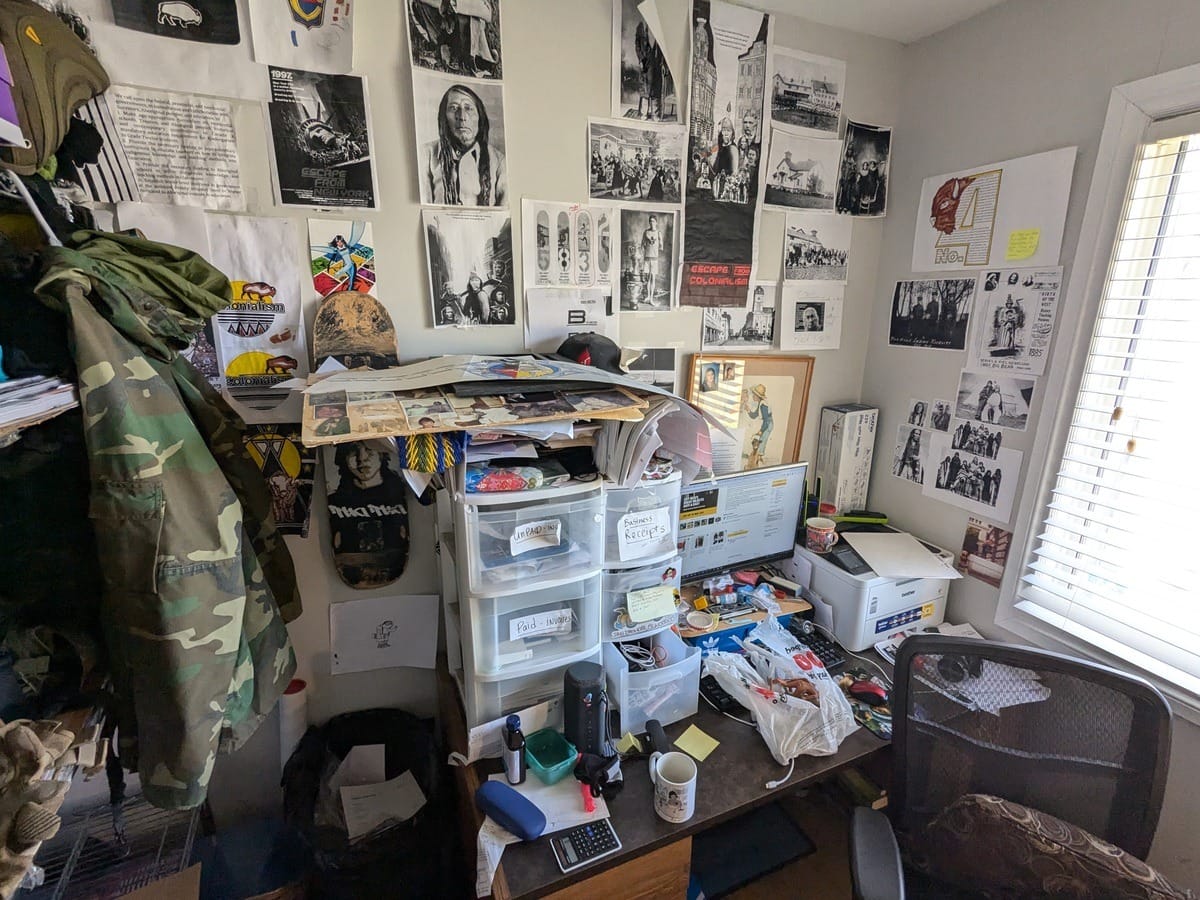
In 2015 Micheal Langan founded Colonialism Skateboards out of Regina, Saskatchewan, in Treaty 4 Territory. Through this project, Langan, an Anishinaabe and Cree artist from Cote First Nation and Peepeekisis First Nation, uses skateboarding to promote public education on the culture of Indigenous peoples and the history of colonialism in Canada and abroad. Each graphic draws attention to and provides history around an issue impacting First Nations peoples. “That’s how I arrive at a graphic: I follow the history… and I turn it into art that can move through the land and spark conversations. It’s mobilized knowledge,” says Langan.
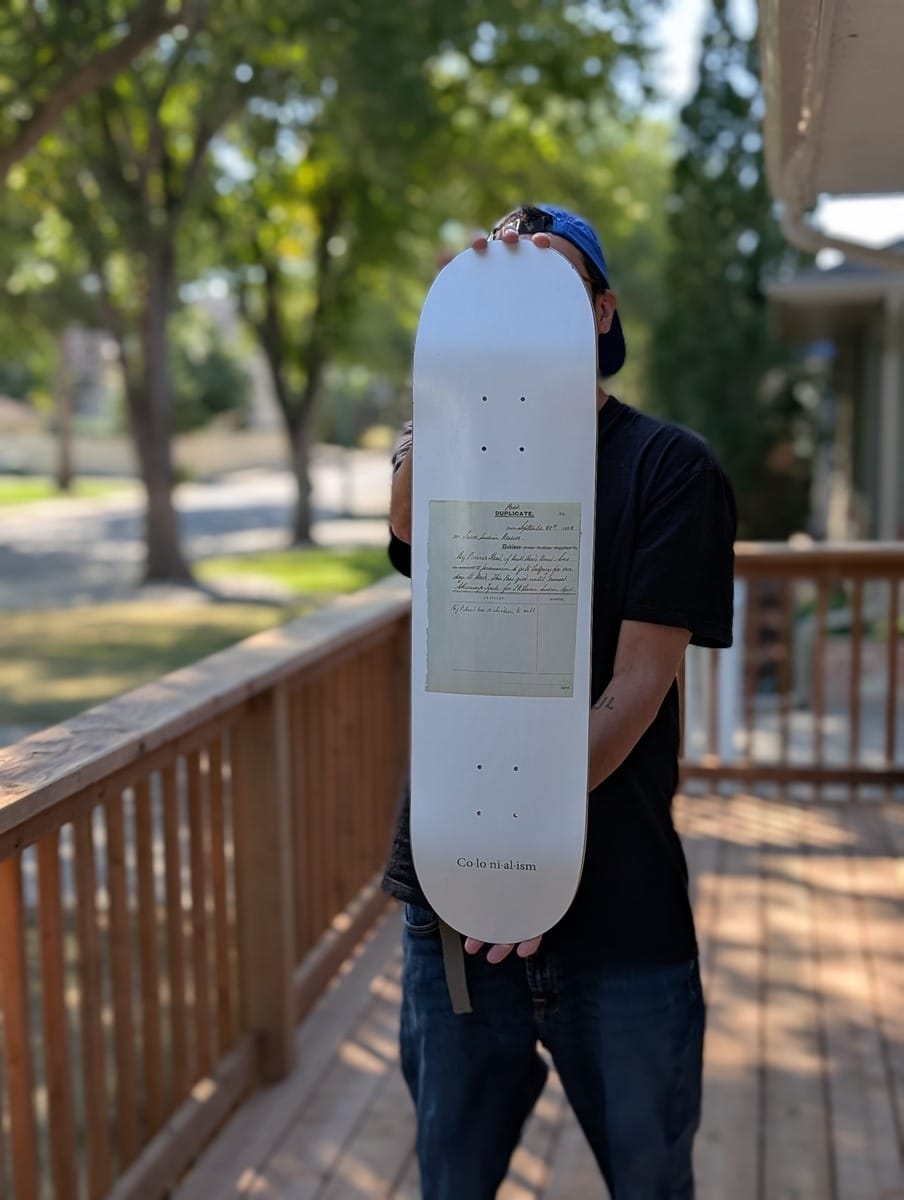
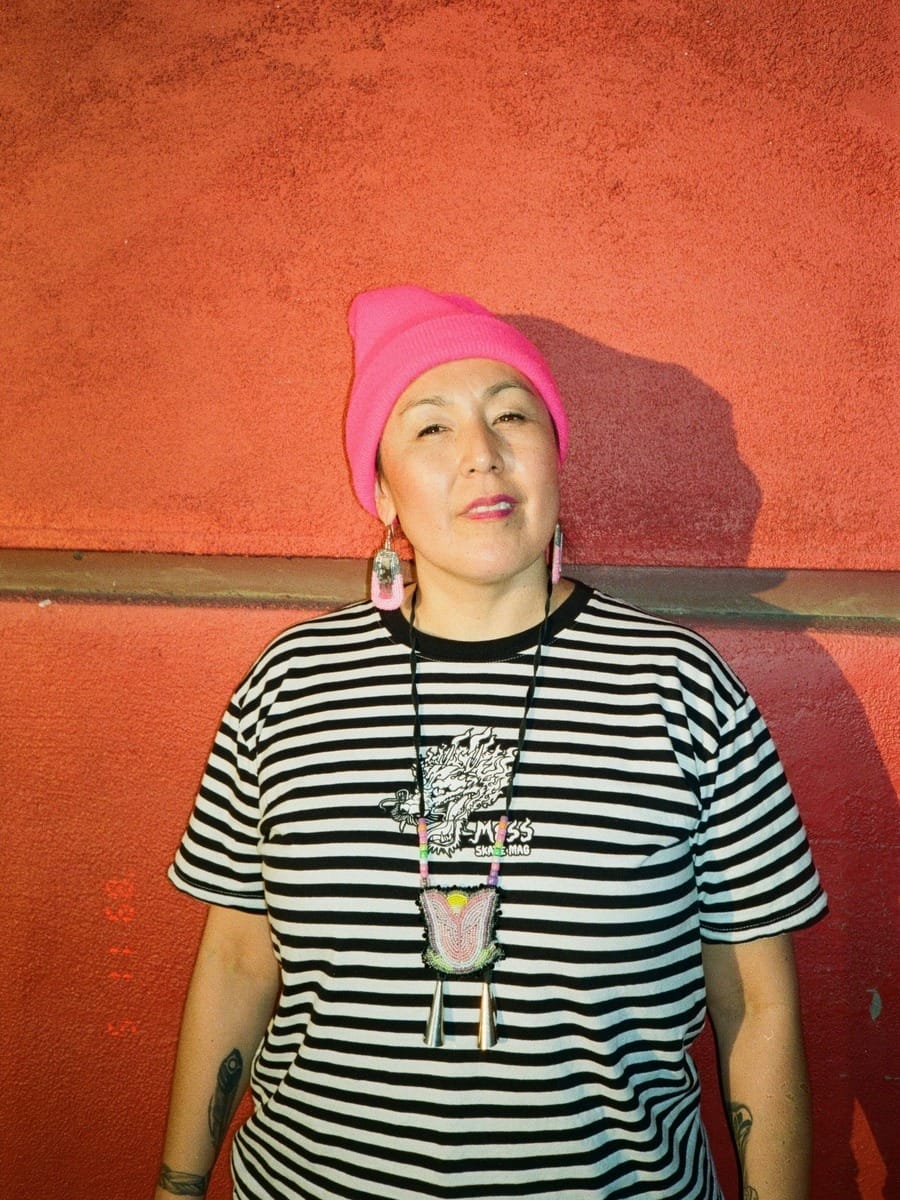
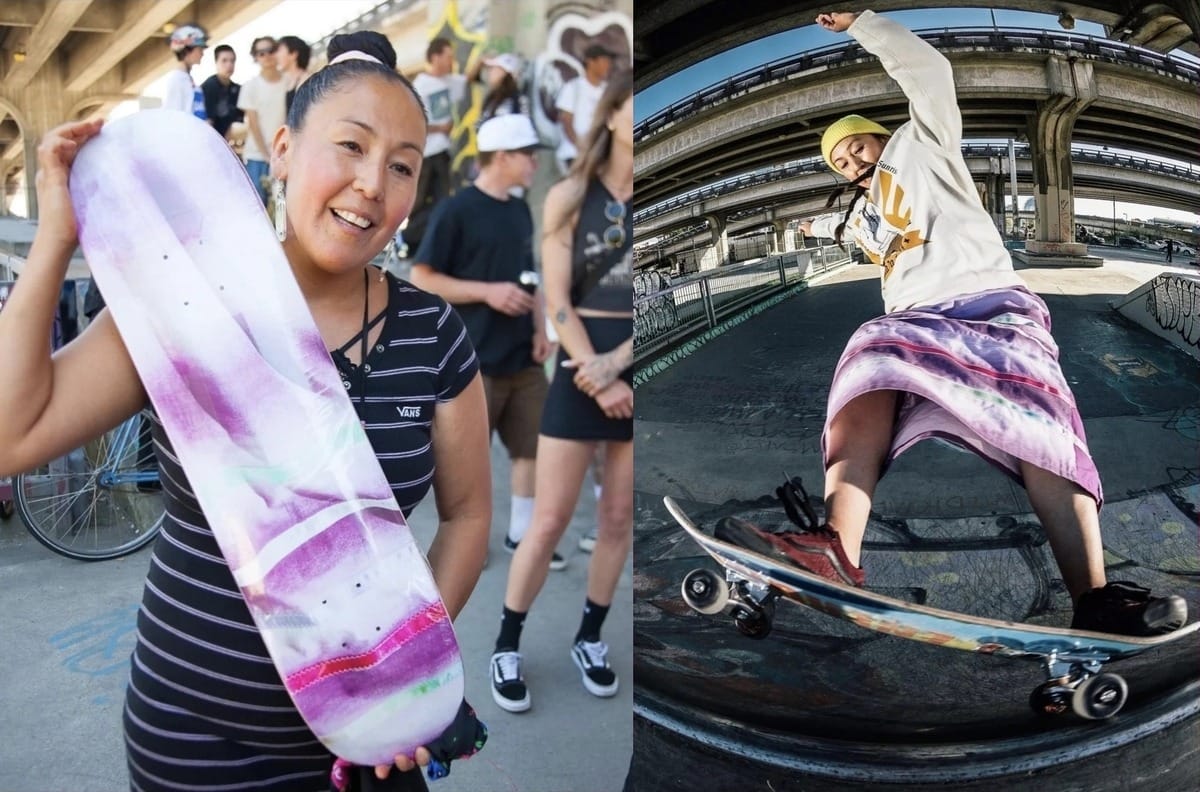
Colonialism also has a long history of collaborating with guest artists, including team rider Rosie Archie. Archie, from Tsq'escen' (Canim Lake) of the Secwepemc (Shuswap) Nation, founded Stop, Drop and Roll, “an all-women, girls, trans, non-binary skate jam,” and co-founded Nations Skate Youth, whose mission is to empower Indigenous youth through skateboarding. “I’ve known Rosie for a long time. I used to see her ripping around Vancouver back in the early 2000s,” Langan says. “I knew I wanted to do a traditional regalia graphic, so I asked her. She shared the story behind the ribbon skirt her mother made, and I was really moved.”
Ribbon skirts are often worn by women, girls, and two-spirit persons during ceremonies, and symbolize resilience, sacredness, and survival. Archie’s debut graphic is dedicated to her late sister: “I asked my mom to make me a ribbon skirt [and] I had my good friend Norma Ibarra take the photo.” In representing Colonialism Skateboards, Archie exemplifies what’s possible to the youth she meets: “Having Indigenous-owned skateboard companies like Colonialism is vital. [It’s] important for us all to see representation out there.”
Through Nations Skate Youth, Archie is in turn helping to further the reach and purpose of Colonialism Skateboards. Each graphic is a new opportunity to discuss the history and culture of Indigenous peoples. “Rosie’s doing amazing things with Nations and that whole crew, travelling, working with youth, sharing her story, and talking about how skateboarding shaped her life. It’s cool to support her through that work,” says Langan.
Brian Lotti and Magenta Skateboards

Since 2010, Magenta Skateboards has fostered a unique identity among skateboard companies. “Magenta is kind of an abstract concept that incorporates skating, videography, urbanism, art, skate culture, freedom, music, as well as the history and personalities of the people that make it,” says Soy Panday, who founded Paris-based Magenta with brothers Vivien and Jean Feil. “Magenta has always been about pushing the artistic aspect of skateboarding.”
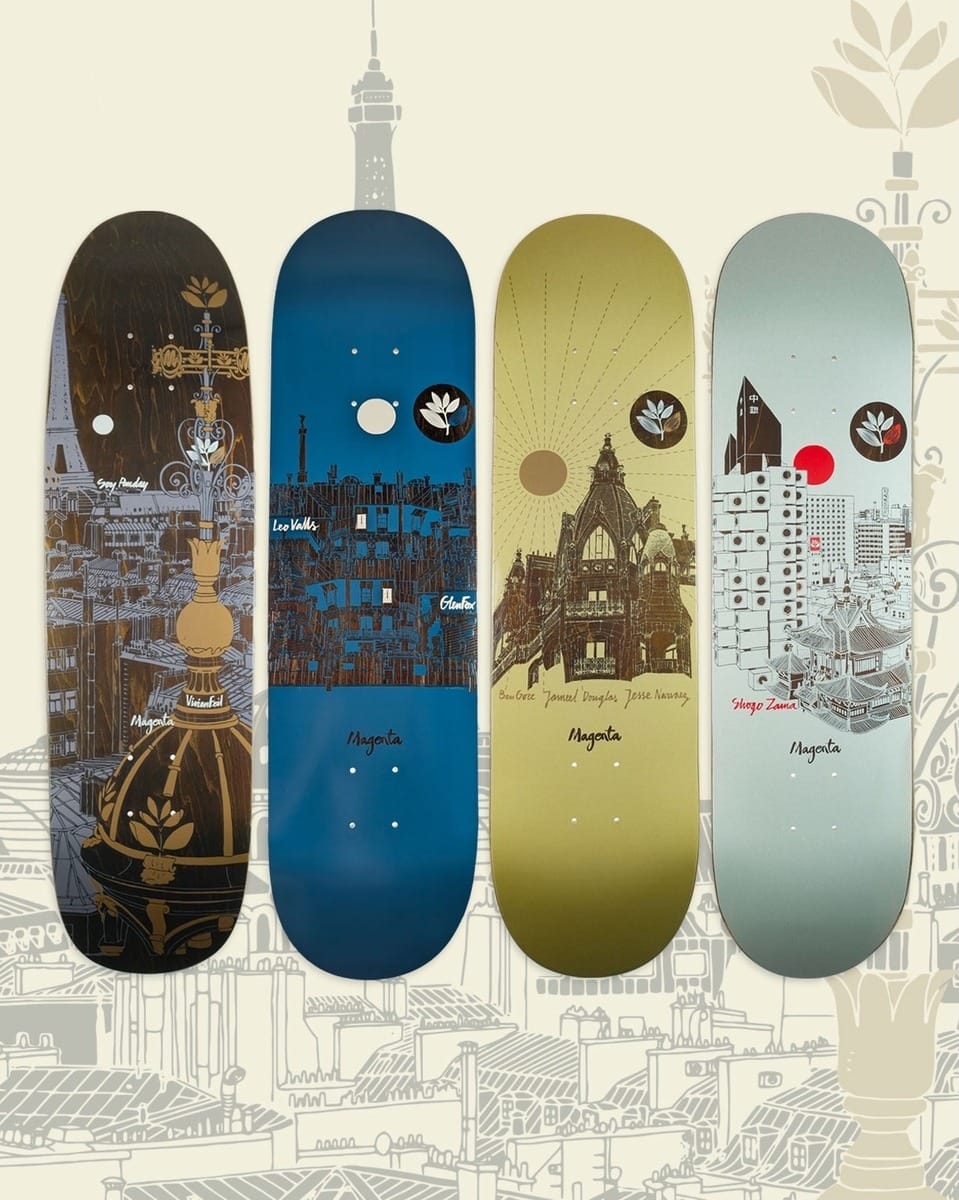
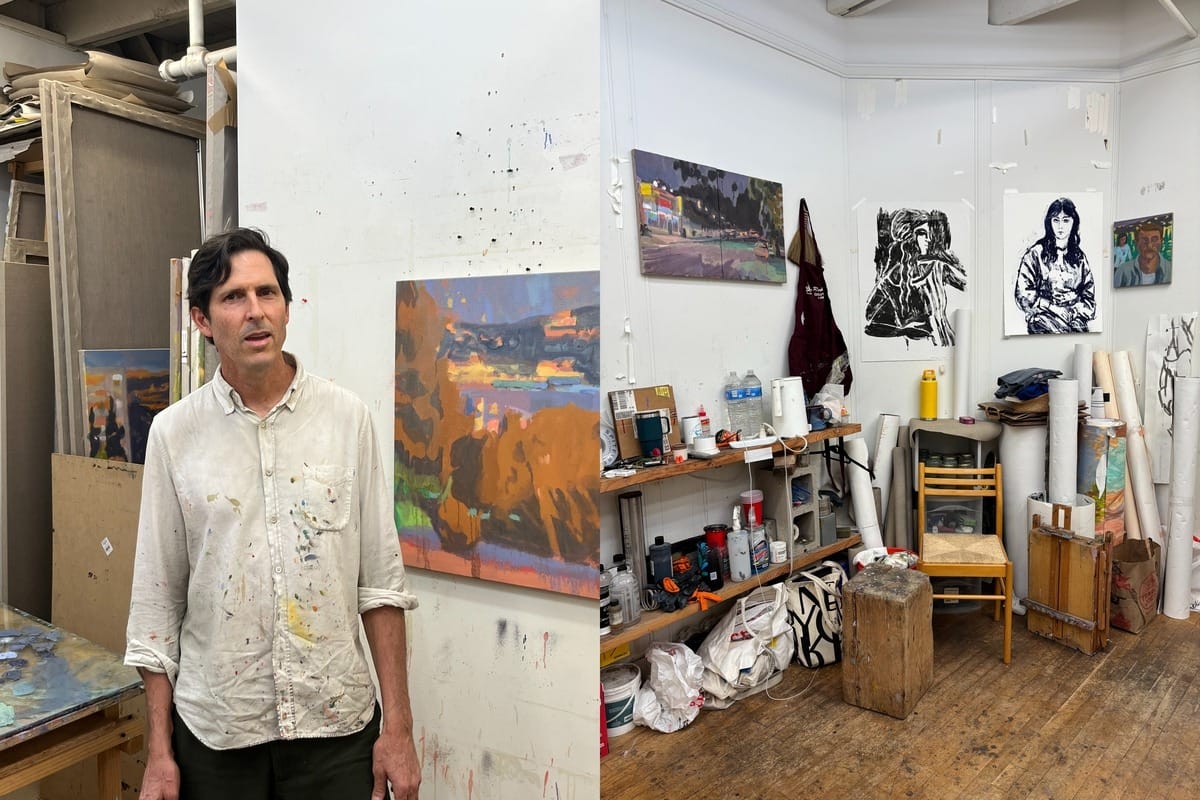
Magenta’s international roster of guest artists has grown over the years and includes Nils Inne, Nick Jensen, and Hovin Wang. Brian Lotti's personal connection to Panday led to a graphic in 2015: “Soy and I were [already] friends, having run into each other at an impromptu curb session in San Francisco.” Lotti’s graphic for Magenta showcases his dedication to exploring colour; the scenes he paints become luminous vignettes of life around Los Angeles. The “biggest through line in all of my artwork is an interest [in] colour harmony,” says Lotti.
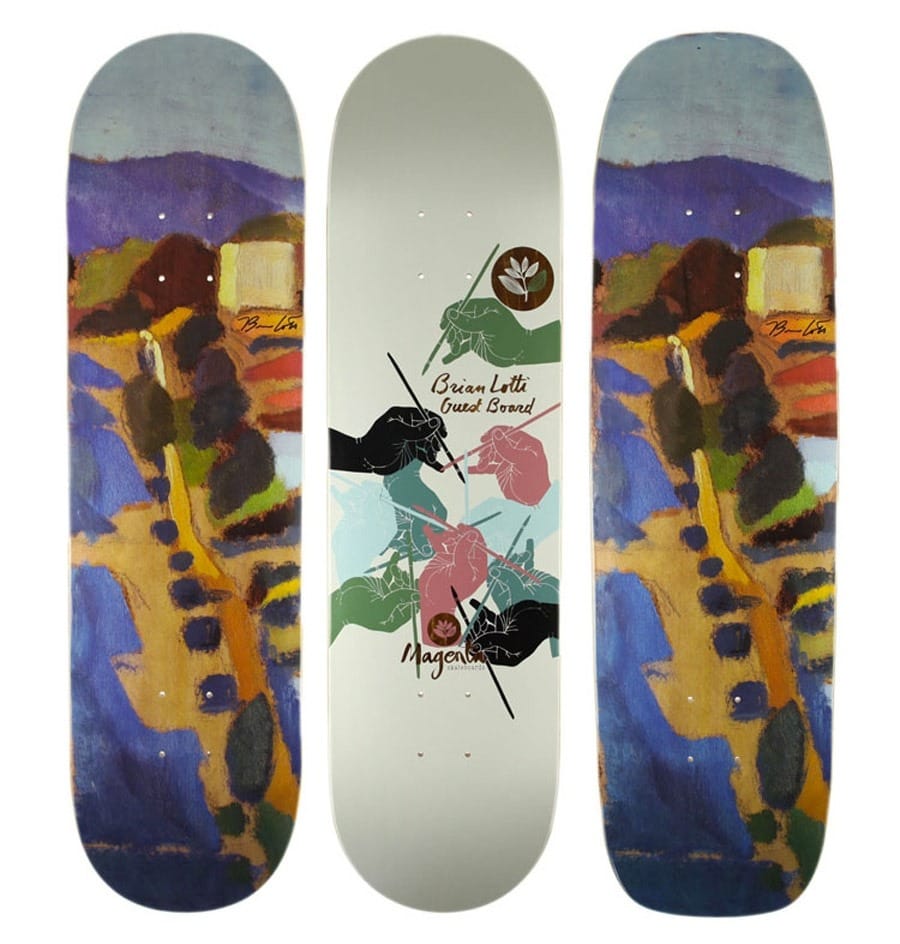
Lotti also cites art history as an enduring source of inspiration, referencing contemporary painters alongside Pierre Bonnard and Berthe Morisot. Panday also shares that several historic artists have inspired graphics, including Gustav Klimt and René Magritte. As for artists that remain on Magenta’s wish list: “I would have loved to do a Bobby Puleo guest [board]," says Panday. “I’ve always thought Brecht Evens would be a good one, as I love his art, but I don’t know him. And this is another aspect of our guest program: we choose people who we have a connection with, people we’ve met. And so, it’s in constant motion.”
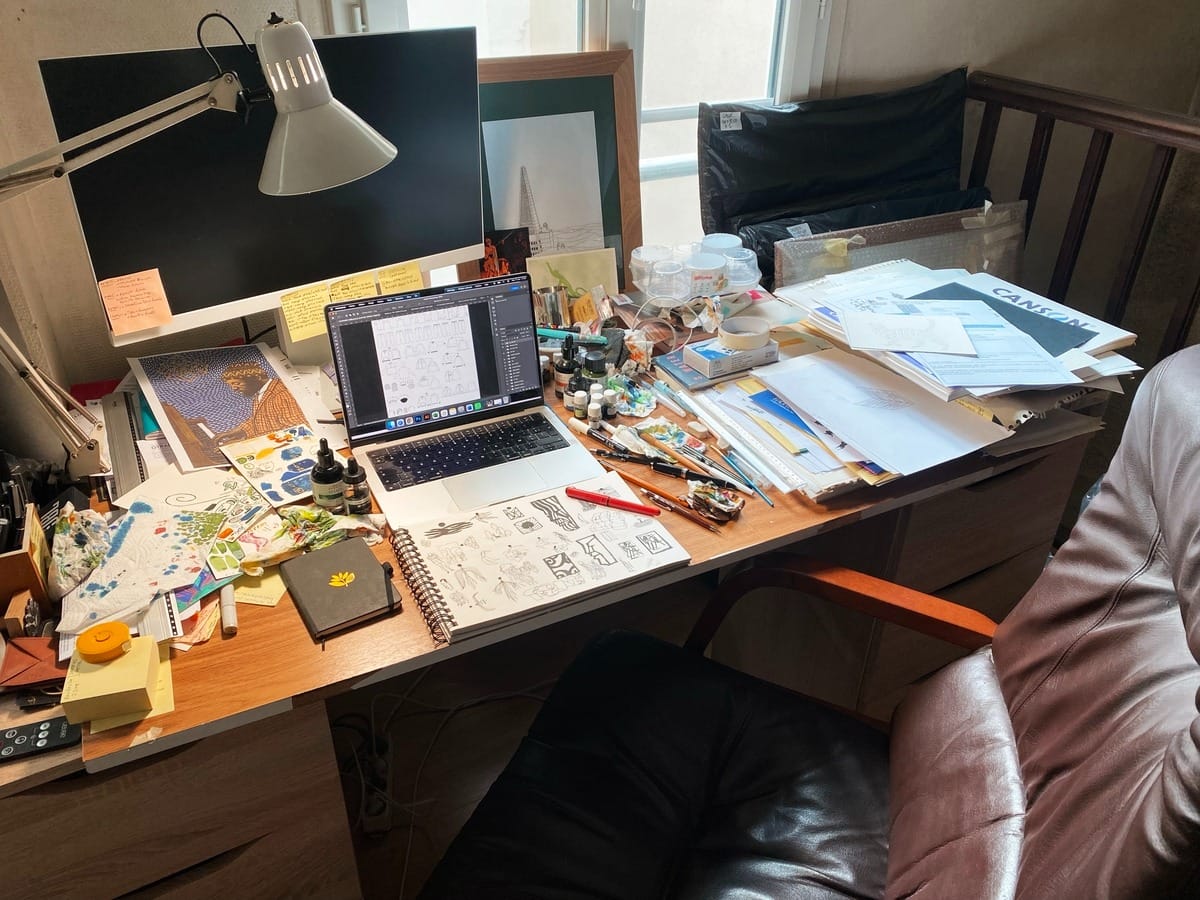
Magenta’s history of collaborating with an international roster of artists on guest graphics is part of a larger vision to uplift creativity in skateboarding. “[Different] artistic styles bring diversity to Magenta… The main objective is to make skateboarding culture richer as a whole,” says Panday. This is part of a broader philosophy that transcends skateboarding. “I’ve seen a lot of things, so I want to express and share them, and I want to help the artists which I find interesting share their own. Ideas make the world richer.”

Goose was not valued
Rank: -400
Mood: 🥚🥚🥚
Who, exactly, makes a commercial product? In a coffee shop, is it the barista handing you your cappuccino or the coffee shop executive in a boardroom putting together a Q3 revenue projection deck? Is it the writers and reporters filing stories or the head of a private equity-backed media conglomerate consolidating and gutting the news industry? In the video game industry, where I used to work, vast teams of developers created the titles, and we in the marketing department did our best to package and promote them.
The greatest impediment and threat to our work, and specifically the work of the developers who made the commercial product, was always the C-Suite. Guided by a fiduciary responsibility to enrich the company's shareholders, much of their time seemed to be spent coming up with monetization schemes that preyed on and pissed off players, along with looking for different ways to shake up org charts, "restructure," and trim budgets in hopes of getting higher returns.
Despite the massive success of the company's games, if a title didn't meet and exceed revenue projections, it was deemed a failure, even if players enjoyed it, even if it just took players a bit of time to catch on. The favoured tool to recoup that projection of revenue, a tool designed to show shareholders how serious the C-Suite are about changing course back to extreme profit, was and is layoffs. Downsizing. Restructuring. Shuttering passionate game studios who suffered under the steerage of a sprawling, out-of-touch publisher.
The company was then acquired and taken private by a consortium of villainous investors, including the Kingdom of Saudi Arabia's investment fund and Jared Kushner's private equity firm, two actors that a new book alleges have orchestrated historic levels of geopolitical corruption.
 Matthew Cole
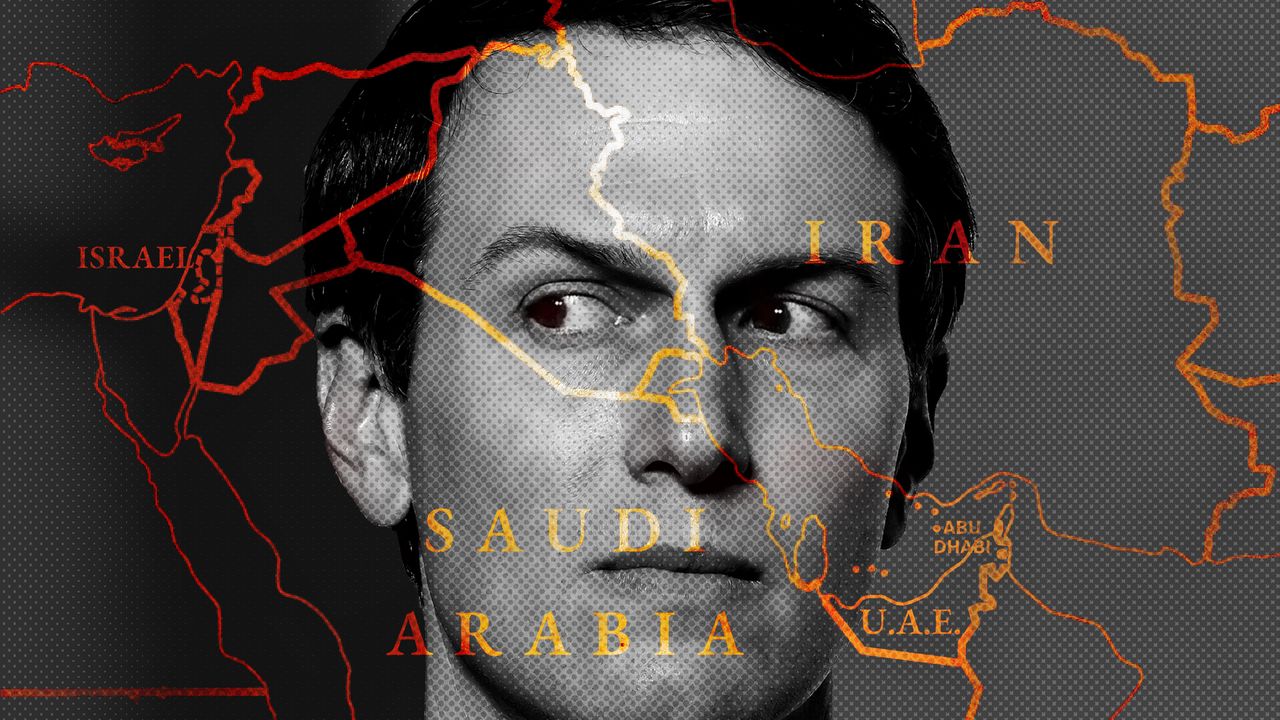
Anyone with a basic understanding of the typical ramifications of a private equity takeover knew what would come next after the company's acquisition was finalized this summer: more layoffs, downsizing, restructuring, shuttering. Leveraged buyouts, standard practice for these transactions, mean the funds used to acquire a company are mostly borrowed, and that debt is then slung over the company that was just purchased; the company now responsible for paying off its own acquisition, so it has to cut costs wherever it can. In the video game publisher's case, it was saddled with a record-breaking $18 billion in debt.
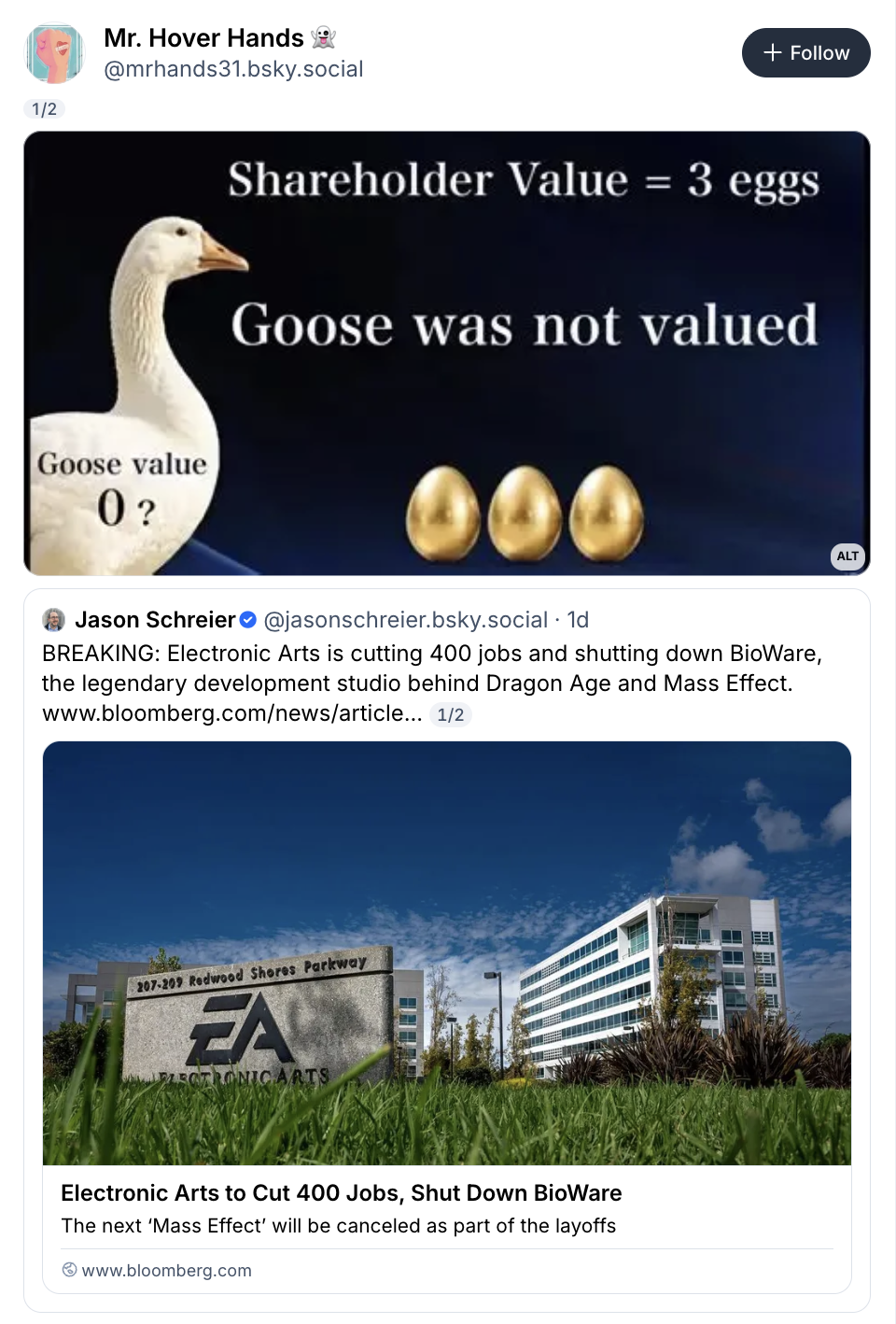
So it was not much of a surprise when news broke this week that the company laid off 400 employees and closed a beloved, influential three-decade-old studio.
 Jason Schreier
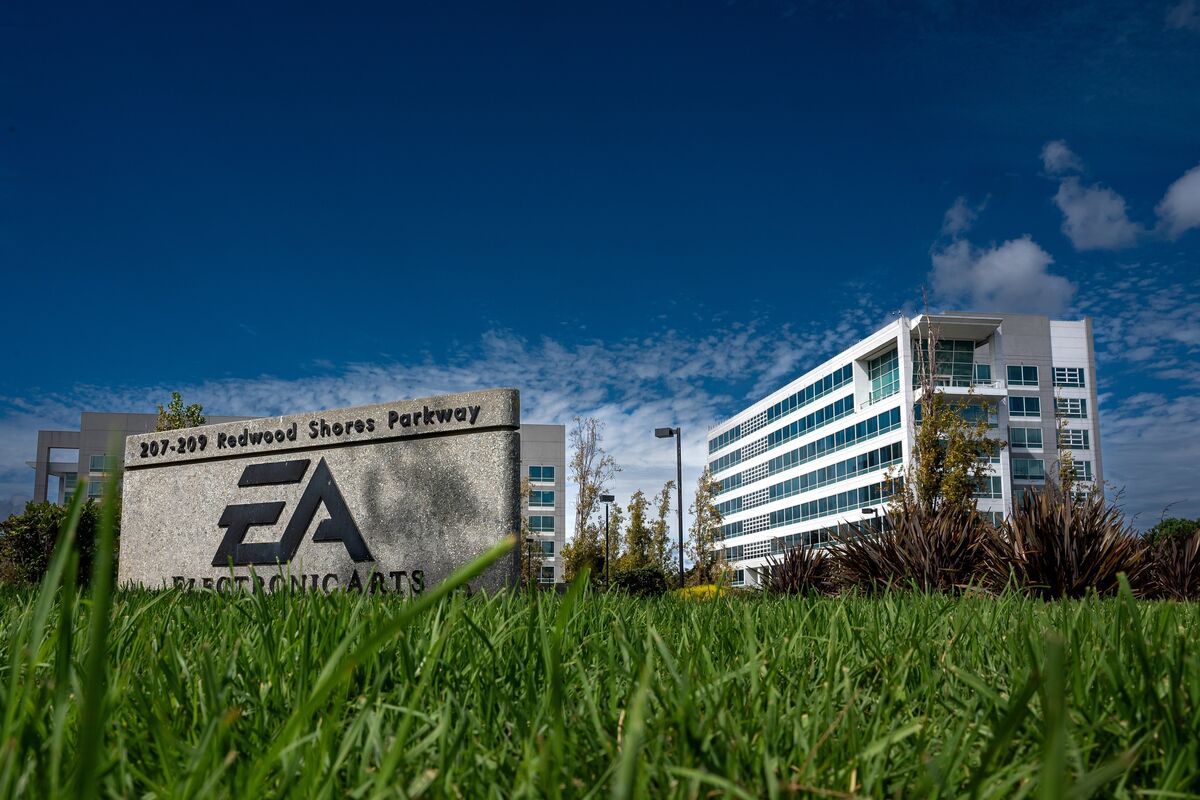
My LinkedIn feed has been a steady scroll of former colleagues announcing the loss of their livelihoods in an industry that continues to contract because of the decision-making of cold and distant bodies in a boardroom.
The CEO of the video game publisher took home $38 million last fiscal year. That news came four months after a round of layoffs hit the team that developed the highest-selling video game of 2025. Those are the people who made the commercial product. The developers are the ones who made the company its billions per quarter that the CEO took a big fat scoopful of for himself, yet they are treated as disposable.
A common refrain in this newsletter is that this isn't new. Because, of course, this is just how capitalism works, whatever necrotic stage it exists in now. This bizarre state of technofeudalism we live under is presented as all there is, and there is "no alternative" but to accept its yoke.
It's impossible to close this out with anything that isn't depressing or doesn't resemble a naive, too-earnest platitude, so one might as well lean into it: the hundreds of people who lost their jobs this week made a living building new worlds. Ones that millions of people pay to get lost in. The sandbox is much different and the stakes far higher, but it's not impossible to build a world we want to live in.

It's this simple, really
Rank: 1
Mood: 🚫

There's been some good CanCon lately
Rank: 1
Mood: 🏒
This is already "old" by today's standards, but I can't stop watching it.

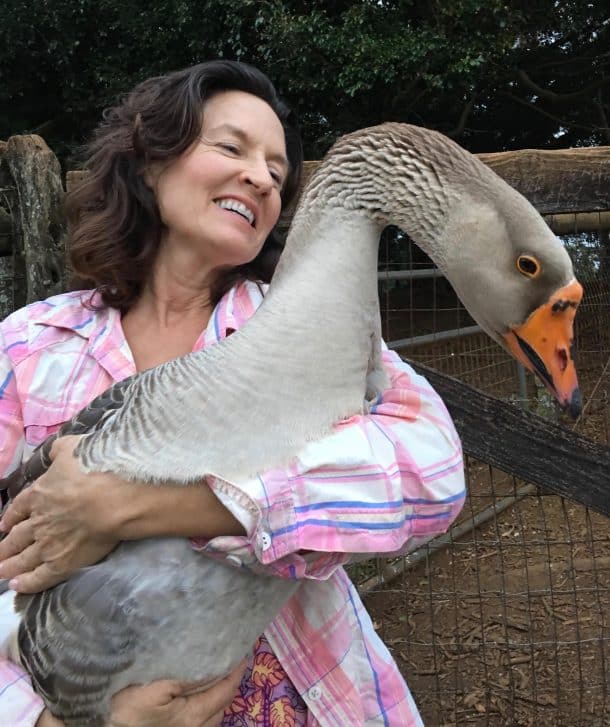
If you also agree that geese should be valued, consider becoming a paid subscriber. Nothing on Simple Magic is behind a paywall, but your money will get you stickers and merch, go towards paying contributors for their great work, and put some dough in my pocket as I write these each week. You can also leave a one-time tip.
Photo: Leilani Farm Sanctuary via Open Farm Sanctuary
Something good to consider: Last week, progressive parties swept into office in Vancouver's municipal election, ousting our awful crypto-pilled business-bro mayor and claiming every seat but one across city council, parks, and school board, a testament to the promise and power of sewer socialism, and also how wack the soon-to-be-former governing party was.
Now, about the provincial election this weekend...
Good things about the people holding the internet together:

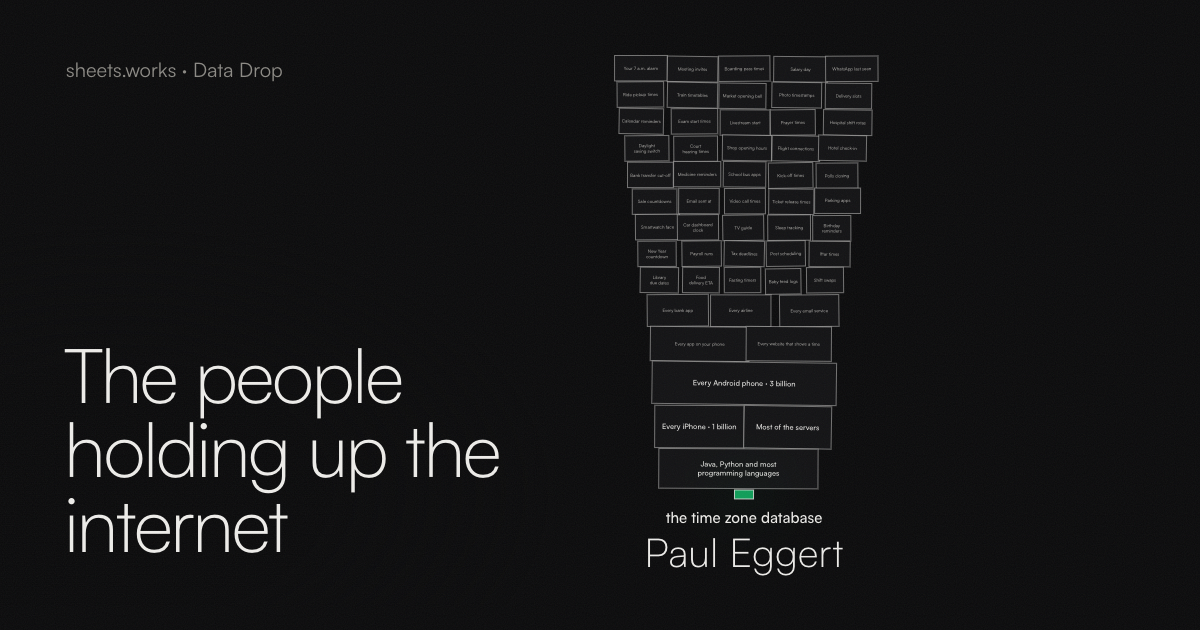
And the one guy who helped avert the PHP vulnerability crisis.
Another good thing:
 TheKed

Yes, good things continue:
 jacobsawyer

More good thing:
 Anthony Pappalardo
Good pod round-up:
 Posted by Templeton

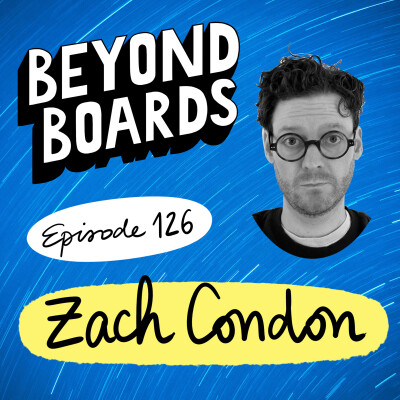
 Wesley O'Driscoll
I haven't listened, but I assume it's good.
Good things, You Can See Everything edition:
 Lindsey Adler
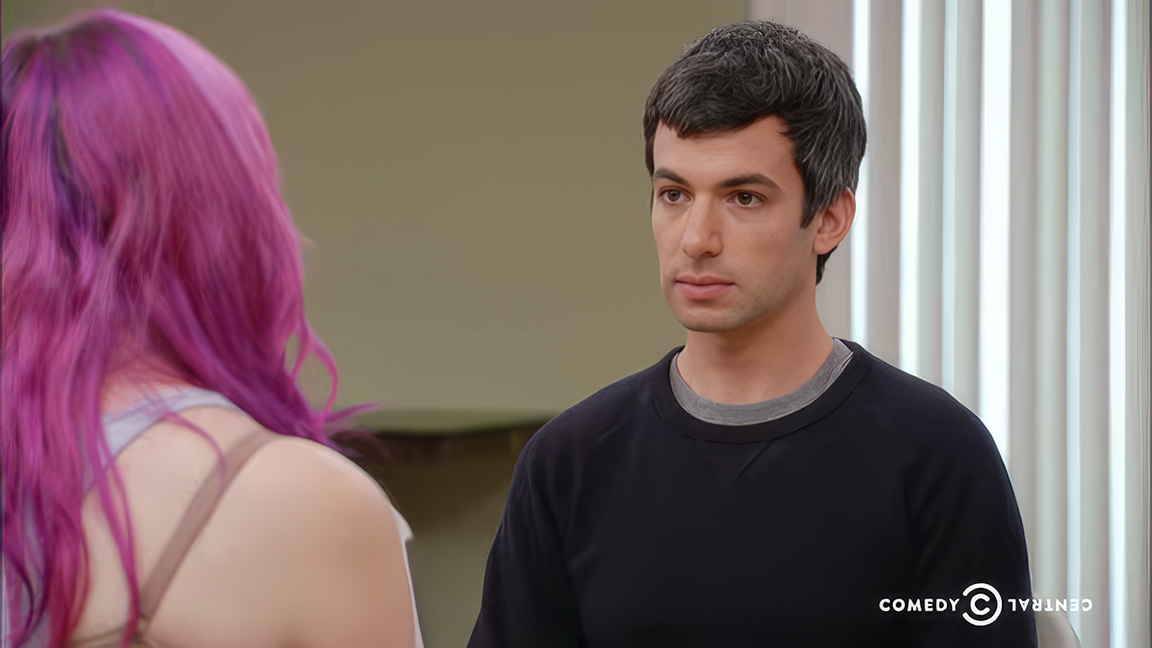
 Laura Marsh

 Katie Drummond

Until next week… if you need to purchase a very large pry bar to move some very large pieces of concrete around so you can skate them, do it now. Winter is coming.


Laser Quit Smoking Massage
NEWEST PRESS
--------------------------------
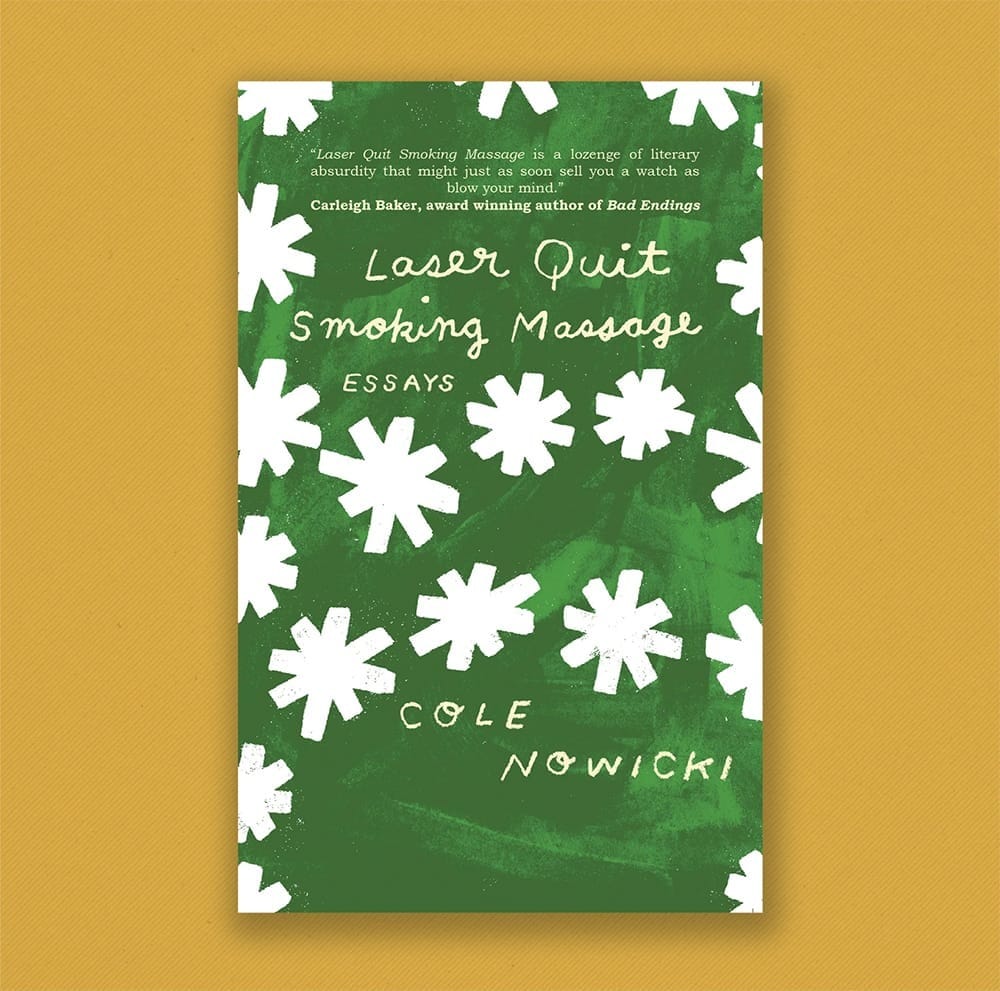
A collection of essays that I think you might like. The Edmonton Journal called it a "local book set to make a mark in 2024," The CBC said it's "quirky yet insightful" (lol), and it won Trade Non-Fiction Book of the Year at the 2025 Alberta Book Publishing Awards.
Book cover by Hiller Goodspeed.
Right, Down + Circle
ECW PRESS
--------------------------------
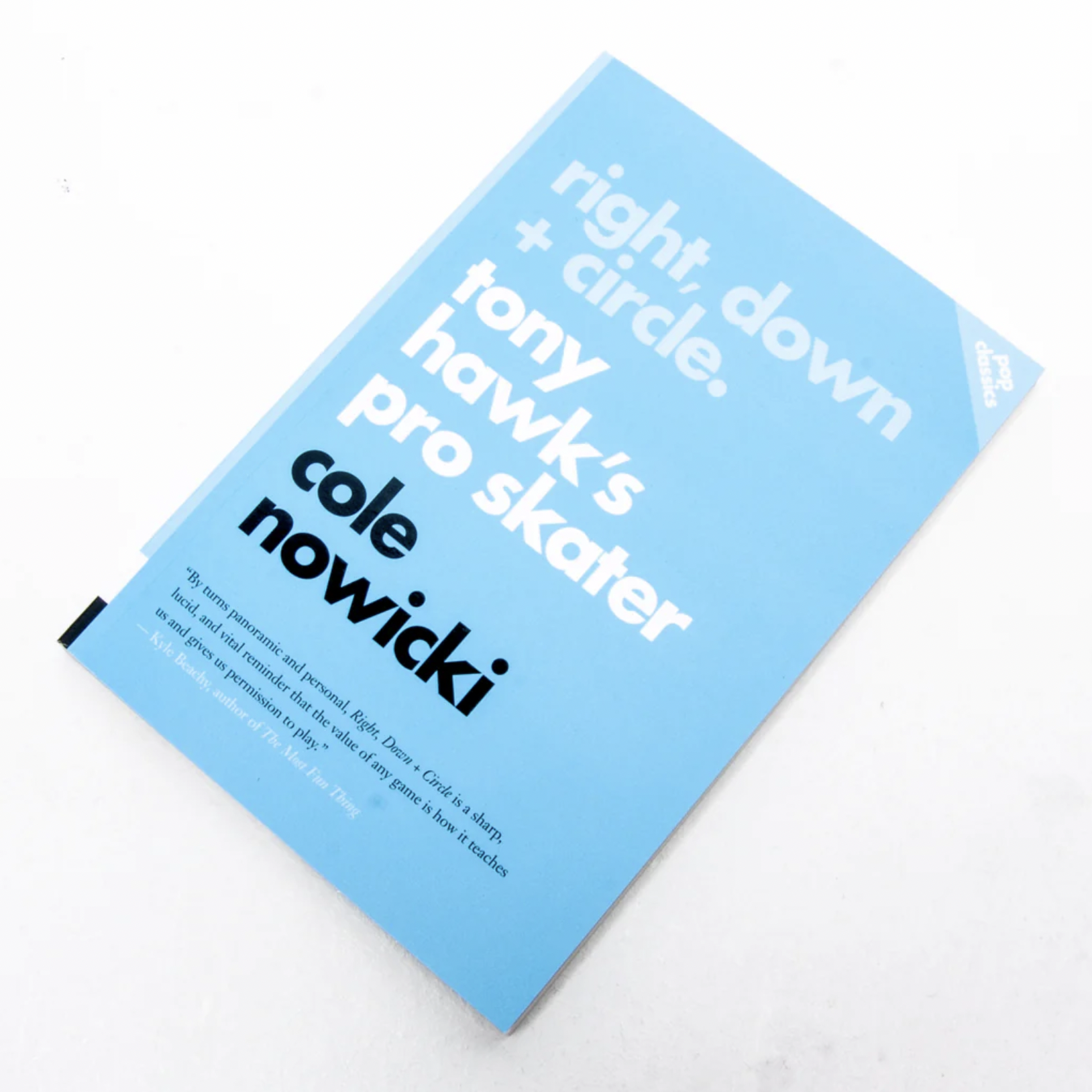
I wrote a book about the history and cultural impact of Tony Hawk’s Pro Skater that you can find at your local bookshop or order online now. I think you might like this one, too.
Photo via The Palomino.