Fate as a fixture
Converse CONS feels the sharp edge of "restructuring," Nora Vasconcellos' "Gilda," a dissolution of the Social Volume Contract, and more.


The definitive weekly ranking and analysis of all the skateboarding and other things online that I cannot stop consuming and how it makes me feel, personally.

Let's take a moment to appreciate two skaters who always find the most interesting and dangerous way to skate a spot
Rank: 1
Mood: ?😱?
Seriously.
I mean, c'mon.

Fate as a fixture
Rank: -40
Mood: 🪓
Sometimes the guillotine just sits there, shiny and poised. Patient. You might even forget it's up there after a time, fate becoming a fixture. A framed print on the wall.
In April, amid headlines that continue to this day about Nike's stock suffering the most Abbott and Costello of fates — slipping, falling, tumbling — rumours began to surface that the sportswear giant was considering selling off one of its dependents, Converse, to Authentic Brands Group, a self-described "brand and entertainment platform" that scoops up ailing companies and licenses out their brand name. They are a familiar subject to longtime readers of this newsletter.
There was immediate speculation about what would happen to Converse CONS, the company's skateboarding division. Generally, this takes the shape of a fantasy draft: which CONS-sponsored skaters will end up where once they get the axe. Jake Johnson on Asics?
Months passed. I heard rumours out of skate shops of imminent "restructuring," which meant some CONS footwear would no longer be in production as the company changed focus. However, that restructuring was already underway. Lee Berman had been with CONS' marketing team for over a decade and was its Principal marketer up until his departure in February (and now appears to be working with DVS). If your marketing lead is out the door, it's only a matter of time until more heads follow.
Boil the Ocean dug into the recent happenings and the familiar parables they bring to mind.
This month suggests a dissolution of the venerable Converse/Cons skateboarding team, with the telltale signs of suddenly alternatively-shod riders excising tags from bios and posts. On the relatively antiquated world-wide web, the roster has slimmed, with speculation on the hoof that contracts are being let to run out, though perhaps franchise talents such as Louie Lopez and Alexis could be retained.
Within the house of Nike, the Converse label has been under terrific pressure. Over the past decade the Converse division’s sales have dropped by about 40%, while Nike’s overall revenue has increased by 43%; the skid has picked up pace over the last few years, and over the past 12 months Converse’s revenue is down 31%, taking a hit around the world, as Nike overall treads water. Perhaps most important, in 2016 Converse delivered a $487 million profit to Nike, versus losing $17 million in the most recent fiscal year. Skateboarding meanwhile is in its own well-publicized slump.
With the whole of the skateboarding industry seemingly "restructuring" in ways promising and not so much, it's reasonable to wonder what's next. The pared-down Converse CONS team page includes, as of writing this, Alexis Sablone, Raney Bares, Louie Lopez, Brian Delatorre, the late Ben Raemers, Erik Herrera, Sammy Baca, Bobby De Keyzer, and Zered Bassett — a considerable downsizing. Notably, Milton Martinez, the only CONS skater to win Thrasher Magazine's Skater of the Year award, is no longer with the company. If Delatorre's contract expires at midnight tonight, will he be on the site come Monday? Will Converse CONS be here come Monday? Probably, but at the risk of copy-pasting Boil the Ocean in its entirety, CONS' fate does leave much to be considered. Impact. Legacy. The present. The future. Things that are more difficult to sever than a contract.
If Converse pulls out, what judgment may be rendered? All the old arguments can be deployed as far as their shoes having been skated in the 70s/80s/90s, including in arguably history’s greatest video part. They gave Chany Jeanguenin a D3-indebted pro model when those things were selling, may or may not have screwed over Anthony Pappalardo, and since then have helped pay many dudes’ bills, funded road trips, produced a Jake Johnson video part and blessed Alexis Sablone with a shoe.
After 25 years of tangoing with multinational corporate conglomerates and all of the requisite tradeoffs — from contractually obligatory hat-wearing to mandated social media postings — the question is whether ‘the culture’ has become accustomed to a more transactional vibe. When team-riders can harvest shoe-sponsor funding to facilitate trips for the bros or their board co, piggyback off their social media presence to expand their own ‘platforms’ and set aside 40% of each box for reselling online, is it understood that authenticity and the ‘family’ stuff is nice for interviews but only ever goes so far?
Is Cons being pummeled by the same painful pendulum swing away from simplistic silhouettes that has lately punished Vans and other non-Blazer sellers? As sportswear conglomerates’ skate rosters have ballooned, is it understood that they have come to be ruled by their own kind of cosmic expansion and contraction?
And most important to me personally: will CONS keep producing the AS1?

Competitive and commercial worth
Rank: ...
Mood: 🥊🏒🛹🏀
The pressure of being a professional athlete is manifold. You must remain healthy. You must perform and perform well. You must steel yourself from the intensity of being in the public eye, and increasingly, you must create and foster your own personal and public brand, which only increases that intensity. If you are a woman or gender-expansive skater, the simple nature of your being acts as a force multiplier to those pressures.
In traditional ball-and-stick sports, athletes get many opportunities to showcase their skill set and, bluntly, their competitive and commercial worth. If you can no longer compete, your stats will flag, a measurable sign your days as a professional might be done. In something like skateboarding, where the basal directive of your job is not winning or even really competing but being seen as a means of promoting your sponsors and selling hard and soft goods, valuing "competitive and commercial worth" becomes a nebulous rubric used almost exclusively in private and judged on a swirl of personal relationships, taste, social media reach, sales figures, and a brand's marketing budget.
Skill and performance matter, to be sure. But for the professional skateboarder, style and one's personal brand are also paramount. For a sponsor, someone who makes the act of skateboarding look beautiful is valued almost as much (and often more) than an elite talent. Same with being someone fans just like and want to support. To have all three is the sweet spot.
Nora Vasconcellos is in that sweet spot. Great style, high level of skill, one of the most resonant personal brands in skateboarding with a devoted fanbase — all of the ingredients are there. That's why she's one of the biggest names in the industry. Because she's one of the biggest names in the industry, her competitive and commercial worth is regularly scrutinized by the online commentariat, which is fair; that's part of any sports fandom, after all, and on an individual fan level, talking shit with your friends can be one of the most enjoyable parts. However, by dint of being a woman, she's often scrutinized to the extreme.
In September 2023, while on tour in London, England, the day before launching her signature shoe with adidas, Vasconcellos broke her ankle. Despite the devastating injury, she still had momentum on her side. Beyond her shoe and its promotional tour, which she continued in a cast, she had just graced the cover of the October 2023 issue of Thrasher and was the guest editor of an issue of Monster Children, where she also had a feature interview. As she recovered, she continued to perform the duties of a professional skateboarder: Being seen and promoting her sponsors. She had clips sprinkled throughout videos and tour edits, was named a character in the latest Tony Hawk's Pro Skater reboot, got featured in an episode of Let It Kill You, and started co-hosting the Good Luck With That podcast on iHeartRadio. That's more than most do in their entire careers.
All of which led us to last week, when Thrasher released Vasconcellos' long-anticipated adidas-backed project Gilda, her first full video part since Welcome Skateboards' Seance in 2019.
It's a fine effort, well-edited, and full of solid, stylish skateboarding, the kind Vasconcellos is known for. There's some filler, to be sure, but most video parts have padding around the edges, whether for runtime, to play with pacing, or the skaters and/or editors just like the clips. Is it the barnburner you might expect for having seven years (minus time injured) to film? Depends on who you ask, but that's also not really the type of skateboarding Vasconcellos does.
She is a high-level transition-centric skater who excels with flowing lines, sneaky technical singles, and the occasional left-field huck, like her half-cab-kickflip, backside-kickflip, and slob-plant to massive hillbombs in Gilda. In that respect, Gilda delivers, though you wouldn't know it judging by the vitriol the part has been met with online (if you want to subject yourself to the comment section on Gilda's YouTube page, by all means).
Most of it is unvarnished misogyny and a generally inarticulate gnashing against unseen forces within the skateboarding industry conspiring to uphold Vasconcellos for reasons that are either "woke," payolla, or TBD. For those whose common refrain is that her Thrasher cover obscured the "ramp" she used to approach the obstacle, I have unfortunate news about almost every Wallengberg cover and clip since Frank Gerwer's kickflip. If there are criticisms around "productivity," those are fair in a vacuum but don't hold up to scrutiny. When's the last time Steve Caballero put out a full video part? Powell's Magic in 1999? Decades later he still has his name on shoes and boards and no one seems to mind because he is a pioneering and marketable(?) figure within skating, descriptors that can also be applied to Vasconcellos.
Doing those sorts of double-standard comparisons isn't always helpful because it can tear down one person to uplift another, and really, the problem here isn't these individuals' careers; it's that a certain subsection of the fanbase does not understand or is choosing to ignore how "the industry" has always worked. Or, worse, they have an idea of how they think it should work that doesn't comport with reality.
And perhaps that's an indictment of the industry's opaque machinations. Why does Brian Delatorre keep his roster spot on Converse CONS while Milton Martinez and Mike Anderson don't? Who knows!
So again, it's fair and fine and normal to criticize Vasconcellos on the merits of her skateboarding and in the context of her career — Gilda is a fine video part that builds on her efforts in Seance and shows an evolution in spot and trick selection; it may not deliver on the expectations some had, but that's also normal within this industry — but that's not what's happening here. This torrent of bile is a questioning of her position in skateboarding, which to anyone actually paying attention, is incontestable. Vasconcellos continues to do the job of a professional skateboarder better than almost anyone in her field: she inspires untold numbers of people to skateboard and those people tend to be inspired to buy her sponsor's products. And she does that, first and foremost, by being a talented skateboarder.
But you can't win with nuance, blunt as that is. Look at Katie Taylor, she had to become one of the best boxers there has ever been and arguably Ireland's greatest athlete to get her flowers over the weekend when she retired in front of 80,000 adoring fans in Croke Park after winning her third undisputed title and calling it a career with a sterling professional record of 26-1.
"I don't know of any other country that would sell out 80,000 tickets for a female athlete." She said in her post-fight farewell speech.
It shouldn't take being the best there has ever been for an athlete's body of work to be celebrated, or just reasonably accounted for. For those who don't like Gilda or Vasconcellos' skating or public persona, that's okay. Not everything is for you. But if you can't understand why Vasconcellos is who she is, why she deserves to be there, the impact she's had, or respect the work she puts into the job of being a professional skateboarder, that's a failure on your part.

Dispatch from the laptop job mines
Rank: -2
Mood: 🙉
The man sitting at the bar next to me finished his drink at the same time as the roughly five-minute Stavros Halkias stand-up clip that he'd scrolled past on his phone finished playing at a volume approaching "full." He had laughed along, loudly, the entire time. The man, like myself, had been sitting alone. His every genuine guffaw bullrushed past my headphones and into my ears as I listened to music and wrote.
More autoplaying videos blared from his phone as the man settled up and made small talk with the bartender. He gave no indication that his obnoxious audio annexation of this communal space was a shameful act. It was as if he and his noise existed outside of the rest of us. Free floating yet contained. Personal and imperceptible.
As someone who does most of their work on a laptop, moving beyond the confines of my home office to a cafe, patio, or bar, and other scenic flat-topped locales in the afternoons and evenings, I've been witness to the anecdotal yet obvious breakdown of the Social Volume Contract. There was once an understanding, unspoken until made clear, generally in anger: if you had to take a phone call, you took it outside or in another room if possible. The initial proliferation of the cellular phone provided an early test to this compact, as novelty ringtones began to pierce the comity of the subway and queues at Subway.
Still, a respected boundary seemed to exist. Listening to music on a personal device in public meant headphones. Audible "typing" SFX would earn you stink-eyes, as would the ping of an incoming text message. Now I regularly write in shared spaces where people take calls on speakerphone.
I don't know if there was an inciting moment rather than the gradual erosion of norms as the smartphone became an inescapable part of modern life, but once we slowly moved back into the public sphere as the COVID-19 pandemic waned (or the popular worry of it, anyhow), there did seem to be a struggle to resocialize. Perhaps the close connections we'd fostered with our digital devices indoors, alone, were harder to let go of than expected now that we were out and together.
Or this is just what socialization is now. The barrier between our digital existence no longer a firewall but a gateway into the physical. It is now normal practice to pull out our phones at the dinner table to share photos and videos from vacations or the second-hand vacations of others shared by and with our parents with glee. And to be fair, those were beautiful waterfalls they visited and preserved with a click of that big red button.
There is another angle to this "breakdown": I'm being a fuddy-duddy scold of people simply living in the digital age; this a complaint that would fit right in on the Washington Post opinion page. That certainly isn't incorrect. What can one do about it anyway? Is that capitulation a symptom or cause of Hyperpolitics?
When the man left, I asked the bartender if she had also noticed a rupture in this Social Volume Contract. She had, and posited that the disconnect may come from the atomized nature of social media culture, the rapid churn of our news cycles, and our leaders who feed into it. She also mentioned that not everyone, everywhere, is as susceptible, bringing up dedicated "telecommuting" train cars in Japan as an outlet for those who feel compelled to make noise with their machines.
Whatever this fracturing is, whatever it means, what concerns me most is that it's really fucking annoying. Without exaggeration, as I write this, an elderly gentleman at the table behind me in the cafe is watching what sounds like AI-generated recaps of recent news headlines — the robot voice put its full self into enunciating tear-ifs. I just turned around to give a cold stare of disapproval and was met with a smile. I smiled back.


Oh, sorry, I didn't see that you had your headphones on. What a courteous person you are. Well, now that I have you, why not consider becoming a paid subscriber. Nothing on Simple Magic is behind a paywall, but your monies will get you stickers and merch, go towards paying contributors for their great work, as well as put some dough in my pocket as I write these each week. You can also leave a one-time tip.
Something to consider: If you're in the Vancouver area, Carter Spinks has a new video premiering tonight at Strathcona Park at 8pm. Gonna be good!
Via Menu Skate Shop on Instagram
Good thing:
 Chloe Williams
Another good thing:
 Hua Hsu
More good:
 Laurie Woolever
Horrible thing that keeps happening:
 Samantha Cole
Good pod round-up:
 Village Psychic


Updates on the AI skater: Follow Filming got into the weeds on @cursed.crybaby, who I wrote about a few weeks back.
Until next week… boomboxes are not subject to the dissolution of the Social Volume Contract. If you've got a boombox, swing that thing over your shoulder and let it rip.


Laser Quit Smoking Massage
NEWEST PRESS
--------------------------------
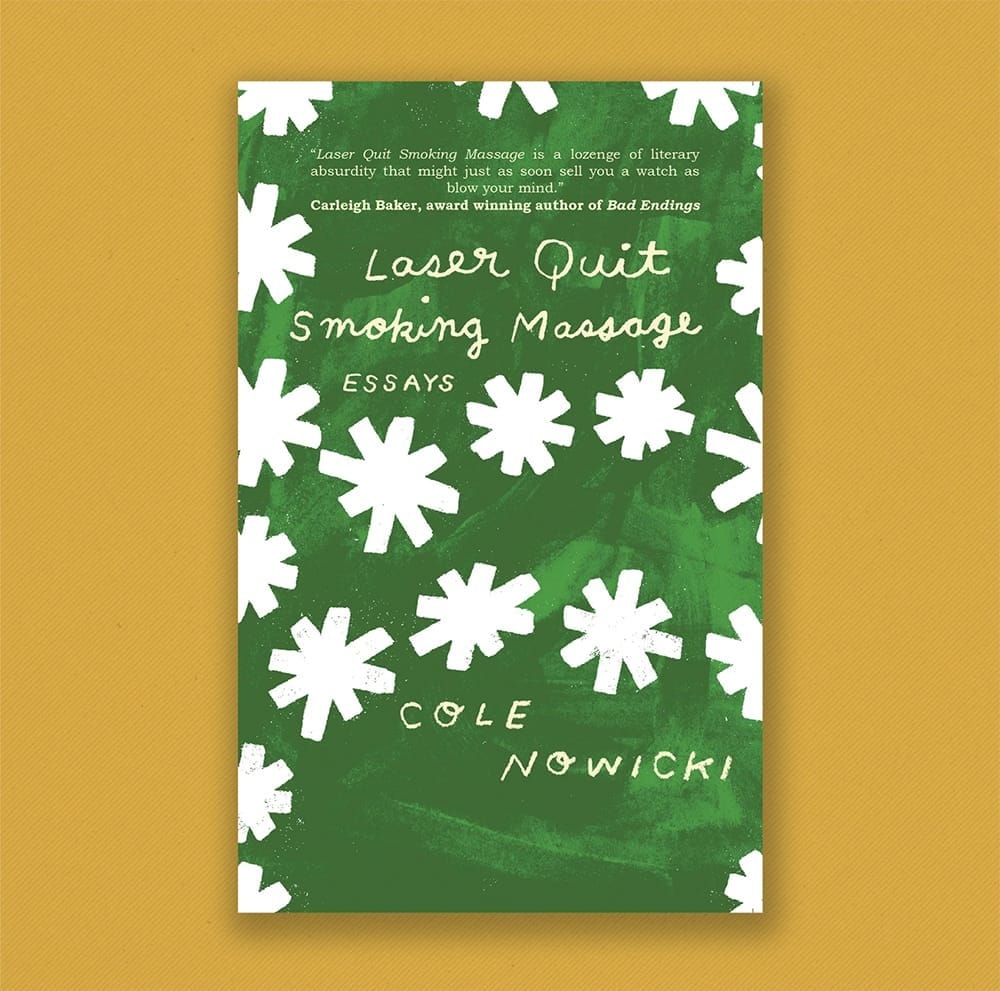
A collection of essays that I think you might like. The Edmonton Journal called it a "local book set to make a mark in 2024," The CBC said it's "quirky yet insightful" (lol), and it won Trade Non-Fiction Book of the Year at the 2025 Alberta Book Publishing Awards.
Book cover by Hiller Goodspeed.
Right, Down + Circle
ECW PRESS
--------------------------------
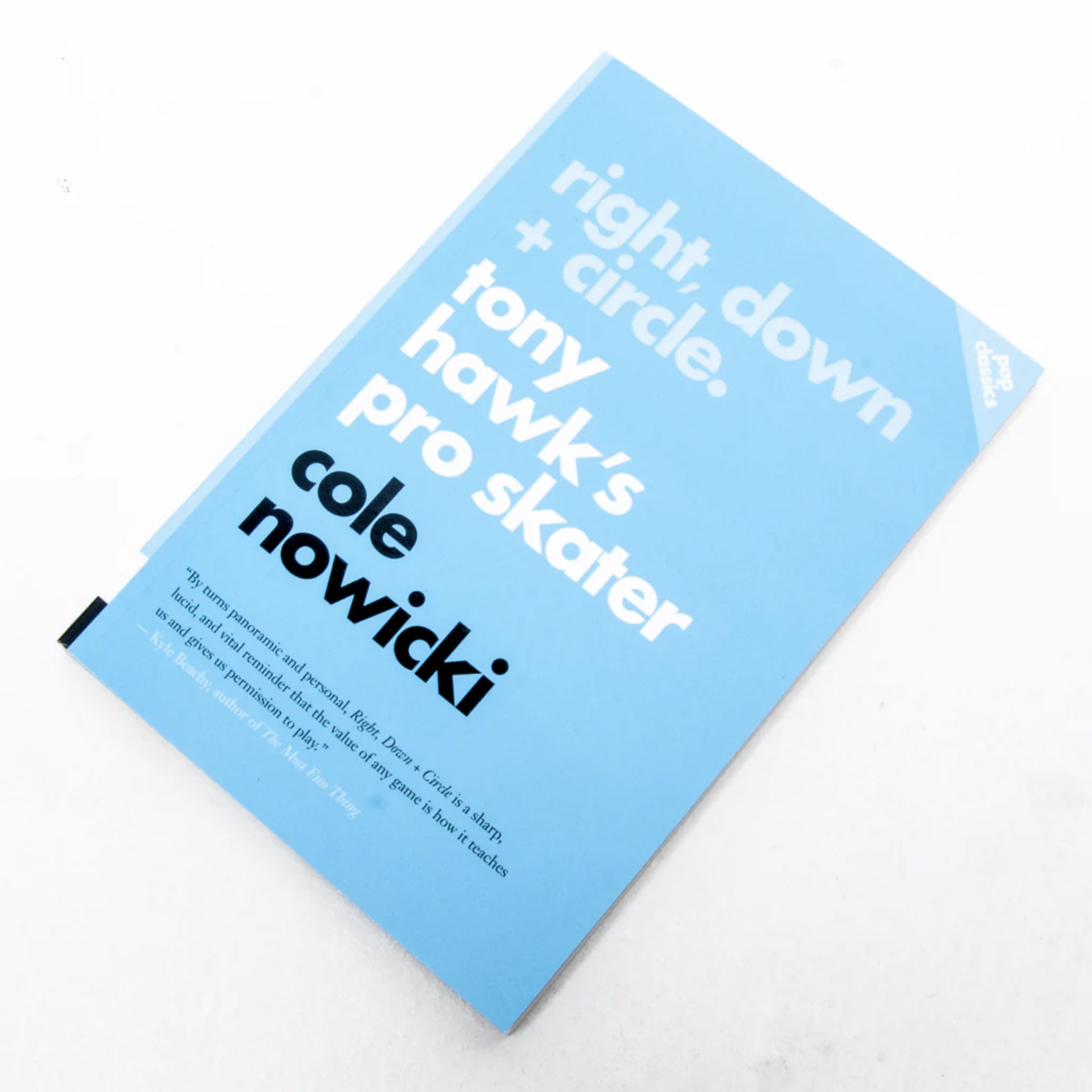
I wrote a book about the history and cultural impact of Tony Hawk’s Pro Skater that you can find at your local bookshop or order online now. I think you might like this one, too.
Photo via The Palomino.