Way to go, Dylan
Thom Callan-Riley attends Angle Iron, Dylan Jaeb meets and exceeds expectations, Ocean Vuong throws himself off an eight-stair, an update from Pulaski, and more.

The definitive weekly ranking and analysis of all the skateboarding and other things online that I cannot stop consuming and how it makes me feel, personally.

Ironing out the angles
A special correspondence by Thom Callan-Riley
It’s rare, these days, that I go to a panel discussion about skateboarding where the audience is non-skateboarders. As skate gatherings propagate around the world like spider plants, the audiences I tend to encounter are almost always skateboarders themselves. Not just that, but skateboarders who like to think a lot about skateboarding. They are committed. They have experienced the magic. This is all to say, you don’t need to explain the value of skateboarding to them.
Yet, last week I found myself in the converted front rooms of a Georgian terraced house in Bloomsbury amongst an audience of fresh-faced architecture students, and it was a treat to pause and listen to someone explain the value of skateboarding to the uninitiated.
Milan Solonenko, a former Copley Square local and now first-year student at the Architectural Association, had assembled a stacked lineup for "Angle Iron: Skateboarding, Architecture and Urbanism," to discuss what can be classed as the two broad themes within skateurbanism: why and how.
The why is the part of skateurbanism that a lot of us are familiar with. The lobbying of the municipality and campaigning for skateboarding to be allowed, preserved, or even designed for, in public spaces. Panellists Gustav Eden and Iain Borden have sat in rooms like this before advocating for skateboarding to councillors, city planners, residents and architects, and they have honed their presentations.
Borden’s central premise is that skateboarding doesn’t provide answers; it asks questions. It is a critique of the passive experience of cities. He flips the question on its head; rather than having to set out the value of skateboarding, skateboarding questions the value of everything else. What is architecture? Who are cities for? What do we even mean by value?
These big questions are posed by something astonishingly simple: a piece of wood with wheels. Borden brought in a 1962 “Roller Derby” skateboard as a prop for the audience to pass around — a simple thing in perhaps its simplest form.
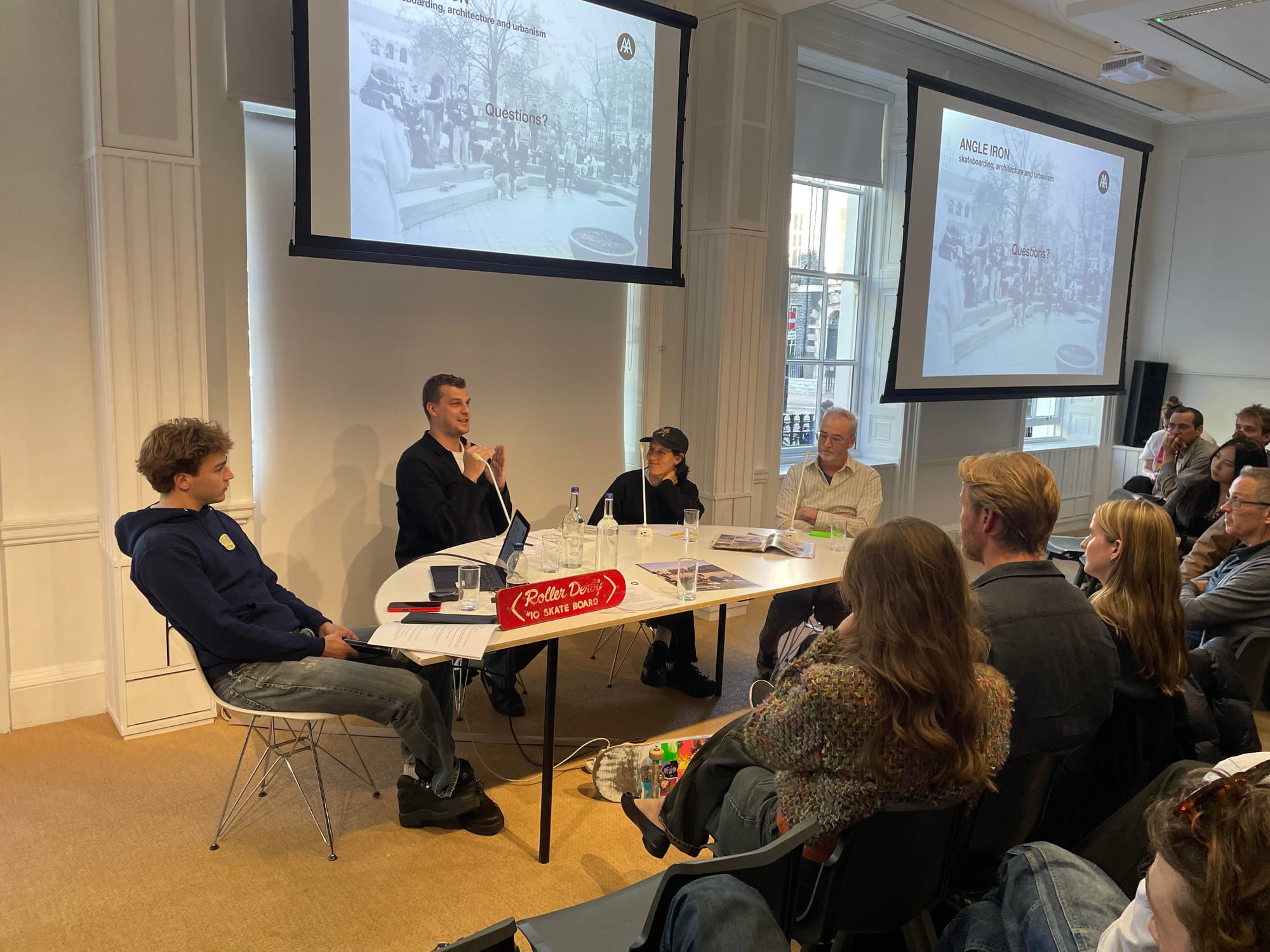
Gustav added that by asking these questions and approaching the city differently (sideways), skateboarding unlocks the true potential of the city.
The second, arguably more complex element of skateurbanism, is how to design skateboarding into the city.
Gustav suggested that first we clarify the question — what is the outcome you’re hoping for? Is it to have a skateable object, or is it to have a space that skateboarders use? Designing a skateable object is relatively straightforward, but if the skaters don’t use it, what is the point? Designing something that skaters will use means creating something they can feel a sense of ownership over. This doesn’t come from something that is defined as "for skateboarding," continued Gustav; you cannot be too prescriptive in the provision of a skateable space.
Alexis Sablone was the centre of the Venn diagram in the room: MIT-trained architect and professional skateboarder. Not to mention designing and building skateable spaces like candy courts and sculptures like this dope chair. Alexis echoed presentations from Taj Hanson and Brian Glenney at Slow Impact: the best skate spots are places that were not designed for skateboarding. They should be somewhat challenging, not perfectly designed for skating. Actually, that chair does look pretty steep.
The way that skateboarders see the city differently is sometimes called the skater’s eye. This concept has generated a bunch of academic interest lately, but at its core, it is about how skateboarders see the opportunity to transform some mundane architecture into something skateable. It is the transformation that is the important part. There is a joy in turning nothing into something. Glenney has described it as a form of alchemy. This mythologized skill doesn’t really apply to, say, a skatepark, because no transforming is taking place. The same is true if you build a skateable object in the city and say it is for skateboarding. If skateboarding is about asking questions of something, it doesn’t thrive when the answer is spelled out.
So far, the brief is (as we’re speaking to future architects): we have to design something that isn’t for skateboarding but can be skated, but is maybe kind of hard to skate?
One way to design something for skateboarding that isn’t too defined is to make it multi-use, but Alexis suggests this is perhaps becoming overused as an expression. Easy to say, hard to do. You have to actually design it in. In doing so, you’re designing in a lack of clarity, what Lee Dubin calls non-binary spaces, where you’re designing in negotiation. This isn’t just good for skateboarders, but good for the isolated worlds in which we live. We need to speak to our fellow humans.
We can entice skateboarders through the choice of material. Through sneakily including angles and references. Hints of skateboarding without saying this is for skateboarding.
Stu Maclure ended by bringing us back to the non-skater audience. We were at the Architectural Association, the home of the 1960s avant-garde collective Archigram, who designed the undercroft, a.k.a. Southbank. Through designing an open and undefined space under the Queen Elizabeth Hall, they unintentionally designed something “perfect” for skateboarding. A skate spot now celebrating its 50th year. One that’s still pretty hard to skate.

An unfortunate update about another hard-to-skate thing
Rank: -1776
Mood: 🤕
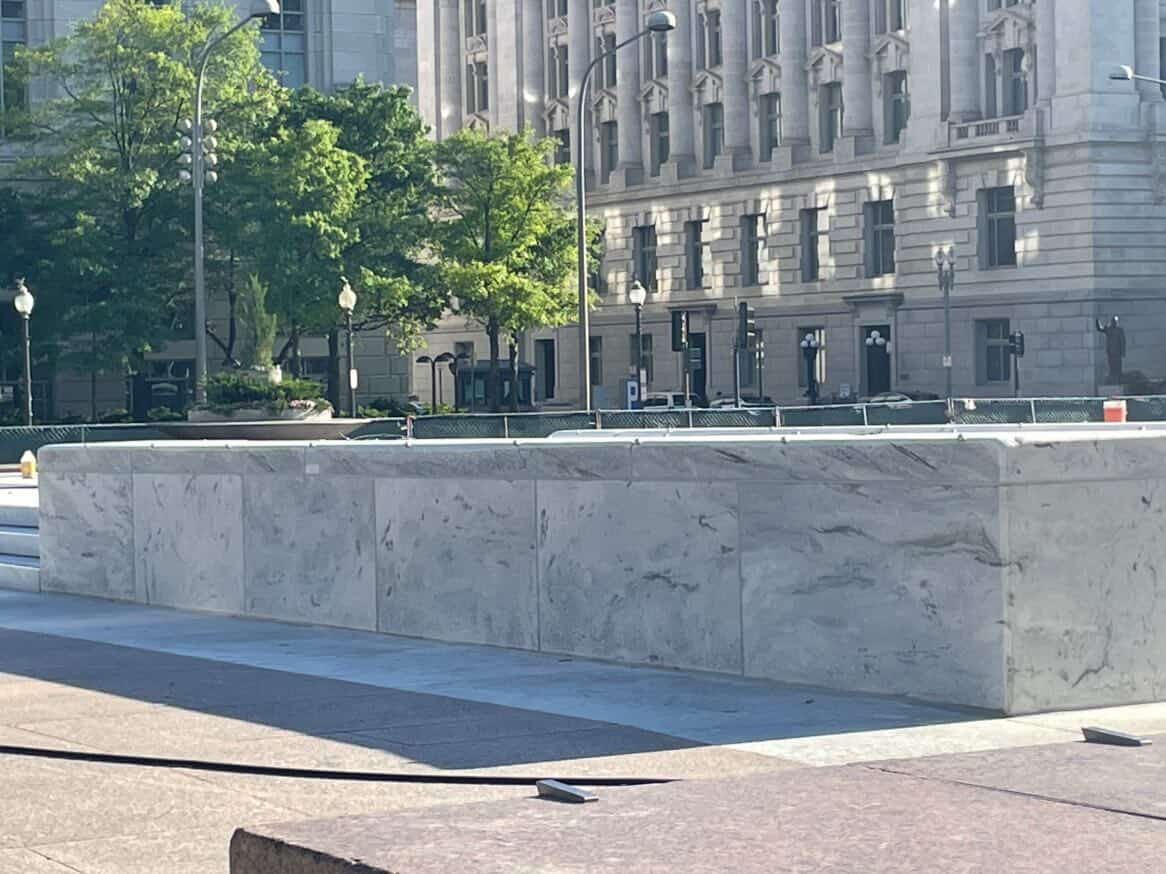
Last Friday, I wrote about the resurrection of Philadelphia's Muni (a.k.a. Thomas Paine Plaza) as a city-sanctioned skate spot and an alternative future for spaces like Pulaski (a.k.a. Freedom Plaza) in Washington, DC, which is currently undergoing renovations that include the skatestopping of most of the plaza's marble ledges.
 Cole Nowicki
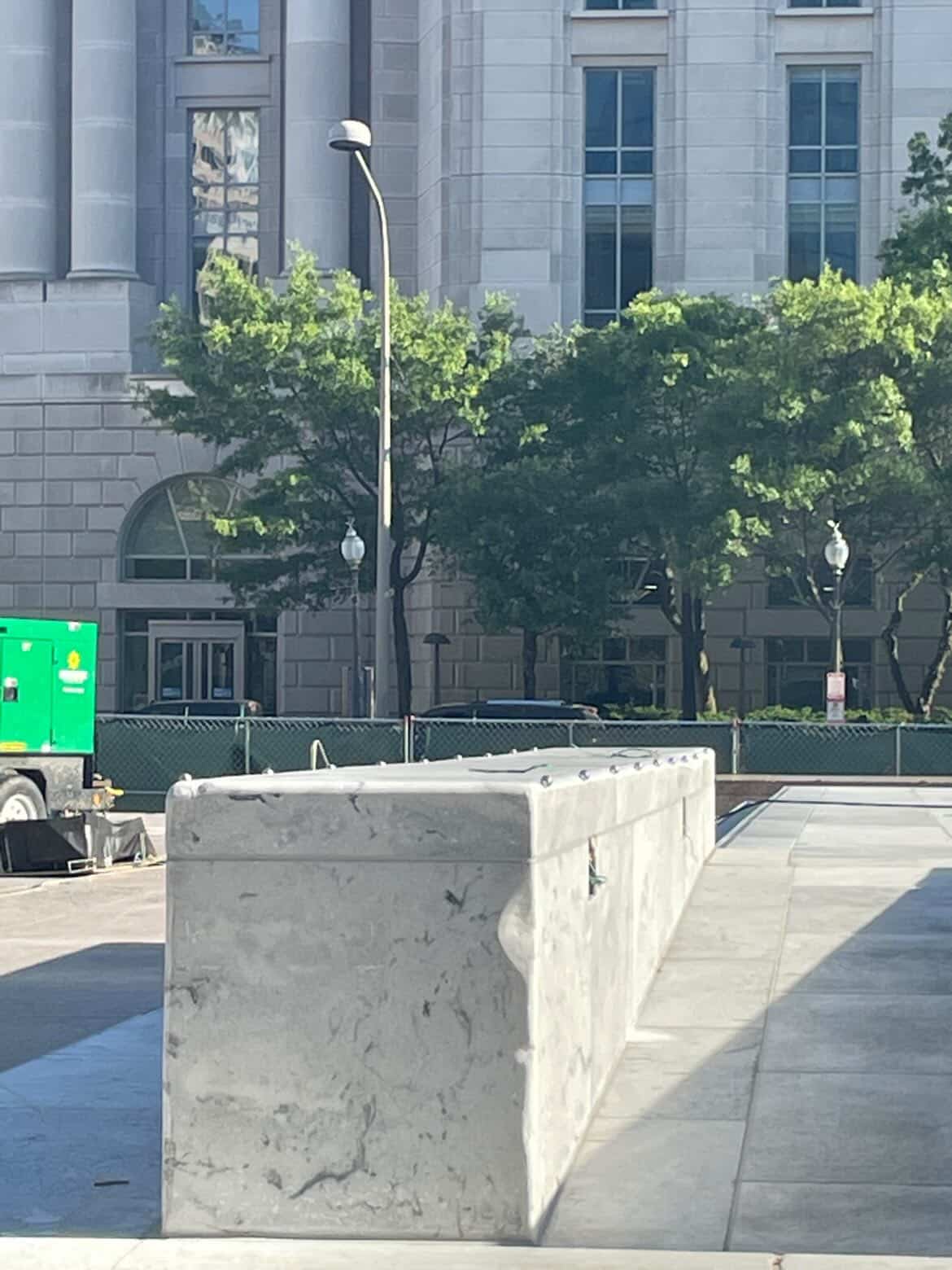
After employing the advanced investigative techniques of zooming in on some Instagram photos and videos, I concluded that "one of the only parts of Pulaski that appears to have escaped hostile architecture’s wrath is the waist-high white Georgian marble ledge." Because why would you? It's barely skateable unless your name is Antonio Durao.
This conclusion was incorrect.
Photos: Owen Basher
Owen Basher, a DC-based skateboarder and photographer (whom Ian Browning talked to about his excellent photobook Bumper for Simple Magic last summer), snapped a couple of photos on his way home from work on Monday and sent them my way, evidence that absurdity is reason enough.
Basher also pointed out that a statue had been installed in the plaza. As the subhead in a Washington Post article succinctly lays out, this "statue of Caesar Rodney, a signer of the Declaration of Independence who enslaved over 200 people, was taken down by the city of Wilmington, Delaware, during protests in 2020."
...the statue of Rodney astride his horse, removed from public view during the 2020 racial justice protests, will be brought to Washington and displayed in a much more august setting, on an outdoor concourse on Pennsylvania Avenue between the White House and the U.S. Capitol honoring Martin Luther King Jr.
The National Park Service plans to install the Rodney statue temporarily in Freedom Plaza, a federal park in downtown Washington that was renamed to honor the civil rights leader in 1988. The statue would be displayed for up to six months as part of the nation’s celebration of its 250th birthday, according to Interior Department documents obtained by The Washington Post.
Skatestoppers, under the seemingly (and sometimes) reasonable guise of protecting property, can also rightly be seen as a means to dismantle shared space for the benefit of capital and the comfort of those in control of it. Installing a statue of Caesar Rodney, a slave owner, in Freedom Plaza, is unambiguous, subtext-free trolling; ultra-bold Impact font spelling out the rabid, white nationalistic fervour of the current American administration.
Not great!

Cali or Connecticut eight?
Rank: 8
Mood: ♾️
H/T to 'sletter friend and contributor José Vadi for sending this over.
While a guest on the How I Write podcast in March, poet and novelist Ocean Vuong touched on what he thinks are overlooked qualities in one's writing practice.
One thing that's rarely talked about that's essential is two things: Daringness and disobedience. Daringness is the willingness to risk it, to make a wager and see what happens, right? Or you correct yourself and say it's better to step back in line and be praised accordingly and move on, even if I sound like everybody else.
So conformity and innovation are two very incongruent relationships, with so much of art-making beyond writing. Any artist can tell you better than I because I only work in two mediums. So then do you have enough courage? Do you not have enough fortitude to risk it?
I think maybe I had that because I was a skater. And the idea of skateboarding was that you threw yourself off an eight-stair, never expecting to land it. Landing the trick is like a miraculous moment of, like, cosmological agreement with gravity, physics, and time, right?
You almost feel chosen when you land a trick like that. And so the idea that failure is not just a prerequisite to success, but part of experiencing life. Sometimes all you do is throw yourself off an eight-stair and all you have is bruises and a broken ankle, and that's it. Yet there is a delight in doing it with your friends and seeing your body move through space.
So I think for me, the expectations were so low in that sense where I'm just like, I get to write books. My family came from factories and nail salons. I get to try. That's my vocation. My job is to try things and then go like this [mimes crumpling a piece of paper] and throw it over my shoulder.
Why wouldn't I try everything? Why wouldn't I relentlessly throw myself off an eight-stair?
It's a beautiful, seemingly off-the-cuff aside, typical of Vuong, and it does make one think: how big is that eight-stair?
Are we talking a California Eight — small, smooth, and easily huckable — or like the eight stairs Vuong would have skated as a teenager in Connecticut — tall, long, and crusty at the take off and landing? There's much to consider here.

Way to go, Dylan
Rank: 1
Mood: 🔶⚪🔺
One of the great and beautiful things about being a human person is that these bodies we have been granted through the primordial charge of reproduction and progression and collaboration means that they, our bodies, by dint of everything and everyone around them — from space dust to grandmothers to Sunny Delight — contribute to our bodies' construction, in real time and generationally, over eons, and is why they are all so different.
We more or less share the same internal and external parts, and they more or less function in the same ways, but often in their own fashion, exactly how they should, for us. What that also means is that we all use things with our bodies in different ways, in the ways our bodies can use them.
I realize that this language is floofy and obtuse and overwrought, but what I'm trying to do is write about Dylan Jaeb in a way I haven't during these last three weeks in the lead-up to the release of his Jaeb Debut debut video part for Quasi Skateboards. I want to move beyond the promotion and celebration of the generationally talented (and hairy) 22-year-old and talk explicitly and exclusively about how he moves.
Jaeb has been a fixture in the collective consciousness of popular skateboarding long enough that it's surprising that he, only last week, became a professional skateboarder. Jaeb first started receiving Zero Skateboards from Jamie Thomas at age 11. The Berrics was introducing him as a phenom at 16 in 2020. (Mundane fact: Steve Berra shaming Jaeb for dropping out of Battle at The Berrics was the headline of the very first Simple Magic "Simply Ranked" Friday post in 2021.)
At 16, Jaeb did not move like a 16-year-old on a skateboard. He had, even then, a level of control and poise that had most comparing him to Mike Mo Capaldi, but in doing so, overlooked how singular his silhouette really was. Is. This is complemented by his ability, of course, but it's also in the way his body reacts to the frequent and jarring motions of the act of skateboarding — the shapes it makes in response. Like riding away was the only expected terminus of that motion. Even Jaeb's signature shape, where upon impact and riding away from some astounding trick, his arm softens and bends at the elbow and wrist and pulls up tight to his chest with fingers splayed, looks like he's conducting his skateboard as if it were a marionette.
It should also be noted how Jaeb has moved through expectation. To be cast as a "phenom" is a burden. Markers are set out ahead of you, whether you want them there or not, and if you don't reach them or decided to approach them in your own time, it becomes, to everyone paying attention, a failure or stunted progress. It may be surprising that Jaeb has just now been promoted to professional, but what if that's what he wanted?
As he's grown older, he's matured, in the endocrinological sense, yes, but also in taste and character. He dresses "better," his spot selection has been refined. He has now aligned himself with a brand in Quasi that can build projects with and around him, like Jaeb Debut, that don't just numbly promote him, but elevate him and his tastes to a more discerning audience, thanks to the deft hands of filmers, editors, and art directors like Jacob Palumbo, Jeremy Tubbs, and Chad Bowers.
Movement gives way to shape, which over time becomes form, but the challenge is to give it meaning. Why should anyone care about a skateboarding video? Watch Jaeb Debut and find out.

Did you enjoy this newsletter? Have you enjoyed them in the past? Consider becoming a paid subscriber. Nothing on Simple Magic is behind a paywall, but your sweet, sweet monies will get you stickers and swag, and go towards paying contributors for their great work, as well as put some dough in my pocket as I write these each week (and help with the production of some new stuff coming down the pike). Scared of commitment but tired of having money? You can also leave a one-time tip.
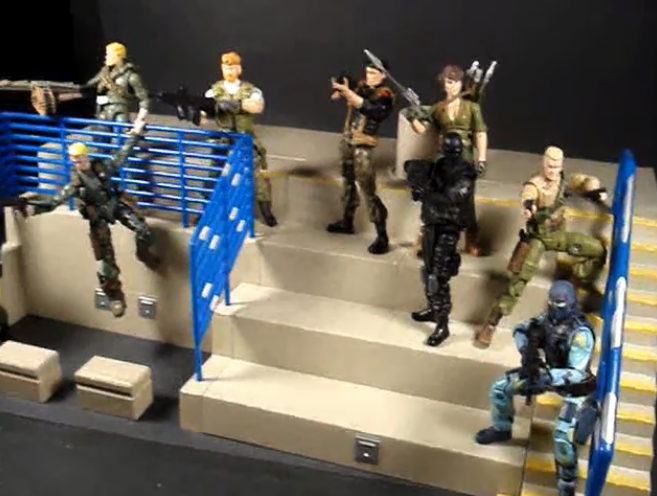
Screengrab from "Tech Deck Rincon" by Actionfigureexpert
Something to consider:
Mahmoud Khalil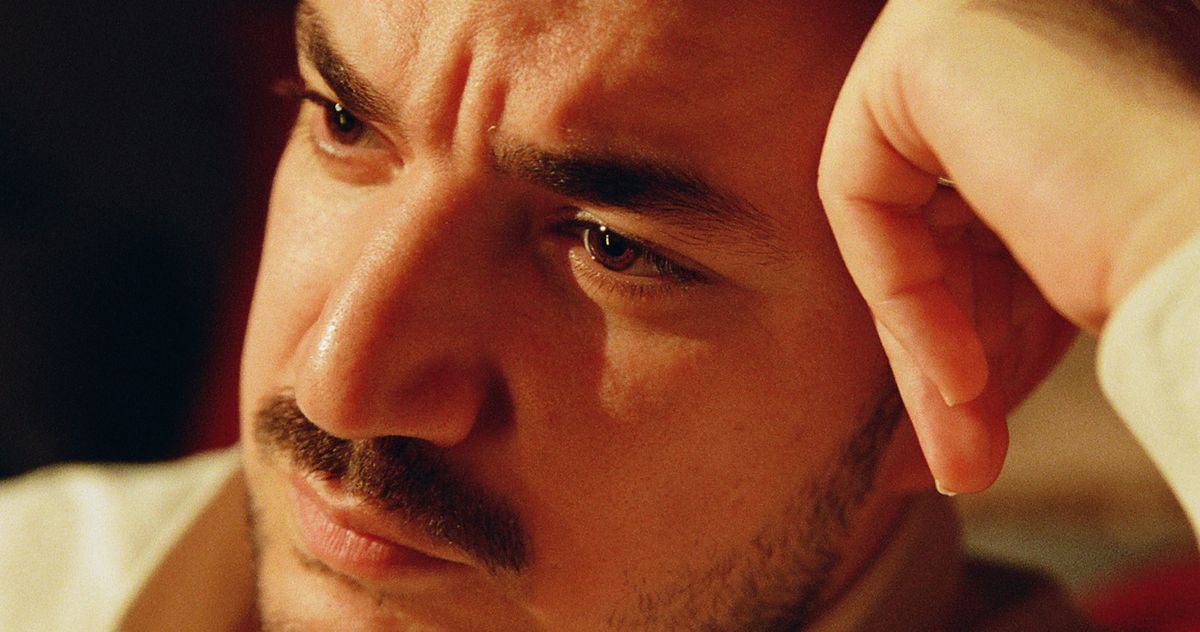
Good thing: 'sletter friend and contributor Mike Munzenrider with another heater for Quartersnacks.
Snack
Bonus QS:
Snack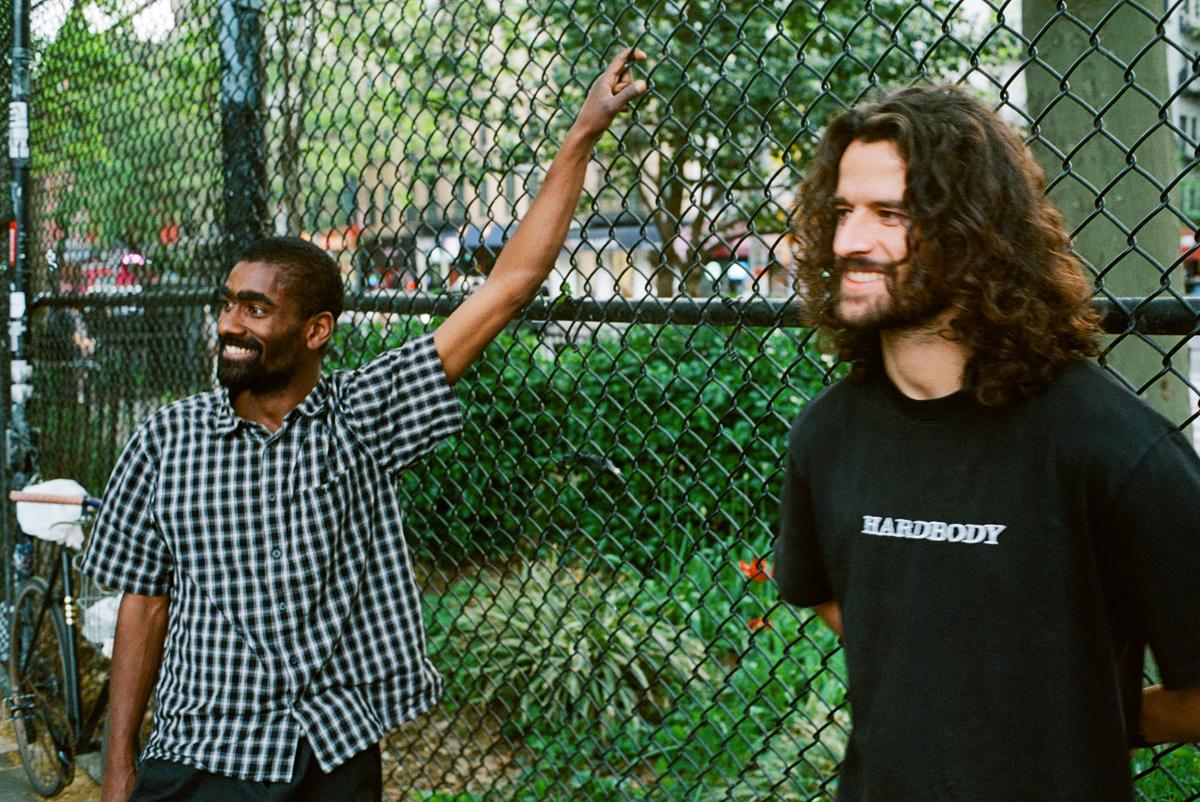
Another good thing:
Noah McManus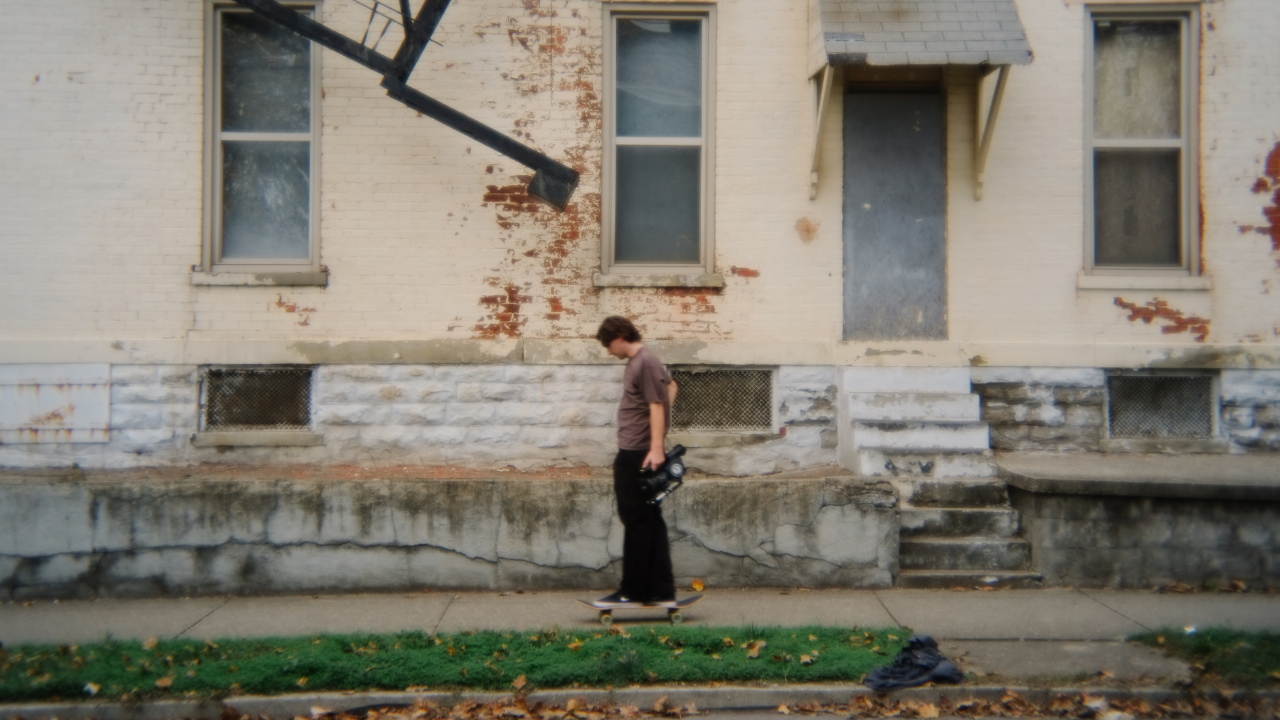
A good Sabini on Kessner thing:
Josh Sabini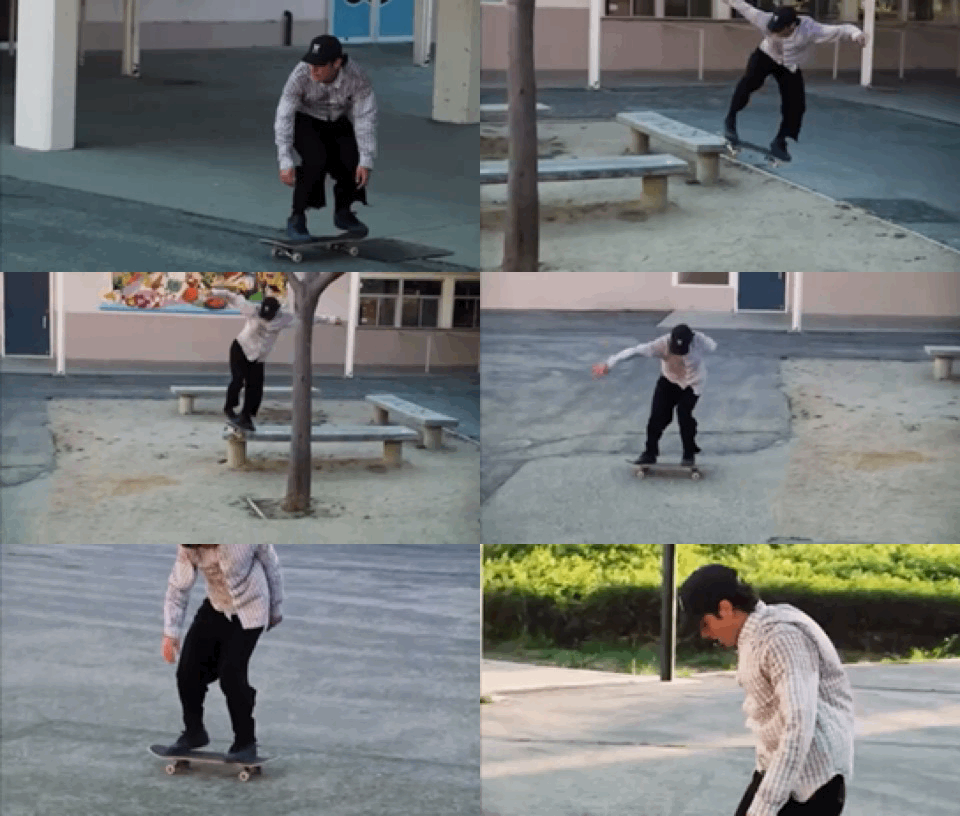
Take a whiff:
Cole Hersey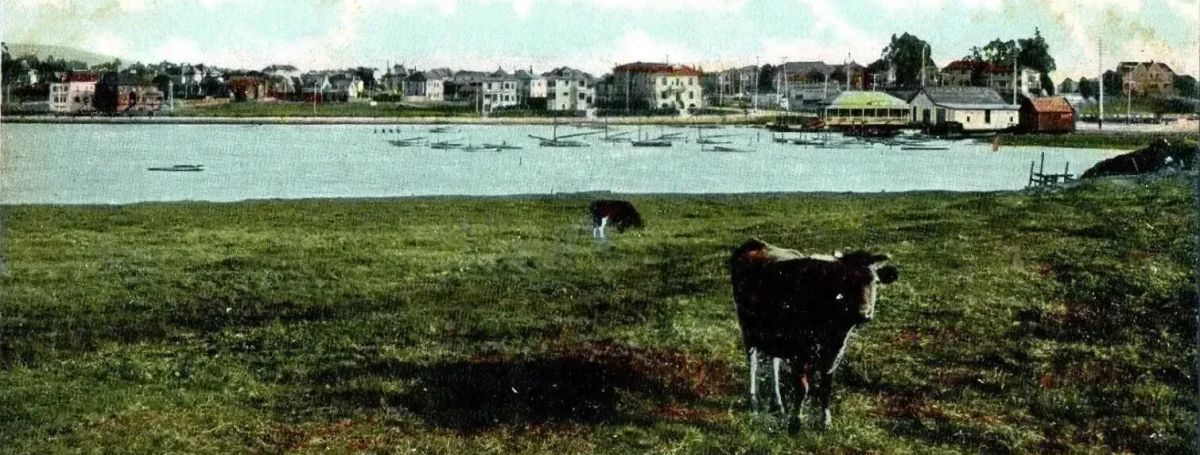
Speaking of a half-century of Southbank:
Marianne Eloise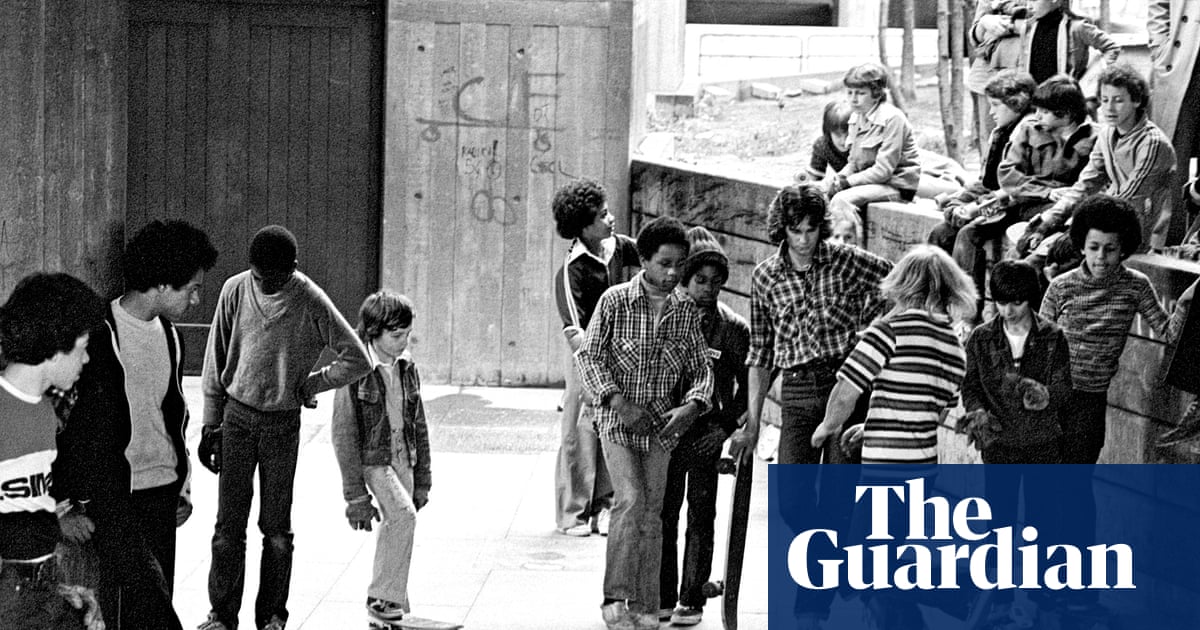
A yeah, that makes sense, thing:
Via the New York Times
Yes, we can do another good thing:
Quinn Slobodian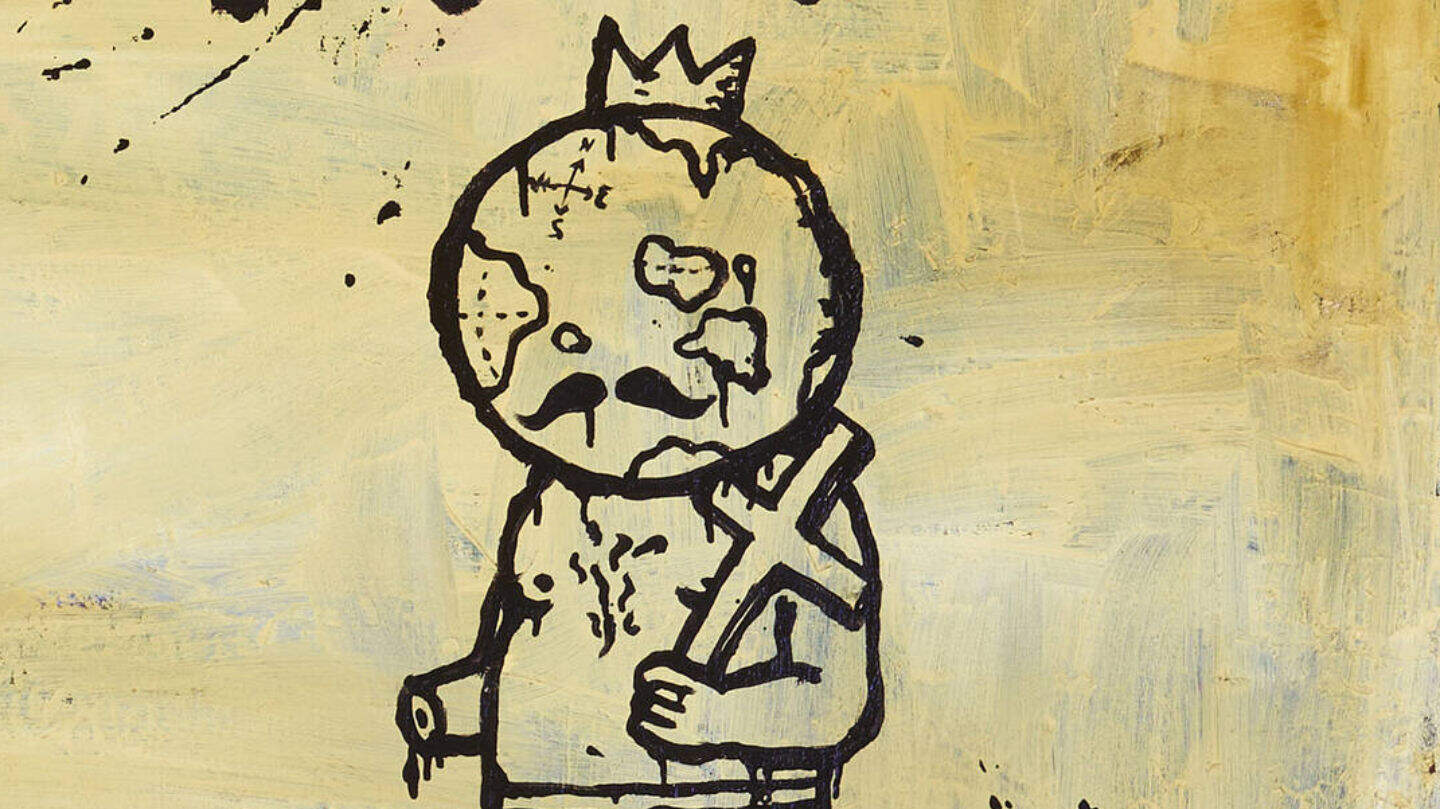
How about one more:
Duby Snacks by Lee Dubin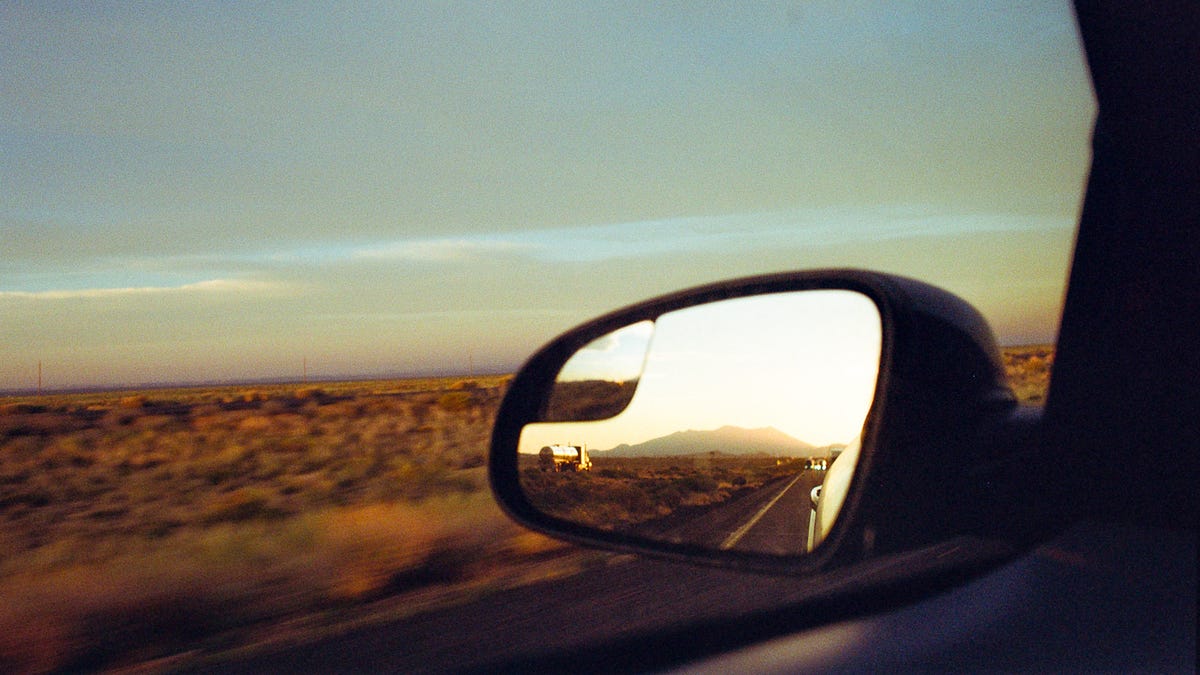
Sage Elsesser on NTS:
NTS Radio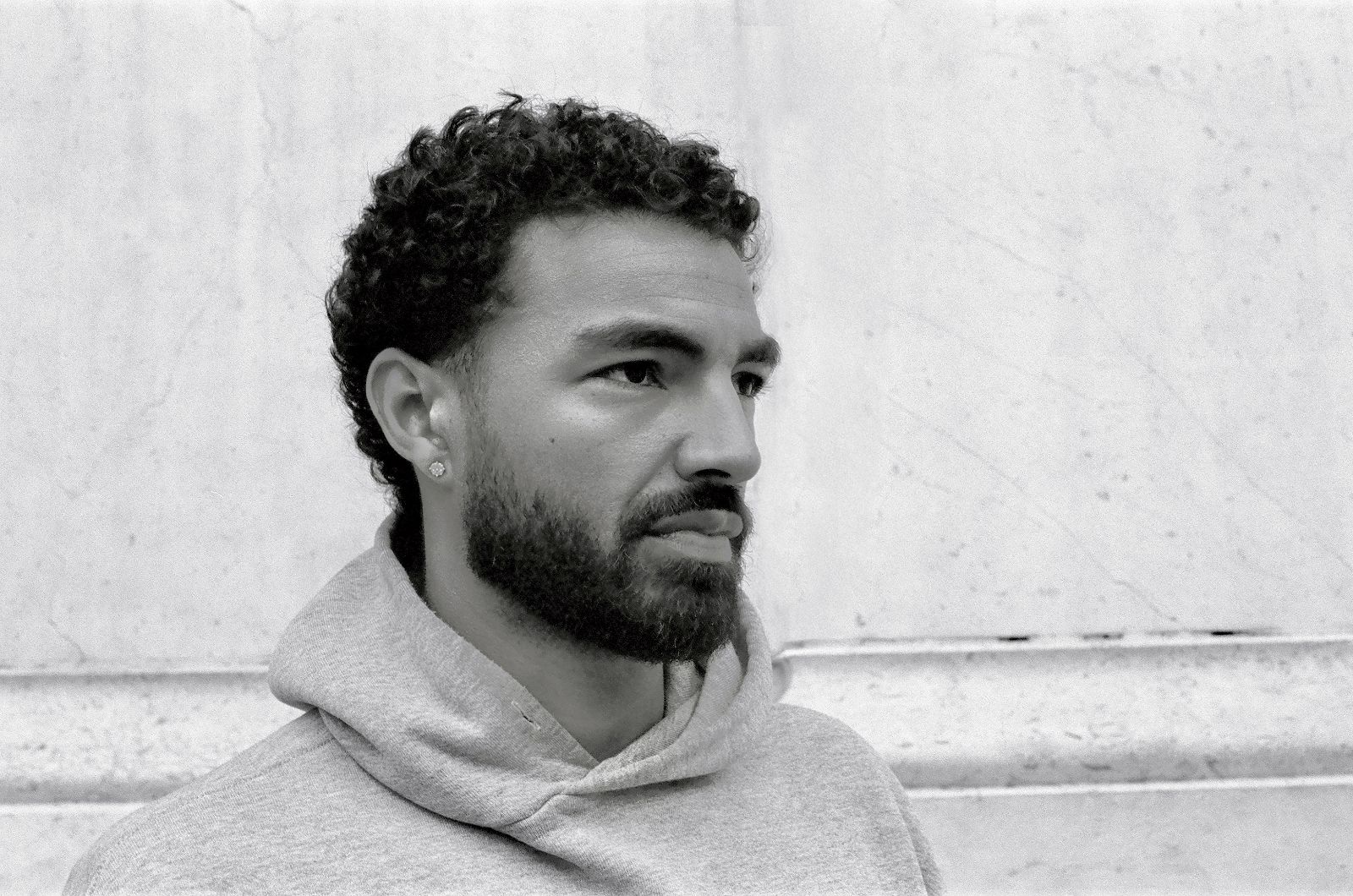
Fast, furious, and so on:
Hua Hsu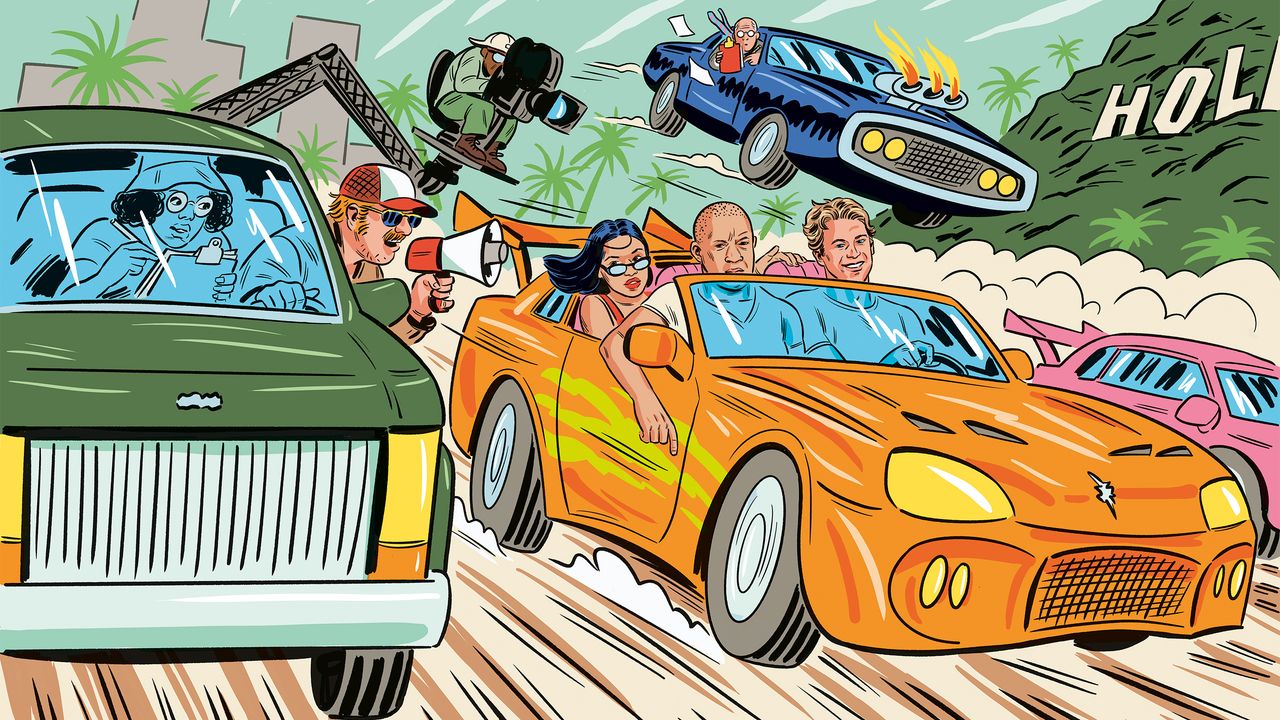
Until next week… if you accidentally disturb a web full of baby spiders and suddenly a small cloud of eight-legged specks descends from above, move out of their way and watch as they race and tumble over one another, figuring out how to be while suspended in air, not at all sure how they got there.


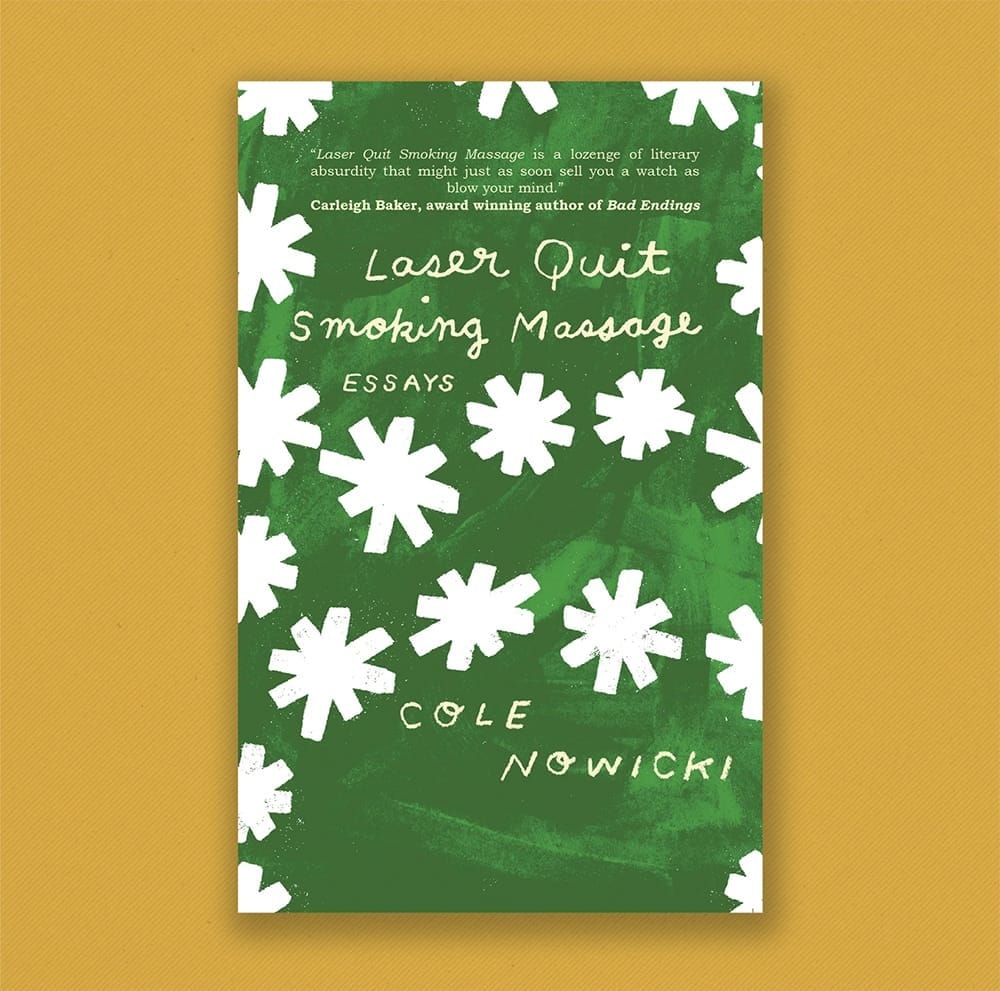
Laser Quit Smoking Massage
NEWEST PRESS
--------------------------------
A collection of essays that I think you might like. The Edmonton Journal called it a "local book set to make a mark in 2024," The CBC said it's "quirky yet insightful" (lol), and it won Trade Non-Fiction Book of the Year at the 2025 Alberta Book Publishing Awards.
Book cover by Hiller Goodspeed.
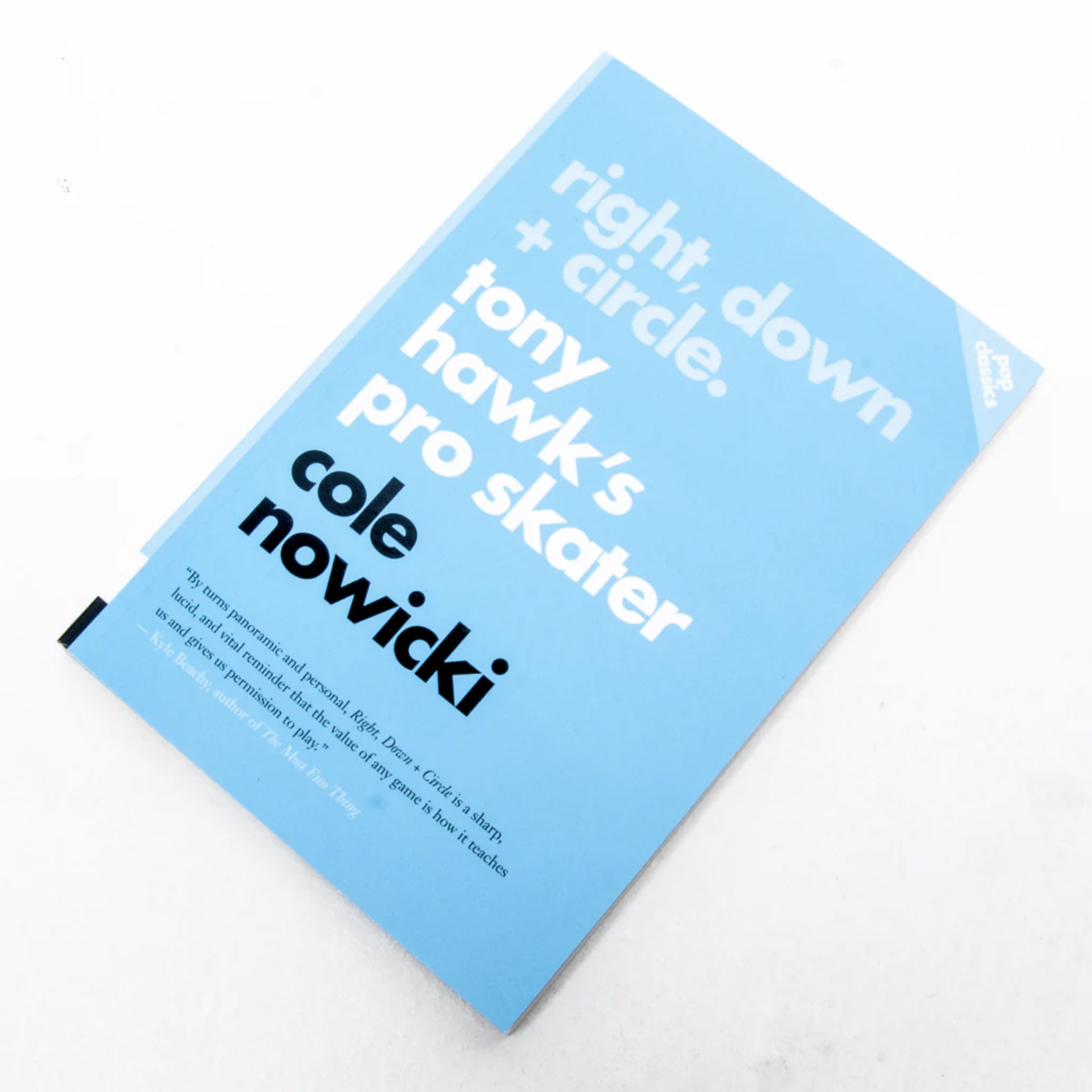
Right, Down + Circle
ECW PRESS
--------------------------------
I wrote a book about the history and cultural impact of Tony Hawk’s Pro Skater that you can find at your local bookshop or order online now. I think you might like this one, too.
Photo via The Palomino.