The State of Skate Studies 2025
Professor Brian Glenney's annual compendium catalogues and analyzes 141 scholarly skateboarding-related books and papers published last year, the trends found between them, and reveals the 2025 SSSOTY.

Purpose and Inquiry
Welcome to the third edition of the State of Skate Studies. For those unfamiliar with what we get up to here, skate studies is an interdisciplinary community of scholars that takes skateboarding seriously. Maybe too seriously. Some analyze it as a culture or lifestyle, others as a sport or leisure activity. Most agree that skateboarding initiates all kinds of novel things, from spatial design and rhythms to technologies and pedagogies, urban activities, and progressive, horizontal social groupings, all on the edge of social norms.
The “State of Skate Studies” aims to bring together as much of that scholarly work as possible into one handy, easy-to-navigate resource, along with some analysis and takeaways from the 2025 studies. Take a scroll through all the publications below and click on a link if a title catches your eye. Really smart people, including you, seem to care a lot about skateboarding.

2025 Overview: Trends
The publication data from 141 scholarly books and papers in 2025 suggests three new trends in how skate scholars are thinking about skateboarding and collectively organizing around it.
- 2025 is the year of the study of skate culture, marking a continued shift away from a “core” study theme of skateboarding’s “spatial appropriation” initiated in 2001 with the publication of Iain Borden’s book, Skateboarding, Space, and the City.
- More than half of the 141 papers written in 2025 are found in edited book volumes (54 papers) and special journal issues (18), collectively organized by various skate scholars, including one edited book entirely in German. (Time to brush up on your Deutsche!)
- 2025 is seeing an increase in anthropological scene reports, such as what skate culture is like in a city in Brazil or Bolivia, or the local history of skateboarding in a country like Uruguay. Many of these are written in local languages, making them difficult to access for English speakers, while also revealing the cultural specificity of such insights. (Google Translate, please.)
These three points suggest that skate scholars are taking seriously the fact that skateboarding is a global culture, i.e. “seriously” global. And global skateboarding benefits from non-Northern and non-Western skateboarding being taken seriously: different cultures skate differently. To see this seriously global study, check that ‘hockey-stick’ increase in skate culture studies of skateboarding in the graph below (purple).
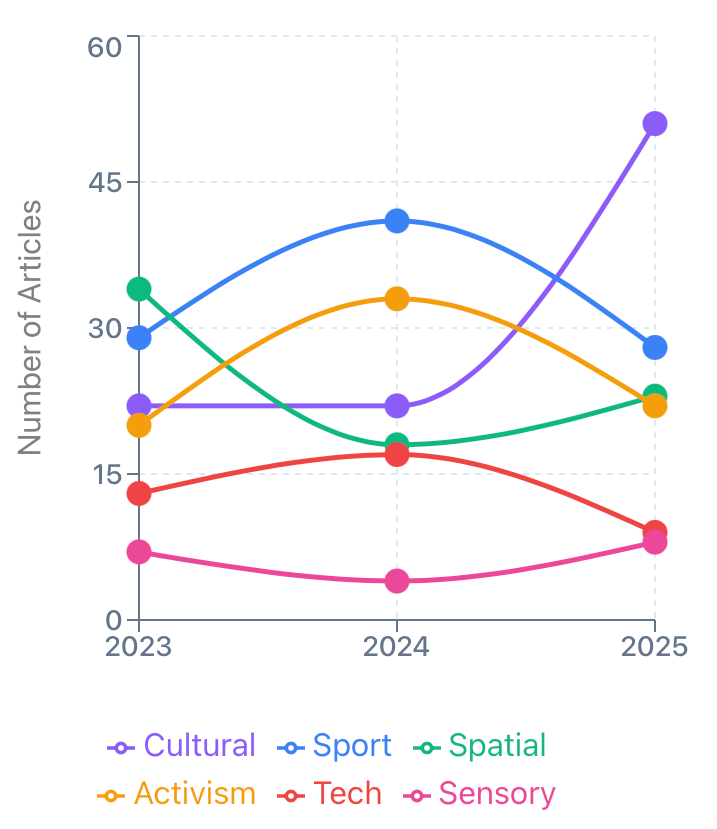
22 articles in 2023 / 22 articles in 2024 / 51 articles in 2025
Sport
29 articles in 2023 / 41 articles in 2024 / 28 articles in 2025
Spatial
34 articles in 2023 / 18 articles in 2024 / 23 articles in 2025
Activism
20 articles in 2023 / 33 articles in 2024 / 22 articles in 2025
Tech
13 articles in 2023 / 17 articles in 2024 / 9 articles in 2025
Sensory
7 articles in 2023 / 4 articles in 2024 / 8 articles in 2025
The Skate Studies Scene: Events
2025 was another robust year for the collective scene of skate scholarship. That includes 15 graduate student theses in skateboarding from around the globe. Some are Bachelor’s and others Master’s degrees, but more than half are PhD Dissertations. Big ups to these new skate scholars! Welcome to the show. Theses are marked below with “*”.
There were also a number of skate conferences, of varying size and focus, in 2025:
Skateboarding in the City (Nottingham, UK, September 25-28)
Stoke Sessions (San Diego, USA, October 9-12)
Connect (Bordeaux, France, October 16-19)
Skateholders Forum (Budějovice/Tábor, Czech Republic, July 2-5)
Civic Space (Plymouth, UK, June 6-7)
Adjacent (Portland, OR, USA, July 25-27)
Vladimir Film Festival (Fažana, Croatia, September 17-22)
While there is not a dedicated publisher or journal for skate scholarship (though there are whispers in San Diego), there were three journal “Special Issues” dedicated to skate studies in 2025 (the first two overlapping with 2024):
Geckle, B., Fang, K., & Saraví, J. R. (2025)
Includes 8 papers in skate studies
The leisure of grey spaces, urban play and the chromatic turn in Leisure Studies
O’Connor, P., Willing, I., Duester, B., & Hölsgens, S. (2025)
Includes 6 papers in skate studies
Special issue on surfing and skateboarding in Sport in Society
Roberts, M. J., & Lawler, K. (2025)
Includes 4 papers in skate studies
In 2025, three edited volumes from academic publishers featured a set of papers by a crew of skate scholars. These authors are usually included by invite only, and, to be honest, getting an invite to a special issue is rare and feels very grand:
Büscher, B., Kilberth, V., & Wäsche, H. (Eds.) (2025)
transcript Verlag. [Google Books link; JSTOR Link with Chapter Descriptions]
Includes 24 German language papers in skate studies (This is a proceedings from the conference “Skating and Smart-Alecking – Academic Perspectives on Skateboarding,” which took place during the 15th annual Sport and Space, commissioned by the German Association for Sport Science in Dortmund, Germany, on 5-7 October, 2023.)
Skateboarding and Philosophy: Essays Concerning the Life of the Grind.
Heter, J., & Simpson, J. T. (Eds.) (2025)
McFarland [Google Books link]
Includes 20 papers in skate studies
Skate/worlds: new pedagogies for skateboarding
Hölsgens, S., & Ong, A. (2025)
University of Groningen Press [book link]
Includes 10 papers in skate studies
Last, but also first, are the skate scholars who basically crushed the year by publishing their own book. There were four monograph books in skate studies for 2025:
Kamper, D. (2025)
U of Nebraska Press [Google Books link]
Insurgent Play: Social Worlds of Urban Disruption
McDuie-Ra, D. (2025)
Anthem Press [Google Books link]
The Skateboard Life: Movers, Shakers, Makers, and Rulebreakers
Williams, N. (2025)
New York: Artisan Workman Publishing Co. [Google Books link]
Girl Gangs, Zines, and Powerslides: A History of Badass Women Skateboarders
Porter, N. (2025)
Toronto: ECW Press [Google Books link]
Skate Studies as Part of Skate Culture
The scholarly study of skateboarding is part of skate culture, at least for the skaters who work in it. What I mean is that for a skater, skate studies takes on a meaning similar to its subject of study. This suggestion has a very specific parallel: the feeling of publishing a scholarly piece on skateboarding is akin to a skater putting out a video part or having a photo in a skate magazine.
That may be a bit obvious, as some scholarly work is also published in popular skate media. (Thanks to Paul O’Connor for pushing me on this point.) Ted Barrow’s This Old Ledge is published by Thrasher, so this scholarly historiography of architectural designs is both a scholarly product (do you put this on your CV, Ted?) and a skate part. This is similar to publishing in Cole Nowicki’s Simple Magic and Farran Golding’s Skate ByLines: skater-produced skate media hosting highbrow poetic, literary, and journalistic readings of skate happenings, written by skaters. Thom Callan-Riley published a piece on skateboarding in The Observer, Willy Staley did the same in the New York Times Magazine, and they both skate. Indigo Willing gets promo’d in Slam, as certainly Quentin Delille’s brilliant podcast Beyond Boards syncs the skate scholars with skate pros as if they do the same thing. With Ryan Lay and Leo Valls putting on the biggest skate culture gatherings ever, it seems there’s no real way to distinguish what it is to do skateboarding and what it is to think and talk about it. It’s all a big ol’ pot of cultural stew, brewing up for anyone hungry.
So, a question for Ryan Lay: is putting on a Slow Impact as meaningful as putting out a part? Maybe let us know in Simple Magic, but you’ll have to tell us if publishing there is also similarly meaningful. Maybe the lines blur so easily because writing, talking, taking photos, filming, editing, building and maintaining spots, and then skating them, are just different ways of doing the same magical thing. Kyle Beachy once said that for him, writing is skating. We know that Kyle is right, but that does not mean we, much less Kyle, know what it means.
While this parallel of felt meanings between putting out writing about skating and putting out skating video parts and clips was mentioned around a decade ago by Gregory Snyder in his 2017 book, Skateboarding LA: Inside Professional Street Skateboarding, it is largely an undiscussed but very potent aspect of skate studies. And it is tempting to push this idealized parallel by listing hierarchies of meaning: a manuscript is like a video part, a published book a signature-model skateboard, the publisher the author’s sponsor who turned them PRO AF.
These parallels are not perfect, but the associated meanings are significant nonetheless; legacies are cemented, popularity refined, and more importantly, scholars feel they have contributed “to the culture” when they publish their work. Skate scholars want to feel like they are part of the skateboarding world, so, like other skaters, they seek to make a living by pursuing their skate lifestyle through academia. A more cynical description might frame the skate scholar’s work as “prestige labour”: rather than building fiscal capital, skate legacy is created and maintained by publishing on skating.
Totalling the number of papers a scholar publishes on skateboarding is a lazy way to rank their efforts, especially since when a paper is published in academia is quite arbitrary, but to see the association of scholars with other scholars who inspire your work feels very fulfilling. The following is a list of skate scholars with two or more publications this year. And yes, Indigo Willing is the 2025 SSSOTY (Skate Scholar Skater Of The Year).
Perhaps the parallel between skate scholarship and skate culture stops at linking “books” with “parts,” but there may be more equivalencies (≈) to ponder and promote in skate studies by skaters that add meaning and momentum to its variegated activities. In conclusion, consider this Jenkem-like “industry skater ≈ skate scholar” top 10.
9. Skate clips ≈ chapters and journal articles
8. Hard slams ≈ desk rejects from editors & journal rejects from “reviewer #2”
7. Politics of going AM/PRO for a brand ≈ politics of getting HIRED/TENURE at a university
6. Skate crews ≈ skate studies collaborators and co-authors
5. Hostile architecture like skate stoppers ≈ paywalls for journal articles and books
4. Getting invited on road trips ≈ getting invited to edited volumes or conferences
3. Battle to land a trick ≈ the revise and resubmit process of a book or article
2. Clips of unlanded tricks ≈ orphaned papers that are never published or presented
1. Road trips with the team ≈ sharing a conference Airbnb with colleagues

The 2025 Report
This report includes an exhaustive list of 141 articles (books, peer-reviewed papers, book chapters, etc.) published in 2025 (slightly down from 144 articles in 2024) that uniquely contribute to skateboarding’s understanding. Scan the list and feel free to email me with any criticism, oversights, and other reactions at bglenney@norwich.edu. As in the 2024 and 2023 reports, I categorize the articles into four genres, with three subgenres, and specify the unique disciplines of scholars in these areas. The genres, subgenres, and disciplines are listed as follows:
(Architecture, Criminal Justice, Ethnography, Geography, Philosophy, Urban Studies): What it means to skate in the city, the (past?) core of skate studies.
1. Senses and Phenomenology: ‘What it is like’ to skate in the city.
II. Cultural Studies
(Anthropology, Economics, Education, Leisure Studies, Religious Studies, Philosophy, Sociology): The lifestyle of skating that is often site-specific and about skateparks.
2. Activism, Inclusion, and Diversity: Progressive elements of skaters’ lifestyles (often discussing aging, disability, gender, orientation, race and community building).
III. Sport, Fitness, and Injury
(Business, Exercise Science, Medicine, Sport Studies, Occupational/Physical Therapy) Institutional developments in skating as athletic pursuit.
3. Sport for Development: Non-profit developments in skating.
IV. Design and Technology
(Computer Science, Engineering) Innovation in skateboarding movement modelling and commodities.
I. Spatial Appropriation and Urban Studies
(Architecture, Criminal Justice, Geography, Sociology, Urban Planning, Urban Studies, Youth Studies)
Skate studies is dominated by discussion of skateboarding’s unique appropriation of space, its effects on the city, and the city’s often hostile response. This area remains the centrepiece of skate studies, with skateboarding being largely defined by its in situ urbanity, even as recreational facilities draw skaters to suburban parks and sport cultures invest in arenas and institutionalizing contests.
(23 articles in 2025 / 18 articles in 2024 / 34 articles in 2023)
Bjorke, I. (2025). Sailing the Concrete Sea. DIY Hand-bound Xerox Zine.
Donaghey, J., & Browne, S. (2025). Skateboarding and contested public space in Portrush, Northern Ireland: exploring tensions between resortification and DIY space-claiming through co-creative methodology. Sport in Society, 28(2), 293-315. [paper link]
Evon, J., & Lacam, J. S. (2025). Le rôle du passeur de frontières dans le management public territorial: Le cas du skateboard de rue bordelais. [The Role of the Boundary Spanner in Territorial Public Management: The Case of Bordeaux Street Skateboarding] Revue française de gestion, 324(5), 131-157. [abstract link]
*Fonda, N. (2025). Skate Integration: Creating Alternative Recreational Spaces on The UMass Amherst Campus. UMass Amherst. [thesis link]
Funke, A. (2025). Über Blumenkübel, U-Bahnschächte und Skateparks: Ein Gruppenvergleich zu Raumvorstellungen von Sportgelegenheiten zwischen Akteur:innen des Street-Skateboarding und der Kommunalpolitik. [On Flower Boxes, Subway Shafts, and Skateparks – A Group Comparison of Spatial Conceptions of Sporting Opportunities between Street Skateboarders and Municipal Politics] In B. Büscher, V. Kilberth, & H. Wäsche (Eds.), Skate and Research – Skateboarding als bewegungskulturelle Praxis und interdisziplinäres Forschungsfeld (1st ed., pp. 137–154). transcript Verlag. [Google Books link]
Giamarino, C. (2025). City of courts: excavating the future in West Los Angeles. Leisure Studies, 1-17. [paper link]
Giamarino, C., & Willing, I. (2025). Planning for subcultures in public spaces: how skateboarding can help to create safe, inclusive and playful cities. In Public Space and the Sustainable Development Goals (pp. 55-67). Edward Elgar Publishing. [abstract link]
*Γιαννακός, Κ. Ι. (2025). Αυτοσχέδιες πρακτικές και δημόσιος χώρος [DIY practices and public space : the case of skateparks] (Doctoral dissertation, Αριστοτέλειο Πανεπιστήμιο Θεσσαλονίκης). [thesis link]
Høyland Tønnesen, T. (2025). Love Malmö: Rethinking Urban Planning through Skateboarding. University of Malmö [thesis link]
Kilberth, V. (2025). Spaces for skateboarding in the city–new spatial concepts beyond skateparks. Frontiers in Sports and Active Living, 6, 1457427. [paper link]
Kyrönviita, M., & Leino, H. (2025). Fulfill the dream: advancing skateboarders’ agency through experimenting and interaction with urban infrastructure. Journal of Urbanism: International Research on Placemaking and Urban Sustainability, 1-20. [paper link]
Langseth, T., & Bergsgard, N. A. (2025). Pavement policies: unraveling the Norwegian ban on skateboarding. Frontiers in Sports and Active Living, 6, 1488825. [paper link]
Lütgerodt, N. (2025). Raum, Regeln, Reibungen: Sozio-räumliche Konflikte im Skatepark zwischen Skater:innen und Scooter-Nutzer:innen: Eine räumliche Fallanalyse. [Space, Rules, Frictions: Socio-Spatial Conflicts in the Skatepark between Skateboarders and Scooter Users – A Spatial Case Analysis] In B. Büscher, V. Kilberth, & H. Wäsche (Eds.), Skate and Research – Skateboarding als bewegungskulturelle Praxis und interdisziplinäres Forschungsfeld (1st ed., pp. 155–166). transcript Verlag. [Google Books link]
Machado, G. M. C., & Romão, M. (2025). In search of picos: street skateboarding in the financial centers of São Paulo city (Brazil). Sport in Society, 28(2), 281-292. [abstract link]
McDuie-Ra, D. (2025). Shredding. In The Social Properties of Concrete (pp. 383-393). Eds. Eli Elinoff and Kali Rubaii. Punctum Books. [paper link]
*Meadley, H. (2025). The Art of Skating Institutions: Incidental Positionality as an Artistic Strategy in Reappropriating Civic Space (Doctoral dissertation, Leeds Beckett University). [thesis link]
*Mayo, J. (2025). Archigestures: Activating Urban Space (Doctoral dissertation, Open Access Te Herenga Waka-Victoria University of Wellington). [thesis link]
Peters, C. (2025). »Playing with Possibilities«: Skateboarding als Spielen mit den Möglichkeitsräumen des Urbanen. [“Playing with Possibilities” – Skateboarding as Playing with the Urban Spaces of Possibility] In B. Büscher, V. Kilberth, & H. Wäsche (Eds.), Skate and Research – Skateboarding als bewegungskulturelle Praxis und interdisziplinäres Forschungsfeld (1st ed., pp. 111–124). transcript Verlag. [Google Books link]
*Poulsen, C. (2025). Finding Harmonious Disorder: Skateboarders and Stewardship of Public Space (Master's thesis, Pratt Institute). [abstract link]
Sims, C. P., O'Brien, D., & Hafenrichter, D. (2025, December). Subcultural Power Among Australian Lifestyle Sports. In ANZALS 2025. [abstract link]
Stenning, A. (2025). Children’s play in grey spaces: Ludic geographies and the chromatic turn. Leisure Studies, 1-15. [paper link]
Türkmen, A. (2025). The Anatomy of Hostile Architecture: A Form-Function-Intent Typology for Urban Furniture and Urban Interior Space. Acta Architectonica et Urbanistica, 1(2), 106-118. [paper link]
Senses and Phenomenology
This subgenre in skate studies puts a sensory spin on skating’s use of the city, suggesting that skateboarders possess uniquely tuned senses that are entrained on ways to experience the city, unlike the ambling pedestrian.
(8 articles in 2025 / 4 articles in 2024 / 7 articles in 2023)
Glenney, B. (2025). The Skater’s Eye, eds. Joshua Heter & Josef Thomas Simpson, Skateboarding and Philosophy: A Brief History of Grind, p. 179–188 Jefferson, NC: McFarland & Co. [Google Books link]
Glenney, B., & Hölsgens, S. (2025). Of skills and tools: Skateboarding as city craft. International Review for the Sociology of Sport, 10126902251360438. [paper link]
*Hasselblatt, C. (2025). Bildteknik inom skateboarding. [Film in Skateboarding.] Arcada University of Applied Sciences [abstract of thesis link in Finish]
Kilberth, V. (2025). Zur Ästhetik des Skateboarding. [On the Aesthetics of Skateboarding] In V. Kilberth, B. Büscher, & H. Wäsche (Eds.), Skate and Research – Skateboarding als bewegungskulturelle Praxis und interdisziplinäres Forschungsfeld (pp. 67–92). transcript Verlag. [Google Books link]
O’Connor, P., Glenney, B., & Boutin, M. (2025). The skater’s ear: a sensuous complexity of skateboarding sound. Sport in Society, 28(2), 332-350. [paper link]
Schweer, S. (2025). Understanding Rough Cuts: Funktion und Notwendigkeit kontextualisierender Formate für Street-Skateboarding. [Understanding Rough Cuts – Function and Necessity of Contextualizing Formats for Street Skateboarding] In B. Büscher, V. Kilberth, & H. Wäsche (Eds.), Skate and Research – Skateboarding als bewegungskulturelle Praxis und interdisziplinäres Forschungsfeld (1st ed., pp. 93–108). transcript Verlag. [Google Books link]
Vieira, G. C., & Nunes, M. F. (2025). Skate é Brinquedo: possibilidades e limitações. [The Skateboard as a Toy: Possibilities and Limitations] Cadernos do Aplicação, 38. [paper link]
Visioli, J., Petiot, O., Prouff, P., & Kermarrec, G. (2025). Resonance and alienation experiences among skateboarders: a study based on the critical incident method. Sport, Ethics and Philosophy, 1-17. [abstract link]
II. Skate Culture Studies
(Anthropology, Economics, Education, Leisure Studies, Religious Studies, Philosophy, Sociology)
Skateboarding is often viewed as a lifestyle with a global following, with local customs often informed by its history of masculine tendencies, gradually shifting toward socially progressive inclusion and diversity across race, gender, orientation, and disability.
(33 articles in 2025 / 22 articles in 2024 / 22 articles in 2023)
Bäckström, Å. (2025). Teaching skateboarding as movement literacy–feel, explore, collaborate, and assess. Edited by Sander Hölsgens and Adelina Ong, 145. [paper link]
Bader, R. (2025). Open-source learning communities for social skateboarding. Edited by Sander Hölsgens and Adelina Ong, Skate/worlds: new pedagogies for skateboarding. University of Groningen Press. [paper link]
Banfi, R. (2025). Skateboards and Motorbikes: Supreme’s Adoption of Akira. The Journal of Anime and Manga Studies, 6(2), 254-286. [paper link]
Barreto, V. M., & Pacífico, M. (2025). Skate, Hip-Hop e a Luta Contra a Homogeneização Da Indústria Cultural. [Skateboarding, Hip-Hop, and the Fight Against the Homogenization of the Cultural Industry] Revista Foco, 18(2), e7856-e7856. [paper link]
Becker, J. (2025). The Serious Beauty of Skateboarding, eds. Joshua Heter & Josef Thomas Simpson, Skateboarding and Philosophy: A Brief History of Grind, (pp. 141–148) Jefferson, NC: McFarland & Co. [Google Books link]
Bock, K. (2025). Inszenierung urbaner Praktiken und szenespezifischer Wissensbestände. Skateboarding im Kurzfilm Belong. [The staging of urban practices and scene-specific knowledge. Skateboarding in the short film Belong.] In Filmische Darstellung von Sport: Ansätze, Perspektiven, Analysen (pp. 85-105). Wiesbaden: Springer Fachmedien Wiesbaden. [abstract link]
Broch, T. B., & Melenteva, M. (2025). Making new sport cultures. In Handbook on Sport and Culture (pp. 51-63). Edward Elgar Publishing. [abstract link]
Buchetti, A. (2025). The ground Zero of a generation. Borders, neoliberalism and sports through the material culture of the skateboard scene in Tijuana. Sport in Society, 28(2), 258-280. [abstract link]
Buchetti, A. (2025). The grey forms of knowledge. Border scraps, secrecy and the reproduction of skateboarding in Tijuana (Mexico). Leisure Studies, 1-17. [abstract link]
*Buchetti, A. (2025). Skatebordering. Produzione globale e consumo locale di una cultura popolare alla frontiera occidentale Messico-USA. [Skateboarding: Global production and local consumption of a popular culture at the Mexico-US western border.] Sapienza University of Rome [thesis link in Italian]
Büscher, B. (2025). Skateboarding: Interdisziplinäre Bestandsaufnahme aus Wissenschaft und Praxis. [Skateboarding – An Interdisciplinary Stocktaking from Research and Practice] In B. Büscher, V. Kilberth, & H. Wäsche (Eds.), Skate and Research – Skateboarding als bewegungskulturelle Praxis und interdisziplinäres Forschungsfeld (pp. 15–30). transcript Verlag. [Google Books link]
Butz, K. (2025). Skateboard Studies zwischen Hermeneutik und Präsenzerfahrung. [Skateboard Studies between Hermeneutics and the Experience of Presence.] In B. Büscher, V. Kilberth, & H. Wäsche (Eds.), Skate and Research – Skateboarding als bewegungskulturelle Praxis und interdisziplinäres Forschungsfeld (pp. 33–46). transcript Verlag [Google Books link]
Cappell, E. (2025). Steve Marcus’ "Yad": Pointing Towards Peace. Humanities and Cultural Studies, 5(1-2), 77-87. [paper link]
Chen, A. N. G., & Xiaoqian, H. U. (2025). “Family Duty, National Prestige”: A Neo-Familialistic Interpretation of Chinese Skateboarders’ Attitudes towards the Inclusion of Skateboarding in the Olympics. Journal of Chengdu Sport University, 51(2), 29-42. [paper link]
Cull, J. M. (2025). Skateboarding Is (in a Sense) a Sport, eds. Joshua Heter & Josef Thomas Simpson, Skateboarding and Philosophy: A Brief History of Grind, (pp. 25–36) Jefferson, NC: McFarland & Co. [Google Books link]
Dahlquist, J. Skateboarding as a school subject: Pros and cons. Edited by Sander Hölsgens and Adelina Ong, Skate/worlds: new pedagogies for skateboarding. University of Groningen Press. [paper link]
Elicker, B. (2025). Skateboarding Is a Crime, eds. Joshua Heter & Josef Thomas Simpson, Skateboarding and Philosophy: A Brief History of Grind, (pp. 46–53) Jefferson, NC: McFarland & Co. [Google Books link]
Fernandes, L. S., & Perin, F. (2025). Pressupostos Para Compreensão Da Manifestação Da Cultura-Corporal Denominada Skate [Assumptions for Understanding the Manifestation of the Body Culture Known as Skateboarding]. Revista Foco, 18(10), e9877-e9877. [paper link]
Friedel, S. (2025). Drop in ride out: Skateboarding in a Gestalt therapeutic setting. Edited by Sander Hölsgens and Adelina Ong, Skate/worlds: new pedagogies for skateboarding. University of Groningen Press, 173. [paper link]
Geckle, B., Fang, K., & Saraví, J. R. (2025). Skateboarding and Society: Intersections, Influences, and Implications. Frontiers in Sports and Active Living, 7, 1649479. [paper link]
Harding, B. (2025). The Risk Is The Reward, eds. Joshua Heter & Josef Thomas Simpson, Skateboarding and Philosophy: A Brief History of Grind, (pp. 121–130) Jefferson, NC: McFarland & Co. [Google Books link]
Heter, J. & Simpson, J. T. (2025). Thinking Is Not a Crime, eds. Joshua Heter & Josef Thomas Simpson, Skateboarding and Philosophy: A Brief History of Grind, (pp. 1–6) Jefferson, NC: McFarland & Co. [Google Books link]
Heter, J. (2025). Skateboarding Is (in a Sense) a Sport, eds. Joshua Heter & Josef Thomas Simpson, Skateboarding and Philosophy: A Brief History of Grind, (pp. 7–114) Jefferson, NC: McFarland & Co. [Google Books link]
Heter, J. (2025). The Problem of the Poseur, eds. Joshua Heter & Josef Thomas Simpson, Skateboarding and Philosophy: A Brief History of Grind, (pp. 37–145) Jefferson, NC: McFarland & Co. [Google Books link]
Heter, J. (2025). Skateboarding Judgments, eds. Joshua Heter & Josef Thomas Simpson, Skateboarding and Philosophy: A Brief History of Grind, (pp. 62–170). Jefferson, NC: McFarland & Co. [Google Books link]
Heter, T. S. (2025). Skate and Destroy Capitalism, eds. Joshua Heter & Josef Thomas Simpson, Skateboarding and Philosophy: A Brief History of Grind, (pp. 131–140) Jefferson, NC: McFarland & Co. [Google Books link]
Hölsgens, S. “We belong here”: Lessons from skateboarding. Edited by Sander Hölsgens and Adelina Ong, Skate/worlds: new pedagogies for skateboarding. University of Groningen Press, 7 [book link]
Hölsgens, S. (2025). What schools can learn from skate culture. [paper link]
Jiménez, W. G. S., What We Talk About When We Talk About Skateboarding Tricks. eds. Joshua Heter & Josef Thomas Simpson, Skateboarding and Philosophy: A Brief History of Grind, (pp. 15–124). Jefferson, NC: McFarland & Co. [Google Books link]
*Jurášek, J. Socializační Potenciál Skateboardingu. [The Socializing Potential of Skateboarding] Univerzita Palackého v Olomouci [thesis link]
Klausing, P., & Rosa, H. (2025). Skateboarding als urbane Praxis gelebter Resonanz. [Skateboarding as an Urban Practice of Lived Resonance] In B. Büscher, V. Kilberth, & H. Wäsche (Eds.), Skate and Research – Skateboarding als bewegungskulturelle Praxis und interdisziplinäres Forschungsfeld (pp. 167–178). transcript Verlag. [Google Books link]
Marsola, M. A., Saura, S. C., & Zimmermann, A. C. (2025). Skateboard: manobras que unem ética e estética. [Skateboarding: Strategies to Unite Ethics and Aesthetics] ATHLETICA-Revista de Filosofia do Desporto, 1, 73-78. [paper link]
Mubirumusoke, M. (2025). Gleaming the Cube or Destroying the World, eds. Joshua Heter & Josef Thomas Simpson, Skateboarding and Philosophy: A Brief History of Grind, (pp. 169–178) Jefferson, NC: McFarland & Co. [Google Books link]
Noe, B. (2025). The ‘dark’ dimensions of grey space in freestyle skateboarding. Leisure Studies, 1-14. [abstract link]
Norman, C. D. (2025). Play Therapy Informed Skateboarding. Journal of Creativity in Mental Health, 20(3), 362-375. [paper link]
Peets, E., Ray, D., Britt, T., Abramson, B., Anderson, I., Cubilla, J., ... & Zen, B. (2025). Collegiate skateboarding in the United States. Frontiers in Sports and Active Living, 7, 1522861.[paper link]
Quintero, H. (2025). The Aesthetics of Skateboarding, eds. Joshua Heter & Josef Thomas Simpson, Skateboarding and Philosophy: A Brief History of Grind, (pp. 54–61) Jefferson, NC: McFarland & Co. [Google Books link]
Reinhart, K. (2025). Kalifornisierung am Eisernen Vorhang: Die Geschichte des Skateboardens in West-Berlin (1970–1990). [Californianization at the Iron Curtain – The History of Skateboarding in West Berlin (1970–1990)] In B. Büscher, V. Kilberth, & H. Wäsche (Eds.), Skate and Research – Skateboarding als bewegungskulturelle Praxis und interdisziplinäres Forschungsfeld (1st ed., pp. 125–136). transcript Verlag. [Google Books link]
Rentmeester, C. (2025). De on Display, eds. Joshua Heter & Josef Thomas Simpson, Skateboarding and Philosophy: A Brief History of Grind, (pp. 73–81) Jefferson, NC: McFarland & Co. [Google Books link]
Regier, M. J. (2025). Kierke-Grinding, eds. Joshua Heter & Josef Thomas Simpson, Skateboarding and Philosophy: A Brief History of Grind, (pp. 82–90) Jefferson, NC: McFarland & Co. [Google Books link]
*Saraví, J. R. (2025). Skate, entre calles y pistas. [Skateboarding: Between Streets and Parks] Bitácora Argentina. [thesis link]
Schäfer, E. V. (2025). Wird Skateboarding ein »normaler« Sport? [Is Skateboarding Becoming a “Normal” Sport?] In B. Büscher, V. Kilberth, & H. Wäsche (Eds.), Skate and Research – Skateboarding als bewegungskulturelle Praxis und interdisziplinäres Forschungsfeld (pp. 47–66). transcript Verlag. [Google Books link]
Simpson, J. T. (2025). Knowing How to Kickflip, eds. Joshua Heter & Josef Thomas Simpson, Skateboarding and Philosophy: A Brief History of Grind, (pp. 161–168) Jefferson, NC: McFarland & Co. [Google Books link]
Sladkarov, M., Zgurovski, К. (2025). From the sidewalk to the podium: the subcultural rebellion of skateboarding in the Olympic transformation. Proceeding book of the 4th International Scientific Congress “Applied Sports Sciences”, 2025, Sofia, Bulgaria. pp. 562 - 568. https://doi.org/10.37393/ICASS2025/87 [paper link]
Sofia, G. (2025). The Journey of the Stoic Skater, eds. Joshua Heter & Josef Thomas Simpson, Skateboarding and Philosophy: A Brief History of Grind, (pp. 91–100) Jefferson, NC: McFarland & Co. [Google Books link]
Stefl, E. (2025). Skating Toward the Good Life, eds. Joshua Heter & Josef Thomas Simpson, Skateboarding and Philosophy: A Brief History of Grind, (pp. 101–110) Jefferson, NC: McFarland & Co. [Google Books link]
Todd, M., & Archer, M. (2025). A different gravitation: acceptance of authentic selves, becoming through doing, and support through connection within a Highland skatepark. Leisure Studies, 1-17. [paper link]
Walker, S. M. (2025). The Sound of One Deck Snapping, eds. Joshua Heter & Josef Thomas Simpson, Skateboarding and Philosophy: A Brief History of Grind, (pp. 111–120). Jefferson, NC: McFarland & Co. [Google Books link]
Willing, I. (2025). Case study 2: Video representations of masculinity in skateboarding. In Subculture in the 21st Century(pp. 181-194). Routledge.
Willing, I., Mestrom, S., Loke, L., & Odlum, N. Skate and collaborate: Carving spaces to create and educate through sociology, performance and interaction design, and public art. Edited by Sander Hölsgens and Adelina Ong, Skate/worlds: new pedagogies for skateboarding. University of Groningen Press. 121. [paper link]
*Yucra Mercado, L. B. (2025). Skate y polleras. Análisis de la representación y recepción fotográfica del colectivo Imilla Skate [Skateboarding and skirts: An analysis of the photographic representation and reception of the Imilla Skate collective.] Quito, EC: Universidad Andina Simón Bolívar, Sede Ecuador. [thesis link]
Activism, Inclusion, and Diversity
Progressive, inclusive social and political values for non-traditional skateboarders have become a significant cultural marker of skateboarding, particularly in contrast to its hegemonic masculine origins. This subgenre of Cultural Studies research is of particular importance in skateboarding’s social achievements.
(22 articles in 2025 / 33 articles in 2024 / 20 articles in 2023)
Almoghayer, M. O. (2025). Fashion and Flips. Chapter 7. In On the Pleasures of Living in Gaza: Remembering A Way of Life Now Destroyed, (pp. 101–110). OR Books. https://doi.org/10.2307/jj.29895257.10 [Google Books link]
Bucklew, C., & Kamper, D. (2025). Origin Stories of “Radical”: The Dogtown Imaginary and Inheritors of the Z-Boy Revolution. In L. Heberling, D. Kamper, & J. Ponting (Eds.), Waves of Belonging: Indigeneity, Race, and Gender in the Surfing Lineup (pp. 159–184). University of Washington Press. [Google Books link]
Černický, R. (2025). Straight Guys Doing Crooked Grinds: Über sexistische Stereotypen in Bewegtbild-Skatemedien. [Straight Guys Doing Crooked Grinds – On Sexist Stereotypes in Moving-Image Skate Media] In B. Büscher, V. Kilberth, & H. Wäsche (Eds.), Skate and Research – Skateboarding als bewegungskulturelle Praxis und interdisziplinäres Forschungsfeld (1st ed., pp. 191–206). transcript Verlag. [Google Books link]
*Chinnapong, V. (2025). Grinding Against the Norm: Student-Skaters and Skateboarding as Queer Resistance San Diego State University [thesis link]
Crawford, M. (2025). Complicating the Sk8rgrl: asymmetrical visibility of feminisms in Olympic skateboarding. Feminist Media Studies, 1-17. [abstract link]
Dean, N. A., & Bundon, A. (2025). From mobility aid to leisure pursuit: exploring the meaning of disabled people’s participation in skateboarding and wheelchair motocross. Leisure Studies, 1-19. [paper link]
Galvão, L. O. (2025). Young Women’s Right to the City: Collective Action within Skateboarding and Surfing Communities. In B. McShane & M. Whelan (Eds.), Youth, Transitions and Social Justice: Researching Spaces of Social Action (1st, First Edition ed., pp. 70–88). Bristol University Press. https://doi.org/10.2307/jj.26193010.10 [Google Books link]
Geckle, B. (2025). Symbolic sovereignty and the decolonizing and indigenizing potentials of skateboarding. Emerging Media, 3(1), 23-37. [paper link]
Geling, K. (2025). Potenziale von DIY-Skate-Räumen aus feministischer Perspektive. [Potentials of DIY Skate Spaces from a Feminist Perspective] In B. Büscher, V. Kilberth, & H. Wäsche (Eds.), Skate and Research – Skateboarding als bewegungskulturelle Praxis und interdisziplinäres Forschungsfeld (1st ed., pp. 207–218). transcript Verlag. [Google Books link]
Gil, A., & Forsyth, J. Staying outside: Pedagogy, resistance, and diy peer support amongst nyc skate crews. Edited by Sander Hölsgens and Adelina Ong, Skate/worlds: new pedagogies for skateboarding. University of Groningen Press. 95. [paper link]
Glenney, B., & Dubois, P. (2025). Skateparks, pollution, and decolonisation. Leisure Studies, 1-15. [paper link]
Kamper, D. (2025). Rezballers and Skate Elders. U of Nebraska Press. [Google Books link]
Kamper, D., & Williams, N. (2025). Skateboarders of color and the (co-) emergence of the DIY ethos in skateboarding. Sport in Society, 28(2), 316-331. [abstract link]
Lebuser, D. (2025). Inklusion im Skateboarding: Teilhabe von Menschen mit Behinderung bei Skate-Programmen und der Planung von inklusiven Skateparks sowie deren Auswirkungen. In B. Büscher, V. Kilberth, & H. Wäsche (Eds.), Skate and Research – Skateboarding [Inclusion in Skateboarding – Participation of People with Disabilities in Skate Programs and the Planning of Inclusive Skateparks and Their Effects] als bewegungskulturelle Praxis und interdisziplinäres Forschungsfeld (1st ed., pp. 181–190). transcript Verlag. [Google Books link]
Lyons, J. (2025). Girlhood, performance and risk: Learning to skateboard in a war zone (if you’re a girl) and the action sports documentary. Studies in Documentary Film, 19(1), 1-15. [paper link]
Mena Calderón, M. A., & Rodríguez Rodríguez, O. D. (2025). Realización de un documental expositivo acerca de la falta de difusión del skate femenino en Guayaquil (Doctoral dissertation, ESPOL. FADCOM). [paper link]
Ong, A. Unlearning motherhood through skateboarding with a baby (in a stroller). Edited by Sander Hölsgens and Adelina Ong, 197. [paper link]
Romero, N., & Miles, D. Anticolonial skate pedagogy: Skateboarding as decolonising education. Edited by Sander Hölsgens and Adelina Ong, Skate/worlds: new pedagogies for skateboarding. University of Groningen Press. 217. [paper link]
Ruberg, B. (2025). Building Worlds through Graphical Depth: The Queer Dimensionality of 2.5D in OlliOlli World. In How to Queer the World: Radical Worldbuilding through Video Games (pp. 141–169). NYU Press. [abstract link]
Sayers, E. (2025). Learning for life: Skateboarding, public pedagogy and belonging. Edited by Sander Hölsgens and Adelina Ong, Skate/worlds: new pedagogies for skateboarding. University of Groningen Press, 73. [paper link]
Vintiadis, E. (2025). The Girls Are Shredding It, eds. Joshua Heter & Josef Thomas Simpson, Skateboarding and Philosophy: A Brief History of Grind, (pp. 149–160) Jefferson, NC: McFarland & Co. [Google Books link]
III. Sport, Fitness, and Injury
(Business, Exercise Science, Medicine, Sport Studies, Occupational/Physical Therapy)
Skateboarding’s athleticism, training regimes, and related pro-social aspects are lately being observed and supported by more institutionalized programs, including educational and “sport for development.”
(28 articles in 2025 / 41 articles in 2024 / 29 articles in 2023)
Chen, A. N. G., & Xiaoqian, H. U. (2025). “Family Duty, National Prestige”: A Neo-Familialistic Interpretation of Chinese Skateboarders’ Attitudes towards the Inclusion of Skateboarding in the Olympics. Journal of Chengdu Sport University, 51(2), 29-42. [paper link in Chinese]
Christ, T., Krick, A., Bohn, C., & Boström, K. J. (2025). Skateboarding in der Psychotherapie: Einsatzmöglichkeiten und Grenzen: Das Forschungsprojekt »Skaten statt Ritalin«. [Skateboarding in Psychotherapy: Possible Uses and Limits – The Research Project “Skating Instead of Ritalin”] In B. Büscher, V. Kilberth, & H. Wäsche (Eds.), Skate and Research – Skateboarding als bewegungskulturelle Praxis und interdisziplinäres Forschungsfeld (1st ed., pp. 249–264). transcript Verlag. [Google Books link]
Cross, R. (2025). Physics of the Ollie jump using a skateboard. Physics Education, 60(4), 043003. [paper link]
Diewald, S. N., Noth, N., Mancini, N., Neville, J., Cronin, J., & Cross, M. R. (2025). Development and Reliability of a Street Skateboarding Notational Analysis Framework and Application. Applied Sciences, 15(9), 5011. [paper link]
Diewald, S. N., Thorpe, R. T., Martinez, A., Neville, J., Cronin, J. B., & Cross, M. R. (2025). Exploring perceptions of success in Olympic competitive and amateur street and park skateboarding and implications for training. International Journal of Sports Science & Coaching, 1747954125133389 [paper link]
Diewald, S., Mancini, N., Thorp, S., Neville, J., Cronin, J., & Cross, M. (2025). Send it? Performance Indicators of the Tokyo 2020 Olympic Street Skateboarding Highlight the Importance of Balancing Risk for Competitive Success. [preprint paper link]
Diewald, S., Mancini, N., Noth, N., Neville, J., Cronin, J., & Cross, M. Skateboarding’s Olympic Debut: A Comparative Analysis Describing the Men’s and Women’s Street Competition. [paper link]
Fouillot, C., Saulière, G., Antero, J., Sedeaud, A., & Toussaint, J. F. (2025). Skateboarding’s Olympic journey: do the performance profiles of top athletes remain consistent?. Frontiers in Physiology, 16, 1548442. [paper link]
Gould, B. (2025). The impact of professionalization and structured coaching programmes in skateboarding and freestyle BMX: A socio-cultural analysis. In Teaching and Coaching Lifestyle Sports: Research and Practice. edited by Thomas M. Leeder, Lee C. Beaumont. New York: Routledge. [abstract link]
Grätz, F., Jodes, P., & Noth, N. (2025). Überprüfung der Leistungsgrundlagen im kompetitiven Skateboarding: Entwicklung einer Leistungsstrukturanalyse. [Review of Performance Foundations in Competitive Skateboarding – Development of a Performance-Structure Analysis] In B. Büscher, V. Kilberth, & H. Wäsche (Eds.), Skate and Research – Skateboarding als bewegungskulturelle Praxis und interdisziplinäres Forschungsfeld (1st ed., pp. 293–302). transcript Verlag. [Google Books link]
Helmich, I. (2025). Gesundheitliche Aspekte des Skateboarding: Schwerpunkt Kopfverletzungen. [Health Aspects of Skateboarding – Focus on Head Injuries] In B. Büscher, V. Kilberth, & H. Wäsche (Eds.), Skate and Research – Skateboarding als bewegungskulturelle Praxis und interdisziplinäres Forschungsfeld (1st ed., pp. 265–276). transcript Verlag. [Google Books link]
Hochgürtel, J. (2025). Einflussfaktoren auf die individuelle Risikobereitschaft im Skateboarding. [Factors Influencing Individual Risk-Taking in Skateboarding] In B. Büscher, V. Kilberth, & H. Wäsche (Eds.), Skate and Research – Skateboarding als bewegungskulturelle Praxis und interdisziplinäres Forschungsfeld (1st ed., pp. 239–248). transcript Verlag. [Google Books link]
Hoveidaei, A., Mosalamiaghili, S., Keshtkar, A., Suresh, S., Adolf, J., & Conway, J. (2025). Orthopaedic Fractures in Skateboard, Scooter, and E-Scooter Injuries: A nationwide study in the US (2010–2022). Injury, 56(7), 112361. [abstract link]
*Kollén, J. (2025). Studie om fysiska och psykiska upplevelsers inverkan av skateboard: En kvalitativ studie. Luleå University of Technology [thesis link]
Küsgens, O. (2025). Skate Coach: Ein praxisorientiertes Lehrkonzept. [Skate Coach – A Practice-Oriented Teaching Concept] In B. Büscher, V. Kilberth, & H. Wäsche (Eds.), Skate and Research – Skateboarding als bewegungskulturelle Praxis und interdisziplinäres Forschungsfeld (1st ed., pp. 325–338). transcript Verlag. [Google Books link]
Lee, E., & Tak, M. (2025). From Back Streets to Olympic Stage: The Development of Breaking and Skateboarding in South Korea. The International Journal of the History of Sport, 42(1), 62-82. [paper link]
Musa, R. M., Ab Rasid, A. M., Samsudin, C. N. C., & Majeed, A. P. A. (2025). Maschinelles Lernen im. Künstliche Intelligenz und maschinelles Lernen in der Sportwissenschaft, 247. [Google Books link]
Noth, N., & Schönburg, S. (2025). Welche Lernstrategien sind im Skateboarding bedeutsam? [Which Learning Strategies Are Significant in Skateboarding?] In B. Büscher, V. Kilberth, & H. Wäsche (Eds.), Skate and Research – Skateboarding als bewegungskulturelle Praxis und interdisziplinäres Forschungsfeld (1st ed., pp. 303–310). transcript Verlag. [Google Books link]
Nowodworski, P., Homölle, P., & Kortmann, P. (2025). Miteinander im Gegeneinander: Kompetenzerwerb im Skateboarding am Beispiel Game of S.K.A.T.E. [Together in Opposition – Competence Acquisition in Skateboarding Using the Example of the Game of S.K.A.T.E.] In B. Büscher, V. Kilberth, & H. Wäsche (Eds.), Skate and Research – Skateboarding als bewegungskulturelle Praxis und interdisziplinäres Forschungsfeld (1st ed., pp. 313–324). transcript Verlag. [Google Books link]
Schairer, L., Crumbach, A., & Flasch-Coura, K. (2025). Skateboarding und Leistungssport. [Skateboarding and Competitive Sport] In B. Büscher, V. Kilberth, & H. Wäsche (Eds.), Skate and Research – Skateboarding als bewegungskulturelle Praxis und interdisziplinäres Forschungsfeld (1st ed., pp. 279–292). transcript Verlag. [Google Books link]
Willing, I. (2025). Book Review of Action sports and the Olympic games: past, present, future, by Belinda Wheaton and Holly Thorpe, London, Routledge, 2023, 326 pp., 67.10 (paperback), 227.20 (hardback), ISBN 9781032128320. [partial book review link]
Yang, M., Guo, Y., & Zhao, K. (2026). Effects of Sprint Interval Training on Brain Fatigue Resistance in Competitive Skateboarders: Evidence from EEG, HRV, and VAS Measures. Life, 16(1), 25. https://doi.org/10.3390/life16010025 [paper link]
Sport for Development
An offshoot of sport institutionalized programs that have an educational and socialization focus rather than an athletic one.
*Castaño Velásquez, M., & Regino Uribe, J. (2025). Medallo Skate: la cultura del skateboarding como símbolo de identidad y territorialidad en Medellín en 2025. [Medallo Skate: the skateboarding culture as a symbol of identity and territoriality in Medellín in 2025] Corporación Universitaria Minuto de Dios – UNIMINUTO, Colombia [thesis link]
Lima, G. C., & Starepravo, F. A. (2025). Estratégias para o desenvolvimento do skate: um estudo das políticas públicas no estado do Paraná. [Strategies for the development of skateboarding: a study of public policies in the state of Paraná.] Revista da ALESDE, 17(1), 133-147. [paper link]
Ogbozor, E., Farnsworth, S., Martin, J., Welch, A., Wojton, J., & Lopez, K. (2025). Everyday Skating, Conflict, and Peacebuilding at Embry-Riddle Aeronautical University. Transportation Research Interdisciplinary Perspectives, 31, 101481. [partial paper link]
da Silva, J. C. C., Oliveira Souza, M. T., & Capraro, A. M. (2025). From California to Brazil: The History of Skateboarding in Curitiba, Paraná (1975–1999). The International Journal of the History of Sport, 42(3), 325-346. [paper link]
IV. Design and Technology
(Computer Science, Education, Engineering, Math, Medicine, Physics)
As with other sports and recreation activities, there’s a burgeoning literature on novel technologies that aid athleticism, injury prevention, and pedagogies for skateboarding.
(9 articles in 2025 / 17 articles in 2024 / 13 articles in 2023)
Bei, Z., Chen, X., Zhou, G., Wang, X., Zhao, W., & Hou, K. (2025). Mutual calibration estimation of dynamic states and static parameters for skateboard chassis vehicle. ISA transactions. [abstract link]
*Christensson, B. (2025). Från avfall till identitet: Hur Deckstool använder storytelling för att lyfta upcycling. [From waste to identity: How Deckstool uses storytelling to elevate upcycling.] Uppsala University [thesis link]
Li, T. (2025, February). Skateboarding in 4 Dimensions: Exploring Quaternions Systems Using Computer Simulations. In Proceedings of the 56th ACM Technical Symposium on Computer Science Education V. 2 (pp. 1735-1735). [paper link]
Liu, H., Teng, S., Liu, B., Zhang, W., & Ghaffari, M. (2025). Discrete-time hybrid automata learning: Legged locomotion meets skateboarding. arXiv preprint arXiv:2503.01842. [paper link]
Lundgren, B. (2025). Hobbes' Ship of Theseus: On the Limits of Surviving a Gradual Replacement of Parts. Theoria, e70013. [paper link]
Musa, R. M., Rasid, A. M. A., Samsudin, C. N. C., Majeed, A. P. A., & Abdullah, M. R. (2025). Maschinelles Lernen im Hochleistungs-Skateboarding. [Machine Learning in High-Performance Skateboarding] In Künstliche Intelligenz und maschinelles Lernen in der Sportwissenschaft (pp. 247-257). Berlin, Heidelberg: Springer Berlin Heidelberg. [abstract link]
de Petris, L., & Khatibi, S. (2025). Organizing Relational Complexity—Design of Interactive Complex Systems. Multimodal Technologies and Interaction, 9(8), 81. [paper link]
Schuchter, T., Till, M., Stetter, R., & Rudolph, S. (2025). Digital Integrated Design and Assembly Planning Processes for Sports Vehicles Using the Example of a Skateboard. Vehicles, 7(1), 22. [paper link]