Being there
Kyle Beachy on being there, Good Medicine, and the branching paths of 1,800 skateboards on the Navajo Nation.

1.
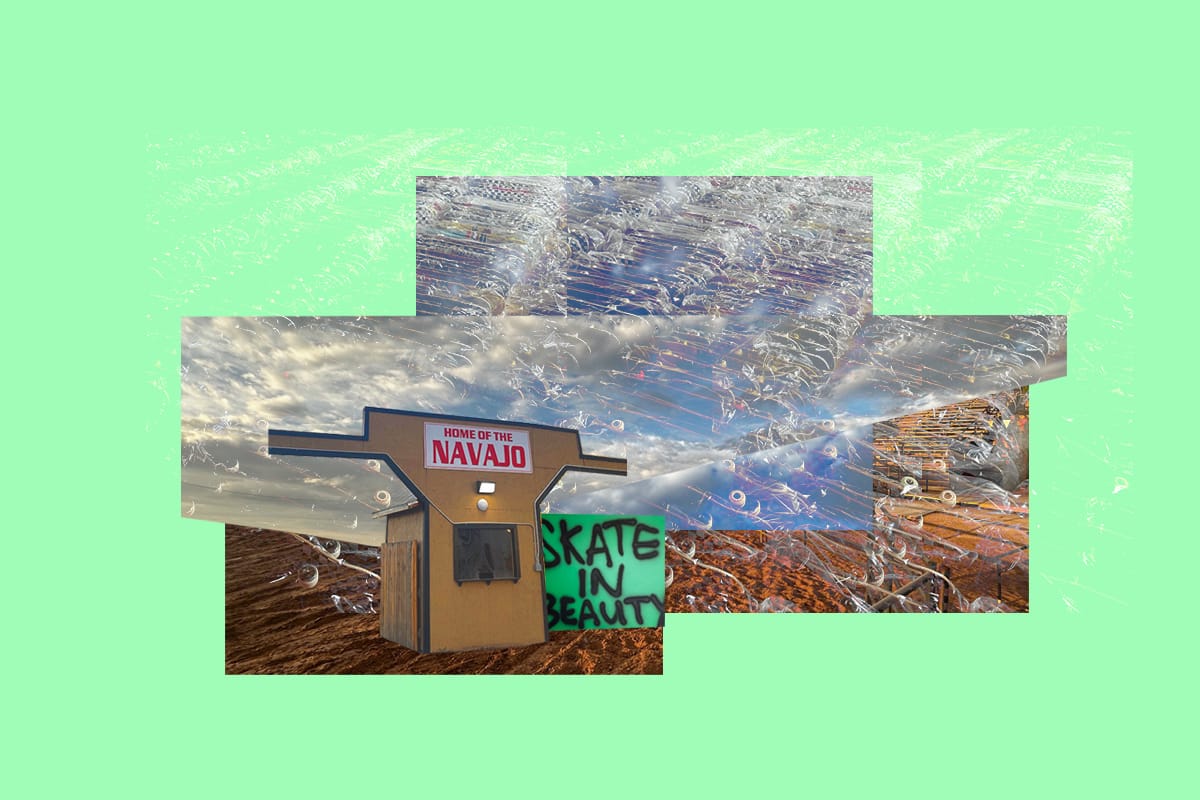
First, you should know that the modern borders of the Navajo Nation encompass over 17 million acres, or 24,000 square miles, an area larger than ten individual US states. I say “you” and mean all of us.
Second, it will interest you/us that the current president of the Navajo Nation, Buu Van Nygren, is a skater. He was born on Christmas Day 1986, and when I saw him in person, he was wearing the outfit he’s known for — a bright blue suit and broad, flat-brimmed black hat accented by an eagle’s feather. His long hair was bunned into a tsiiyéél. Two thick cords of a bead necklace hung in the place of a tie, and there was much silver and turquoise along with a single pair of midtop brogues. Like all successful politicians, Buu Van Nygren functions as a kind of eye magnet, shaking hands and posing and doing a standstill ollie on a borrowed board.
I watched him roll across a strip of the warehouse or hall where we were gathered, dust rising from his wheels. He hopped off, shrugging, and then someone appeared with a tool to loosen the board’s trucks. More photos, more posing, then he was back on the board filming a nollie 180, which took him five tries.
And yes, okay, of all the facts it would benefit us to know about the Navajo Nation — current employment and health data, the prevailing dearth of basic infrastructure that most of us take for granted, the basic history of The Long Walk and uranium mining and other violences the Dinè have withstood in the face of a duplicitous and malicious and genocidal United States government — Nygren’s background as a skater isn’t exactly paramount. But if you’re someone who believes in skateboarding’s ability to empower young people, to improve healths physical and mental, particularly among those who are trapped in cycles of socioeconomic struggle with extremely limited resources? Then Buu Nygren getting his clip on a borrowed board starts to matter in new ways.
In the midst of the fray that morning, I overheard one person say of the president, “He’s pretty much full of shit.” Which is almost certainly true. That’s the flipside of charisma. But he is a skater. I know because I was there to see it.
2.
One day in August, staring dumbly into the flat death of my handheld screen, my thumb was stopped by a hardpost from Jacob Rosenberg. It was Mike Carroll’s fiftieth birthday and here was archival b-roll video and a caption:
This was the norm. Trying more than making. And I don’t mean that critically. I just mean that when you film, it’s about being there and doing the reps together. At least that’s how I remember it. Happy Birthday Mikey. I am grateful I was there. Love you buddy.
Well, some nostalgias never cease. But after that initial bump, I found myself settling on this notion of “being there.” Two years after moving to New Mexico following two full decades in Chicago, I was thinking fairly constantly about where I was, where I am, and what kind of being I’m currently up to, living in a place where there’s not a skate spot within twenty miles.
But I do not mean FOMO. FOMO is sitting in a bar in Crown Heights and worrying you’re supposed to be at some other bar in Greenpoint. I mean a larger and more encompassing longing for what I spent twenty years learning, the city and people and skateboarding in Chicago, complicated by this young and pretty much ignorant happiness at where I am now. I mean the joy of being here, even if I’m not at all sure how to do it.
If you’d have asked me ten years ago about “Southwest culture,” I’d have chuckled about Kokopelli and images of coyotes howling at moons. I understood nothing. Before moving here, I didn’t understand that New Mexico had trees, much less entire mountainsides swathed in towering ponderosa pines and dense forests of aspens that in autumn put on a show to rival the northeast. For the bulk of my life “desert” has meant a single thing, broad and brown and endlessly open, by which I mean empty.
And not by accident, this notional emptiness. Listen to Sean J Patrick Carney’s exceptional and terrifying Time Zero podcast and you’ll learn of the many ways that “emptiness” was cultivated by “centuries of colonial flattening of the geographically and culturally diverse Southwest into a generic mono-desert." It was there as early as John O’Sullivan claiming a “manifest destiny to overspread” a vast and empty frontier that was just waiting for Europeans to claim it. And it continued through the world-altering Trinity nuclear test of 1945 and over 100 additional atmospheric tests (and 828 underground tests) in Nevada and New Mexico. All regions where people did, as a matter of fact, live, and thus suffered and died due to the radiation fallout of these tests. It continues through the ensuing and ongoing boom in uranium mining across this definitely not empty, deeply misunderstood portion of the United States, particularly inside the borders of the Navajo Nation.
There are people, forces, and systems invested in having us believe that places rich with life are, in fact, devoid of it. Author Traci Brynne Voyles has named these efforts “wastelanding.”
3.
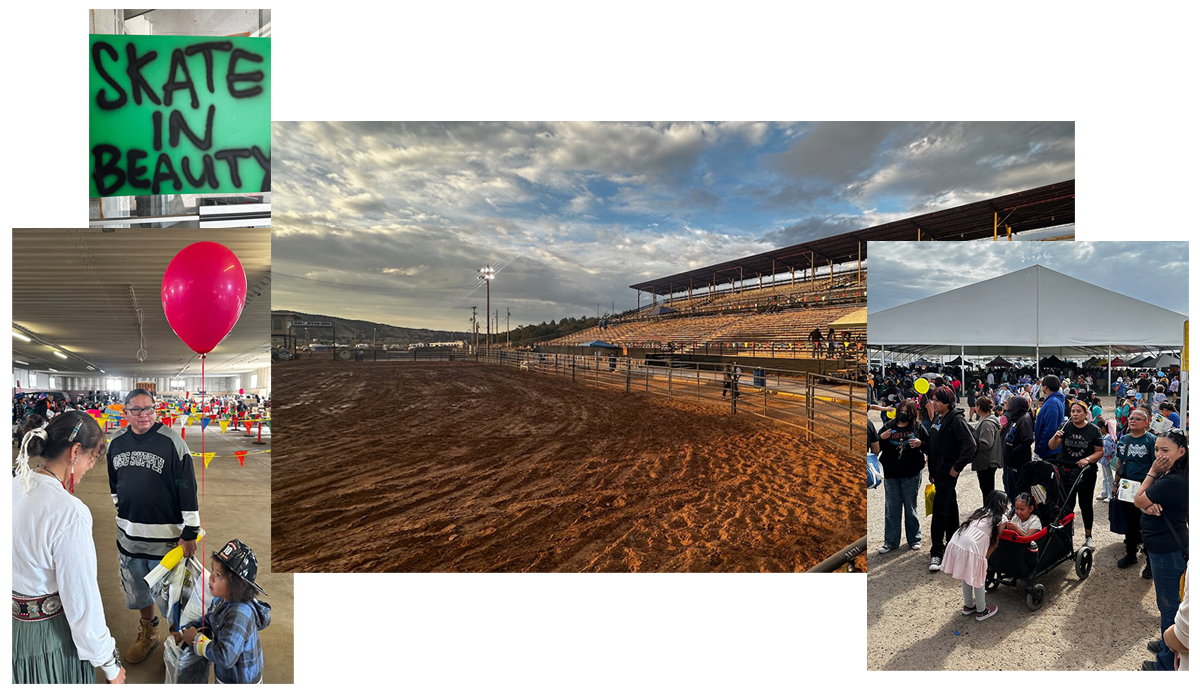
The annual Navajo Nation Fair at Window Rock runs for a full week in September. The packed schedule features a mix of your standard rodeo and ag-fest events — team roping, 4-H livestock sales — along with a frybread contest, multiple pow wows, and many other distinctly Indigenous activities.
On the Wednesday of this year’s fair, Amy Denet Deal had organized one of the Good Medicine events that centre skateboarding outreach in a broader project of resource building and allocation among Indigenous populations. Amy is the founder of 4Kinship, a sustainable fashion brand and creative collective currently based in Santa Fe. She is as inspiring and philanthropically ambitious and flat-out fucking cool an individual as I have personally ever looked in the eyes, the sort of person around whom better futures seem not only possible but inevitable.
So, on a Tuesday morning, I climbed into my two-year-old truck and headed south toward Albuquerque, where I turned west. Past the city, you crest a hill and find yourself seeing forever, a distance unmentionable, more miles and distinct layers between me and the horizon than I could estimate. It is a kind of constantly re-upped wonder, how much depth this region reveals. You don’t experience such depth in cities, of course. Nor in the endless and convex plains of the American Midwest. Or in the Rockies, for that matter. The effect is a striking coherence and continuity of place that — with apologies to a long lineage of Southwestern authors and painters who have laboured to describe New Mexico — I can only compare to playing a contemporary open-world video game, like the new Zeldas.
But I can say that the desert throbs colours, that the colours and light are constantly changing. Soon, I came upon rolling fields of jagged black rock, the lava flow of the malpais, and horses just, like, hanging out. Hawks are constantly circling overhead. And then some very real verticality and horizontality, strange lines to encounter in nature. To the north, I saw the darkness of weather gathering above towering red walls lined by plumes of deep green juniper. By the time I hit Gallup, the clouds were dense and textured and forboding.
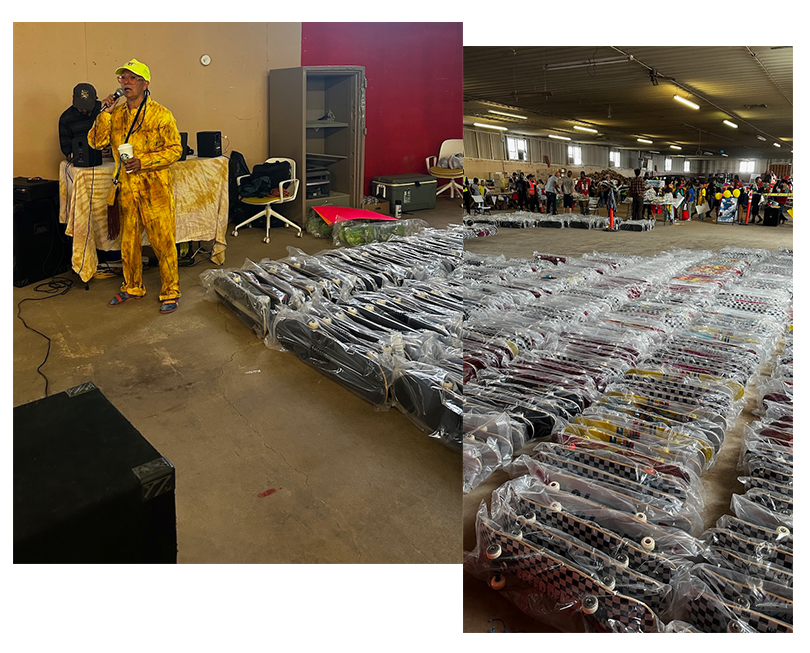
A message popped up on my screen welcoming me to Arizona. The roadside sign for the Arizona border didn’t appear for another ten minutes. A harsh confusion of winds raised dust as I drove into the fairgrounds, parked, and found a dusty convention hall busy with volunteers and forklifts. And filling about a quarter of the massive space, like some unlikely body of water, were 1,800 complete skateboards, all in plastic bags and standing on their sides. More skateboards, and by far, than I have ever seen in one place.
4.
Or maybe two places. How to understand these nations within a nation? Federally recognized tribes like the Navajo are officially sovereign, but there are real limits to that sovereignty. The relationship, as Maurice “Mo” Crandall explained to me, has been defined by the United States Supreme Court and centuries of federal Indian policy as that of a ward to a parent.
I went to Mo because he’s a citizen of the Yavapai-Apache Nation of Camp Verde, Arizona, and also because I trust him not to ridicule me for knowing so little of the basic facts of the place where I live.
“We don’t own our land,” said Mo. “They’re trust lands. You can’t own land on a rez. You don’t pay property tax. We don’t hold any titles. The federal government holds it all in trust.”
He also told me that more citizens of these nations live off the rez than live on. That could be due to resources on some reservations being so severely limited. Many Diné live without electricity and plumbing. There is only spotty wireless internet. And there is exactly one skate park to be found on the 24,000 square miles of the Navajo Nation, the Two Grey Hills Skatepark, which was conceived of and made real thanks in large part to Amy Denet Deal.
5.
My god, the logistics of large-scale social actions can boggle the mind. Here, all those skateboards. Over there, 7,000 boxes of Native shoes that volunteers have opened to make sure the shoes match and are the proper size. I watched the same boxes of toothbrushes get relocated three times. I stood among head-high stacks of diapers and backpacks and school supplies while a squad of friendly young people in day-glo vests scurried about like diligent insects.
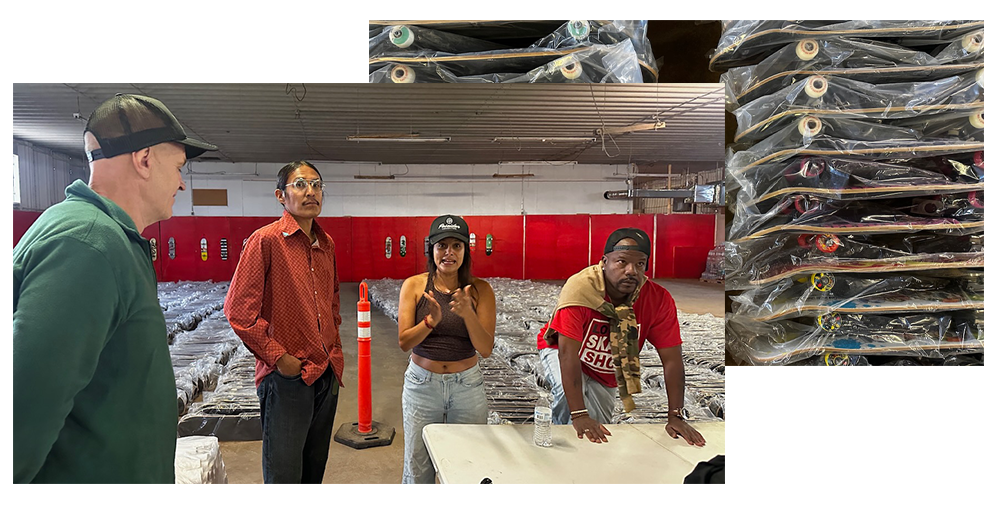
These were volunteers from Sean Penn’s Community Organized Relief Effort (CORE) organization. Micaela Ramirez of the Poseidon Foundation was there, along with skate industry mainstay, former pro at Schmitt Stix and New Deal, co-founder of Underworld Element and 411 — I mean holy shit, go read the guy’s Wiki — Steve Douglas, who has arrived with the Make Life Skate Life crew. What appeared just this side of mayhem when I arrived Tuesday afternoon is, by Wednesday morning, a totally workable operation I’m a little shocked to be part of. A squad of volunteers are staffing the various tables and you can feel things settling into gear.
In a quiet moment, Amy tells me, “The first thing the kids are going to ask you is, can I keep it?”
Soon we circle up and are led in a blessing by the actor and activist Loren Anthony, who runs a program called Chizh For Cheii to provide free firewood for high-risk elders.
“We are a maternal people,” he says. “We all have origins and songs of where we came from. You are here as guests, but you’re putting in the work, so you become part of us too. Creator, we ask that you give us much fun today. Much joy.”
Moments before the doors open, an elder with deep lines in her face and dangling earrings takes me by the crook of my arm and tells me that skateboarding is key to breaking the cycle of diabetes in the young ones. Then the children come flowing into the hall.
We have two plastic tables for distributing our product, which are all what I’d call off-brand completes: Heart Supply and Speed Demon, Verb and KFD and, somehow, Ocean Pacific. And I can feel my little opinion factory whirring away, the same little pocket of neural goo that sees old Carroll footage and goes, Yes, more, please heap this by spoonfuls into all of my holes. But there’s too much here for it to really get going. Here, my hardwired senses of cool and core and the rusty steel beams that gird my skateboard comprehension feel ludicrous, wrong, and just wildly beside the point.
Two Diné skaters, Shawnshine Harrison and Di'orr Greenwood, engage in serious crowd work around the first table, while Steve Douglas, smile very broad and head cleanly shaved, serves as the eager face of table two. Most of us devote our efforts to running laps, hunching over to pinch two or three plastic board bags into each hand and lugging them from the great oceanic puddle toward the tables.
I watch kids receive the boards. Many of the young ones are too small for the board they are given, so they end up clutching or hugging the skateboard. Embracing it. Most of them give the thing a quick look and then turn as bashful to it as they are to us.
Di’orr insists that they say ahéhee'.
I steal a chance to step around the table and hand a few over myself. In the thick of it, as the line cycles and does not cease, it can be easy to slip into gender essentialism. Pink to girls. Devils and demons to boys. Checkers to everyone. At some point, Nestor Judkins arrives and joins in. The day goes on and on, the line endless, the hall rippling with life and conversation, giving and receiving, the space itself living, the massive hall a creature and all of us the heart and blood pumping through it.
At 12:53 pm, four hours after opening the doors, we hand out the final board. We are caked in dust, our hands clawed by the labour. My back is wrecked. I sense that somewhere along the way my relationship to skateboarding has been permanently changed.
6.
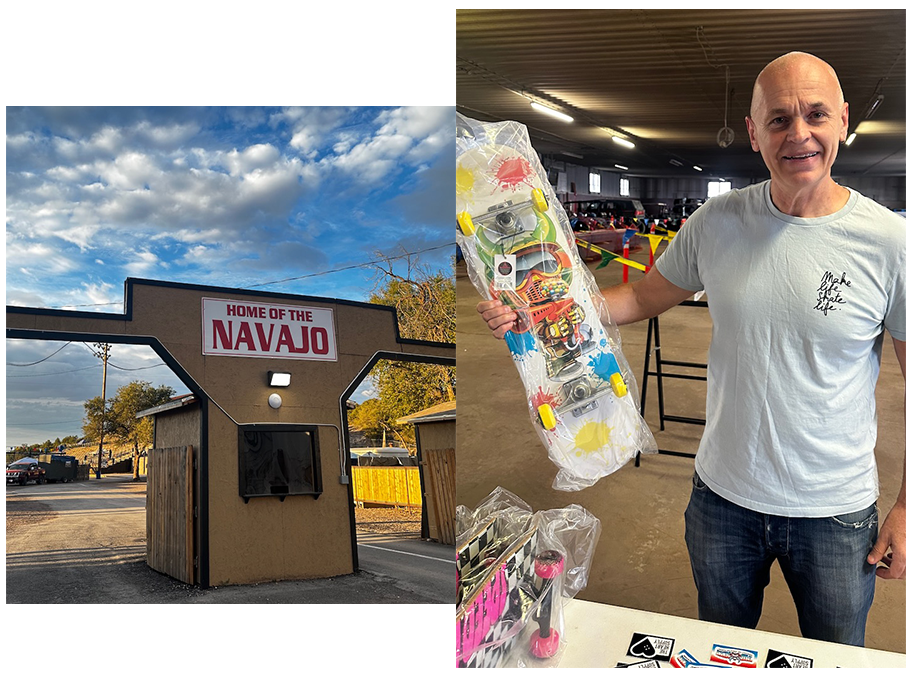
Not long after the doors opened, Steve Douglas had gotten up to something. Steve is a big, energetic bald man with a kind of statesman’s air about him, and the hale, fit look we’ve come to expect from today’s fifty-something businessmen. When I look over, he’s come up with a plan to tweak the two-table system so that the second table, his table, would offer a chance for the kids to swap the board they were given for a different one.
Friends, I did not like this plan. It gummed up a system that had to work quickly. It also said, this event on the Navajo Nation is something I, a skate industry titan, wish to personalize and make my own. I grumbled, put my head down, and focused on being there.
“Get a skateboard, you own a skateboard. You know? But you’re not a skateboarder.”
Talking to Steve Douglas, I learned, is fun as hell. He is a believer to the core. Amy Denet Deal calls him her “skate uncle,” and as I understand it, he’s largely responsible for the spread of affordably made complete skateboards made with North China Birch rather than Canadian Maple.
“It was Chet Thomas who told me, if you use resin glue, Chinese birch will be stronger than Canadian maple with water-based glue,” he says. “Anyway, no kid needs seven-ply maple.”
Steve has been selling pre-made completes since joining Dwindle in the middle-aughts. He speaks of a come-to-god moment when he realized that his own son had an easier time turning on Blind trucks with soft bushings than on Indies. Since then, Steve’s driving passion seems to be creating new skateboarders.
“COVID was a once-in-a-lifetime chance,” he says. “We’ll never have it again. Every team sport is shut down, people are all at home, but we blew it. They bought a lot of boards and now they’re all sitting in their garage right next to a scooter. Right next to a hockey stick. That’s because we didn’t convert them into being skateboarders.”
The theory of the second table, I come to understand, is to activate the first of what might be an avalanche of desires. More than give a kid a skateboard, Steve’s plan was to give each kid a chance to desire a specific board and then have it.
Steve believes every complete should come with a tool. First, so the child or a parent can adjust the trucks, which arrive with a factory setting far too tight for a child’s body. When he says this, I actually cough at the obviousness of it. How many kids know which size wrench fits a kingpin and have access to that wrench? How many even understand that the kingpin is basically a dial to control their entire skate experience?
And beyond being able to, you know, turn, to have a tool is to understand that a skateboard isn’t just a thing to stand on, but to customize. Which is to say personalize, which is to say listen and respond to just as it listens and responds to their own bodies. Because whatever else it is, a skateboard is first and foremost a thing with which we form a relationship.
“Every complete should come with a hang tag, with a QR code, that shows the basics, shows carving, shows how to adjust the trucks.”
Provoked even gently, Steve Douglas will talk. About boards with EVA foam instead of griptape. About the car crash that ended his career. About the “incomplete,” a box that contains a full set of wheels, bearings, trucks, board, grip, and hardware, along with instructions. All assembly required. About the YMCA skate camp in San Luis Obispo, way back when, sharing a room with Jesse Martinez, and how Jovantae and Mike Carroll were there. He talks and I think of the Jacob Rosenberg post and what it was like for me to watch videos of Carroll back then, a kid in Missouri forming my own relationship to a skateboard. How badly I wished I could be there at Embarco, Carroll being my actual north star of desire and cool. So I ask Steve, does it bother him that pre-made completes are completely, 100% uncool?
“Yeah, right. I mean, there’s a reason Polar doesn’t make completes. We’re not trying to be cool. Who cares?”
7.
It takes no effort whatsoever to understand why Americans tend not to think about the realities of tribal life in our country. It is far easier and much less painful to treat the blank spaces on our screen’s maps as empty than it is to confront even the entry-level truths of the slow, relentless violence of colonialism and what it’s meant for native Americans. Easier to put terms like “environmental racism” between ourselves and the specific cruelties and sufferings the term defines. Navajo miners being told nothing of the deadly risks of their labour, sent into uranium mines without any protective gear. Statistically wild rates of tuberculosis, silicosis, fibrosis, and birth defects. Abandoned mines leaving contaminated water and unguarded, unlabeled toxic waste behind. Decade upon decade of extractive wealth created for everyone but the people who live on the very soil that is being plundered.
In Time Zero, Sean J Patrick Carney describes the American Southwest as the most nuked place on planet earth. A nuclear “test” is another word for detonating a bomb. “Wholly aware that radioactive fallout was deadly,” he says, “the government only set off the bombs if the winds were blowing to the north or to the east… to avoid sending fallout over larger population areas like Las Vegas, Phoenix, Los Angeles, or San Diego.” And send it instead toward people who the Atomic Energy Commission described at the time as a “low-use segment of the population.”
I was invited to this summer’s Good Medicine Youth Day on the Navajo Nation as a guest to help with distributing pricepoint skateboards. And, though this was not made explicit, to write about being there. Between my home and Window Rock, I drove across parts of the Kewa, San Felipe, Santa Ana, Laguna, and Acoma pueblos. There are 574 federally recognized American Indian and Alaska Native tribal nations inside the current borders of the United States. You’ve got to zoom in on the maps to find them, and their names are often pale or ash-colored typefaces, while American cities are labelled in bright, vivid whites.
A big mark against Buu Nygren, President of the Navajo Nation, is his coziness with Donald Trump and eagerness to open up coal mining across his territory. For jobs. Economic growth. When I wrote to his comms team to ask if Nygren has a stance on future uranium mining on the Navajo Nation, I got passed around, forwarded, and received no answer. Already, a dozen trucks a day are moving uranium ore on roads through Navajo land.
There are, of course, many more things that skateboarding cannot change than those it can. But I am convinced, mightily so, that Amy Denet Deal is right. Shawnshine Harrison and D’iorr Greenwood and Steve Douglas are right. To form a relationship with a skateboard – which begins by having access to a skateboard – is to begin down a path that will, if followed long enough, branch in all manners of unknowable ways.
For instance, I would like you to come see this vast, brown, unlabeled region of our map. Come and be here, a place with skate spots unlike anywhere else on earth. We’ll meet in Albuquerque and tour the endless network of ditches, absorb the lore from elders, and learn of the ways that people here managed water in the days before these concrete culverts. It will not take long to recognize the extent of the great lies that are at play here and places like here, starting with that first one, that cunning and bloody fiction at the heart of so much American power. They would like you to believe these places are empty. They are not.