A world where things matter
Digging up, resurrecting, and celebrating the history of forgotten skateparks.

GLASGOW
Nearly half a century ago, a hand was planted in Glasgow’s Kelvingrove Park. It lies somewhere between the Cyprus Duck Pond, Stewart Memorial Fountain, and River Kelvin, which cuts across the park in the shape of a swollen elbow. All of these years later, nothing has broken through the rock and soil. However, if you know where to aim your shovel and push your heel into its footstep, you might uncover the exact spot where a young David Murray used to throw up inverts, the outline of his fingers and thumb spraypainted onto the lip of a long-buried concrete bowl.
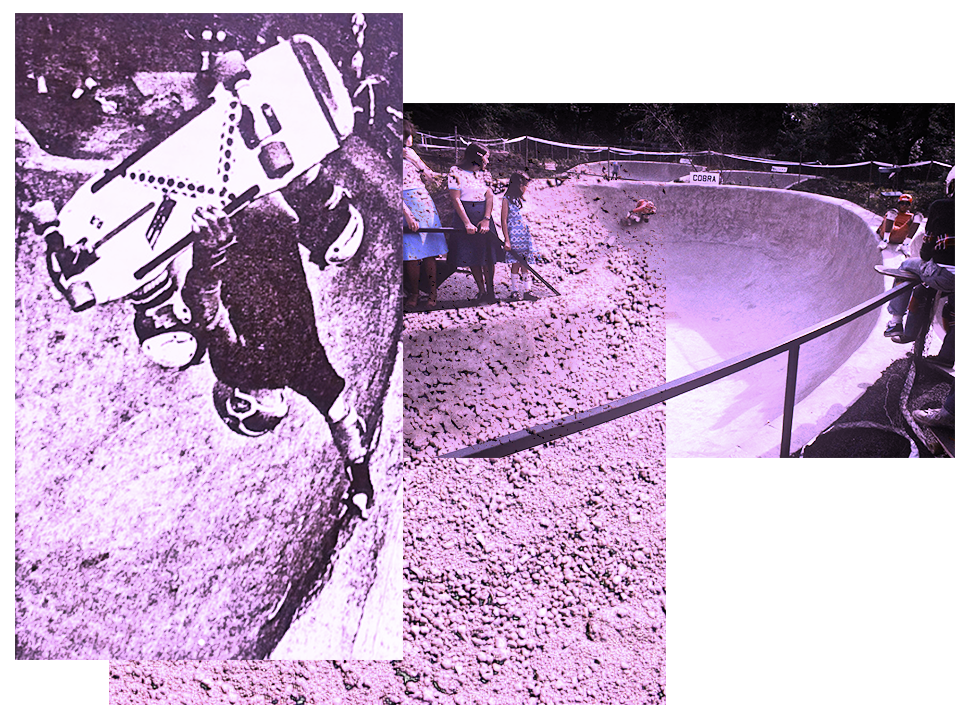
That structure was part of Scotland’s first-ever skatepark, Kelvin Wheelies, known to locals as “the KG.” Designed by Richard Wrigley in 1977, construction finished in the spring of ‘78 for a cost of £100,000. Jamie Blair, owner of Glasgow’s Clan Skates and a longtime fixture of the Scottish skateboarding landscape, was a park regular in his youth and described it in detail for North Skate Mag.
Utilizing the natural slope of the hill, the skatepark attempted to replicate most of the features that were expected for that era: Halfpipe (with no flat bottom), Cloverbowl, head-to-head Slalom Run, and a Snake Run. The freestyle area used an already existing 1950s-era concrete dance floor roller rink, which was probably one of the main reasons that this area of the park was chosen.
A product of its day, including named features like the Cobra, Jaws, Bazooka, and Torpedo Bowls, KG existed on the surface for a mere five years. By 1983, as the BBC later explained, “concern about maintenance costs and safety” prompted the city to fill the skatepark with dirt, rocks, trash, and chunks of its own obstacles that were hammered off and tossed into the mix.
As grasses and shrubbery filled the space that skateboarding once took, evidence of KG remained. Outlines of the skatepark are still traceable, protruding from the earth like a gleam of bone from a shallow grave. Subsequent generations of skateboarders stomped around the park in search of what became an urban legend: a skatepark buried somewhere in Kelvingrove.
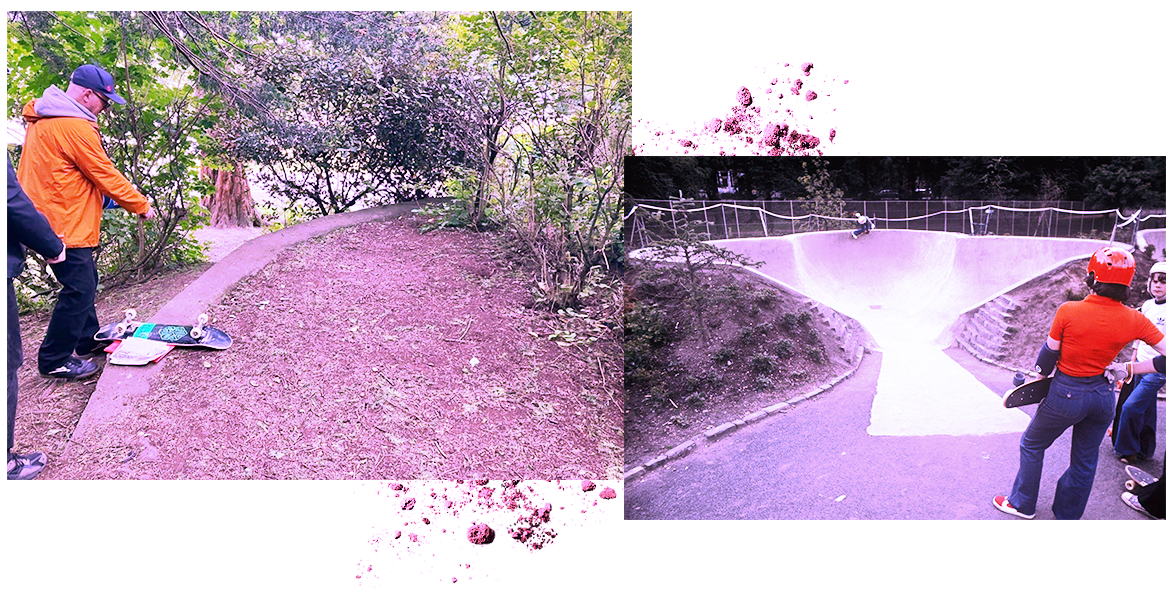
Four decades later, it’s that awe, a sort of astonishment at this historical abandonment, which caught the interest of Dr. Kenny Brophy. This past summer, Brophy, an archaeologist and Senior Lecturer in Archaeology and Prehistory at the University of Glasgow, along with his master's research student Lorna Cummings, led “a contemporary archaeology exploration” to dig up sections of Kelvin Wheelies.
Brophy first encountered the remnants of KG while taking his students on a walk through the park.
“There was a parallel line of concrete blocks and I couldn't work out what it was. I thought it was maybe an old abandoned railway station or something.” When he finally learned that beneath all of that earth sat a skatepark, “I just couldn't imagine the scale of it because it's so huge.”
As it would happen, Cummings later focused on KG in a portion of her master’s research and was in communication with Jamie Blair, who told Brophy that “it'd be quite cool if he could see bits of it again.” The project began to take shape from there, with a grant from the Society of Antiquaries of Scotland financially supporting the fieldwork and Blair and other local skateboarders getting on board. David Murray even beamed in via videocall from Australia to let Brophy know where they could find his hand.
How does one go about getting permission to dig up sections of a popular public park “in quite a posh bit” of Glasgow’s west end?
“It was pretty easy,” says Brophy. “I've got an ongoing relationship with Glasgow City Council… they're quite keen to see archaeology happening in parks, as long as it's got a community involvement angle. The only proviso was that we left it as we found it.”
While they were allowed to dig, it was in moderation. “Uncovering whole stretches of the slalom runs and that sort of thing” wasn’t feasible, but they were given the go-ahead for “some small holes.” In total, they dug three separate trenches that cut across two different slalom runs, the primary run 50 metres long and five metres wide. “We put one [three metre by five metre] trench through that just to see what it was like at the end of the transition.”
Brophy likens the process to “taking little slices out of a cake.” The biggest slice revealed a skateable section, akin to a mini-ramp, that locals took advantage of for the brief time it remained exposed to open air.
The team also proceeded with a handful of metre-by-metre pit trenches in the Bazooka and Jaws bowls, but due to their depth, they weren’t able to excavate safely. “They're really, really big,” says Brophy.
Despite what he calls the "modesty" of their dig, it received significant media attention, which in itself was one of the project's goals, as Brophy told the BBC, "There is a very real danger that this skatepark, a place that was so special for hundreds of young people just decades ago, will become forgotten and lost."
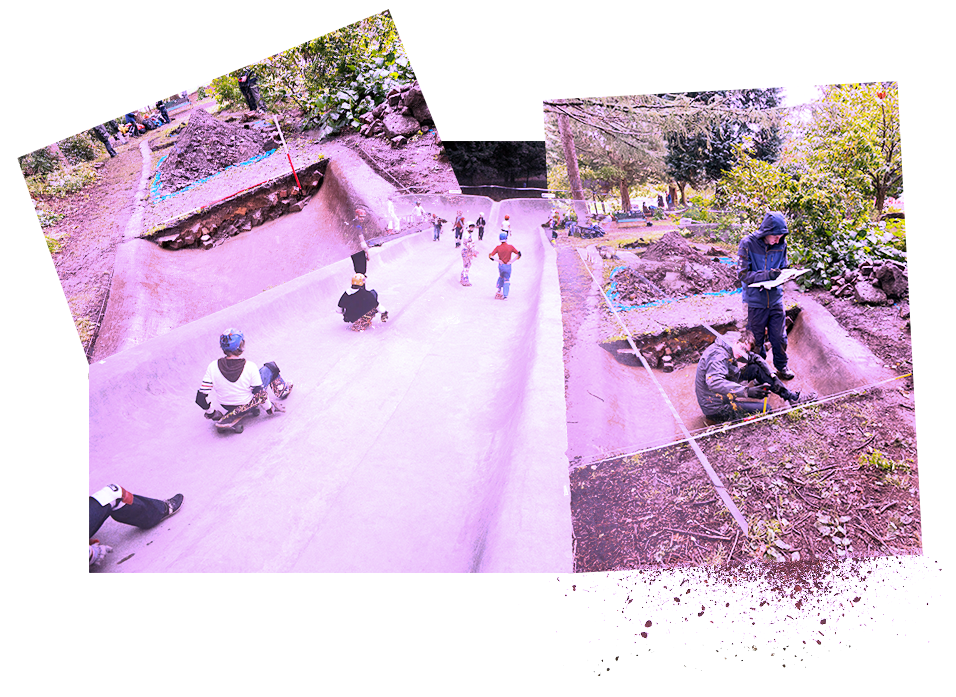
There were also more academic objectives. “In terms of the archaeology, the main aims we had were to find out what state the concrete was in — was it still skateable, for instance? Could we find any graffiti or any evidence of stuff on the sides? And also, we wanted to tell a bit of the story of the filling in of the features, because even though it doesn't seem the most exciting thing in the world, there was still some doubt as to when that happened and exactly what went into the fills, because it wasn't documented very well at the time by the council. There's no media coverage, really.”
In that sense, it was a success. The concrete the team uncovered was in good enough condition to skate. They found splashes of graffiti, though much of it was covered by “white blocks,” which Brophy guesses is the result of the city painting over the offending artwork. He hopes that with the pictures they took, they can use software designed to “look at historic graffiti” to pick up on those details, as archival photographs show things like “band names, CND [Campaign for Nuclear Disarmament tags] and various early '80s motifs and logos.”
They also found that KG was filled with literal rubbish. “I mean, there was stuff like bricks, stonework, carpet tiles, linoleum, light fittings, a doorknob, a Wellington boot. It was all sorts of stuff.” That’s where the skatepark fits into a broader historical context. Brophy says that in the late ‘70s and early ‘80s, a number of Glasgow’s low-income tenement blocks were demolished and “swept away.” He believes it’s possible that debris was dumped into the bowls and snake runs — one destruction aiding another.
Unearthed chocolate bar wrappers with best-before dates of March 1983 also provided a timestamp of events, whether they were garbage dredged from the tenements or tossed in by the crews destroying the skatepark in real time. All of this is evidence of an extant world below the greenery and soil, where the skateboarder once thrived.
Still thrives. There is a modern skatepark in Kelvingrove, not far from the bones of KG. Brophy says skateboarding served as an uncanny soundtrack to their excavation. Those skateboarders, in their teens and twenties, also came over to check out the progress. “For them, the KG was like a mythological place, so they wanted to pay homage — and skate it as well.”
Brophy calls the support he and his team received from the local skateboarding community “amazing” and a “privilege.” At the end of the dig, some of those skaters even paused their sessions at the new park to help backfill the trenches at the old.
It takes many hands to maintain history. They never did find David Murray's.
GREENFIELD
In 1976, Wisconsinites Scott Winston and John Kollross saw a business opportunity. A skateboarding boom was underway, and the enterprising duo decided to enter the market, chopping up the inventory of a local water ski company into skateboard decks and selling them under the branded portmanteau Winross.
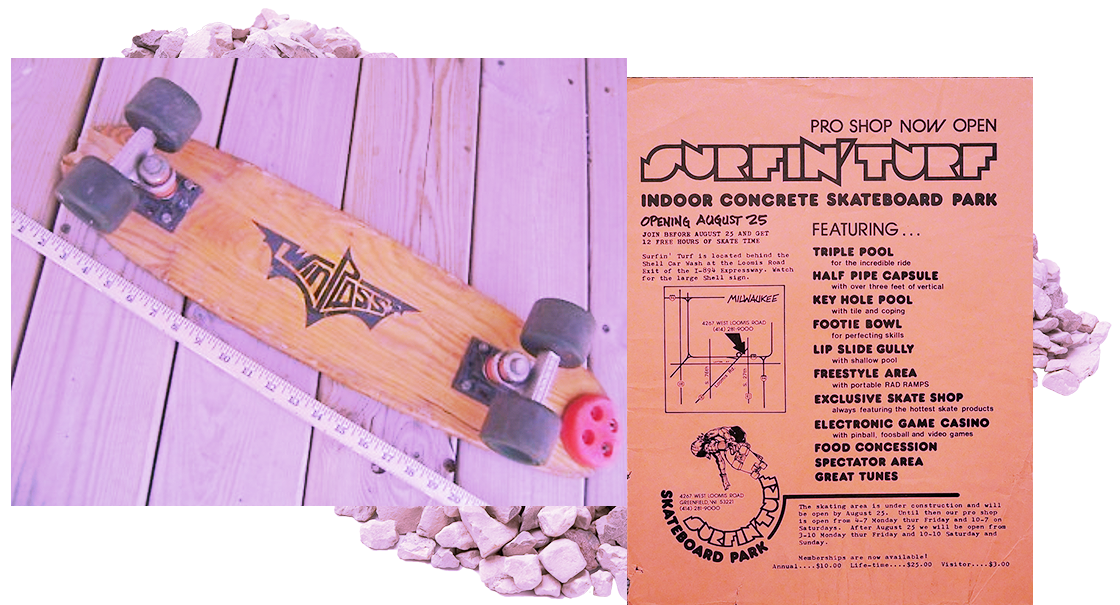
As Kollross’ LinkedIn profile tells it, over the next two years, the company “Pioneered the skateboard industry in the Midwest,” opening three retail outlets and hosting clinics at schools, malls, community events, and on local television. Eventually, Winross began looking for investors in the next logical step of their enterprise: a skatepark.
Answering the call was Jerry Steuernagel and his brother, Ray. Jerry was a budding entrepreneur with a diverse skillset, including experience as a photographer, boat captain, and airplane pilot. Most importantly, he had a plot of land in Greenfield, Wisconsin. The property was owned by his parents and had originally been an apple grove before his father cleared the land and built a print shop and a gas station. The elder Steuernagel had encouraged Jerry to open a self-storage facility alongside the other businesses; a decidedly low-maintenance, low-overhead, low-payroll, and high-profit venture.
Jerry wanted a skatepark.
The Steuernagels and Winross duo hired Californian architect Art Kent to design the park alongside a developer group called Foxfire, which Kent explained to the Milwaukee Journal Sentinel, “financed skateparks as cash-based recreational facilities where skaters would pay a few dollars for timed sessions.”
Surfin’ Turf opened its doors roughly two years later in August 1979 as something of a marvel: an indoor skatepark with concrete bowls. Five of them. There was the Lip Slide Gully, Footie Bowl, Triple Pool (or clover bowl), Key Hole Pool, and the Half Pipe Capsule, which Kent says was inspired by a “Taco Bell hot sauce cup.” They ranged from 4’ to 13’ feet deep. Skateboarders flocked to Greenfield.
Joe Medrow was a Charter Member of Surfin’ Turf, taking his younger brother to be one of the first 100 to sign up for memberships in June of that year, months before the park officially opened. Surfin’ Turf was a boon for the local scene, as the closest park, Biddles Skateboard Palace, had closed the year before.
Medrow remembers that during the early days, when Winston and Kollross were managing the park and the pro shop — which, of course, sold Winross products — they played jazz through the P.A. system, “which blew my mind, since most of us were into heavy rock, and just getting into punk and New Wave.” However, “While Scott and John were nice guys, they, and their jazz, didn't last long.”
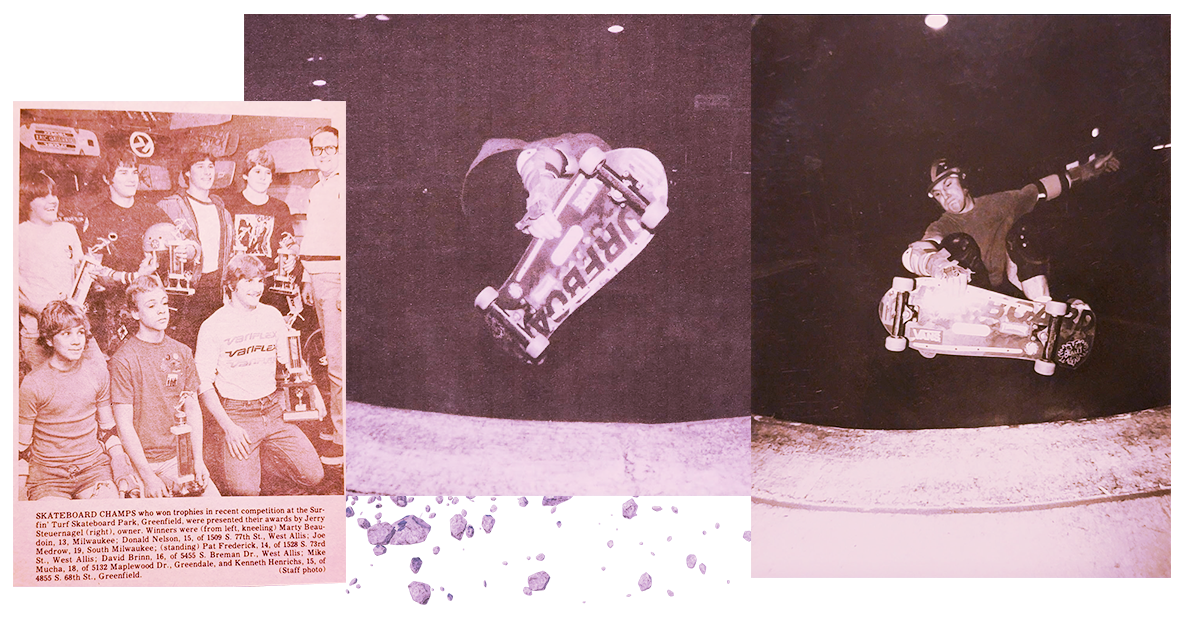
Kollross’ LinkedIn says he left his role as “owner/manager” in 1979, just months after Winross’ dream of a skatepark came to fruition. This was apparently due to a falling out with the Steuernagels. In the Winross’ absence, Jerry and Ray became more involved in the park’s day-to-day, but they also relied on additional help.
Bob Petoskey was 14 years old when he became Charter Member 34 of Surfin’ Turf. He couldn’t afford regular sessions at the park, which ran for $5.25 a pop, so he struck a deal with Jerry. If young Petoskey swept the pools, took out the trash, and managed the general upkeep of the park, he’d accrue time on a “skate balance” and earn an unlimited monthly pass.
From there, Petoskey says, “it was like a minimum of five days a week. Pretty much go to school, head up to the park, skate, go home, do homework, then go to school the next day, and back up to the park. In summertime, it was pretty much all day, every day at the park.” That evolved into a full-time role by the time Petoskey was 17.
In 1981, skateboarding’s popularity, especially transition skating, began to dim. Surfin’ Turf’s clientele base dipped and business grew dire. Steuernagel did what he could to maintain, changing the rules to allow BMXers to use the park, building a bike track out back, inviting bands to play, and putting on fundraisers. Steuernagel even took odd jobs to make ends meet. It wasn’t enough. They needed outside investors.
In 1982, an outfit from Chicago, which included a man named Mark Little, pitched Steuernagel on a reinvention of the business. The Chicago group purchased A.A.A. Fun Center Inc., the corporation that the Steuernagel ran Surfin’ Turf under, and leased his building. The sale included all of Surfin’ Turf’s inventory, from the hard goods in the pro shop to the sodas in the fridge and the business permits.
Steuernagel assumed Little and company would continue A.A.A. Fun Center Inc.’s operations as a skatepark. However, with skateparks being the novel thing they were at the time, when Steuernagel got the permitting for the park, it was granted under a broad special-use permit for entertainment businesses, which the new owners saw as an opportunity.
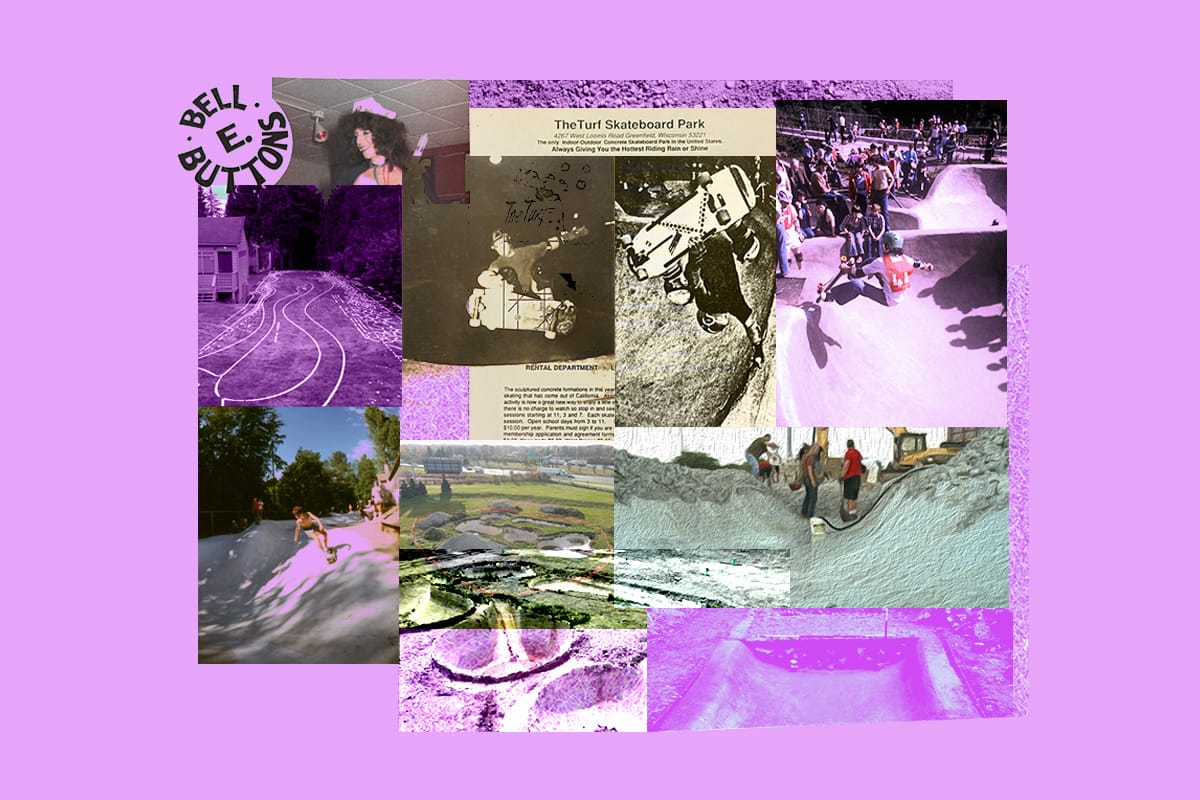
To quote the decision from Little v. City of Greenfield, “On March 14, 1983, A.A.A. Fun Center, Inc., opened for business as the ‘Bell E. Buttons’ nightclub. The adults-only nightclub featured comedy acts and dance presentations, during which the live dancers periodically were nude.”
The skatepark had become a strip club, which was, technically, an entertainment business. A stage was built in what was once the pro shop and booths for private dances were constructed in the viewing area that once overlooked the Triple Pool. The windows that framed the skating area had been boarded over and the park itself was cordoned off.
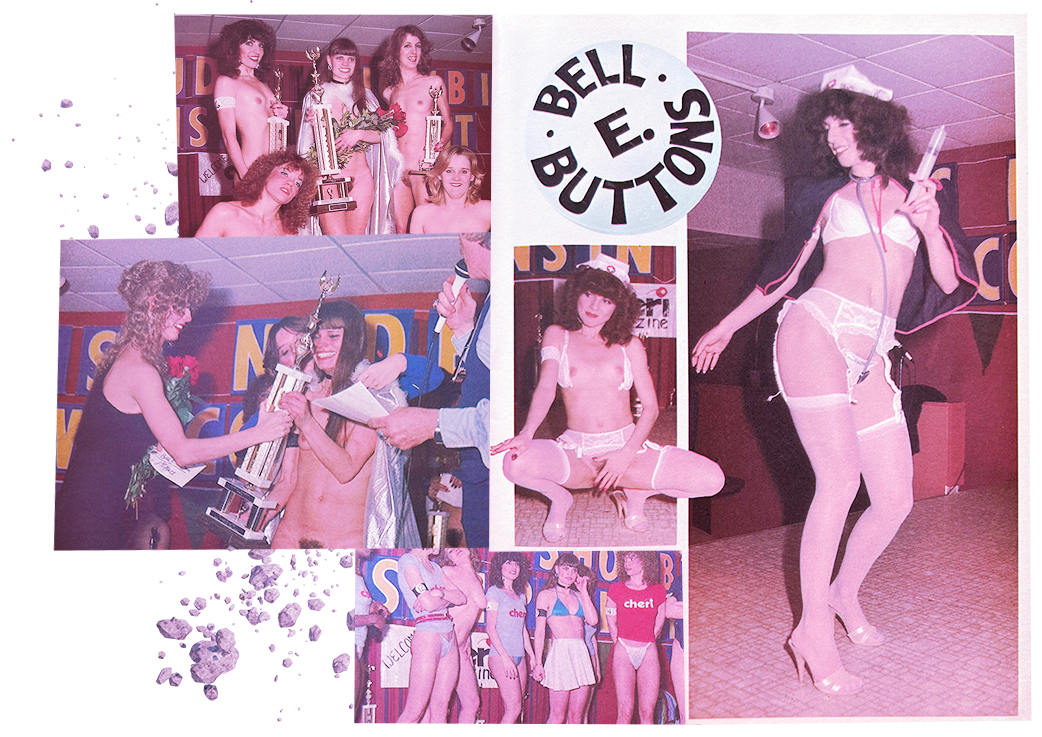
An initial effort by the City of Greenfield to shut Bell E. Buttons down failed after that successful legal challenge by plaintiffs Little and his landlord Steuernagel. Still, even with a steep $25 cover charge — that included two sodas as they couldn't secure a liquor license — the club struggled.
Mike Beer (his surname a preferred nom de plume), proprietor of Milwaukee’s esteemed Beer City Skateboards and Records, says that at one point, Steuernagel pitched the idea of opening a hybrid skatepark and gentleman’s club to ease the financial strain and get his business back up and running.
“[Jerry] thought he could have a pro shop in the parking lot with a trailer… the skate park open during the day, and then at night, it could be a strip club.” The city, perhaps wisely, refused to issue a permit.
By September of ‘87, Bell E. Buttons was limping along, and Steuernagel, who had grown frustrated with his tenants, seized on a late rent cheque as grounds for eviction. He had other plans in mind. Steuernagel had studied the consumer demographics, was aware of skateboarding’s ebbs and flows of popularity, and was confident that this was the time to reenter the market.
A decade on from first scheming with the Winross duo to build a skatepark, and with considerable support from the local skate scene, Steuernagel reopened the park that November as The Turf. This reincarnation included a new outdoor street course to appease the growing style of the day.
In the intervening years, Bob Petoskey had graduated from high school, gotten a job, and moved to Madison, Wisconsin, life flowing in a different direction. After word got to him of The Turf’s opening, he made the hour drive back home.
“I skated Friday, Saturday, and Sunday. Could barely walk the next week. Came back the following weekend. And I did that, you know, probably for the next four, five weeks.”
In Madison, Petoskey successfully pitched his boss on getting transferred back to the Milwaukee area. Not long after that, his old boss, Jerry, offered him a job managing The Turf. Petoskey worked with Steuernagel until the park closed again in late ‘94, early '95. (Some say '96. The exact timeframe went fuzzy as the years went on.)
That second era spawned the likes of Al Partanen, Mike Beer, Darren Navarrette, and Sam Hitz. It was also a time of serious notoriety for the park, as names like Tony Hawk and Jeff Grosso trekked out to Greenfield to try out its terrain. The Turf was famously featured in Santa Cruz Skateboards’ Streets on Fire in ‘89.
Toward the end of the skatepark's second stint, as wheels shrank and interest in transition skating waned to nought, Steuernagel once again did all he could to keep things afloat. That included captaining tourist boats in the Milwaukee area during the summer, funnelling the cash he made back into the park. As Petoskey tells it, with foreclosure imminent, Steuernagel, at this point something of a skateboarder at heart, convinced the bank to loan him the money for one last try.
He used the cash to fill the pools with gravel and cover them with concrete tops, turning the building into a traditional warehouse space. Above the covered pools, they built a street course, and, in turn, a heavy-handed metaphor: As one era of skateboarding died, another struggled to be born, and it was not profitable. The Turf eventually sputtered out. Finished. Again.
Steuernagel had debts to pay. He leased the warehouse to a company that sold treated flameproof lumber. A means to an end. Underneath his tenants remained the possibility. Capped, but not destroyed, because he knew the winds would shift, that skateboarding would be popular again. He was right. Unfortunately, Petoskey says, Steuernagel had reached his limit. “He had sold his boat, sold his car, sold his house, pretty much cleaned out his retirement [savings], all trying to keep the park open.”
When another company approached about purchasing the property outright, he accepted. According to Petoskey, who stayed in touch with him for years afterwards, Steuernagel took the cash and bought a condominium complex in Florida. He’d eventually go on to build and sell “mini-tugboats,” and, as any proper seafaring person with the opportunity would do, he purchased the submarine from the film U-571 (2000) after seeing an ad in a local newspaper. He kept it in his driveway.
The Turf has lived multiple lives. These are a handful of stories from the generations of people who pumped that life into it, whose own lives were changed by the potential of its swooping concrete forms. A feature from the September 2025 issue of Thrasher by Sam Hitz and Peter DiAntoni states there were over 10,000 members of The Turf worldwide (Donny Nelson can claim status as member #1).
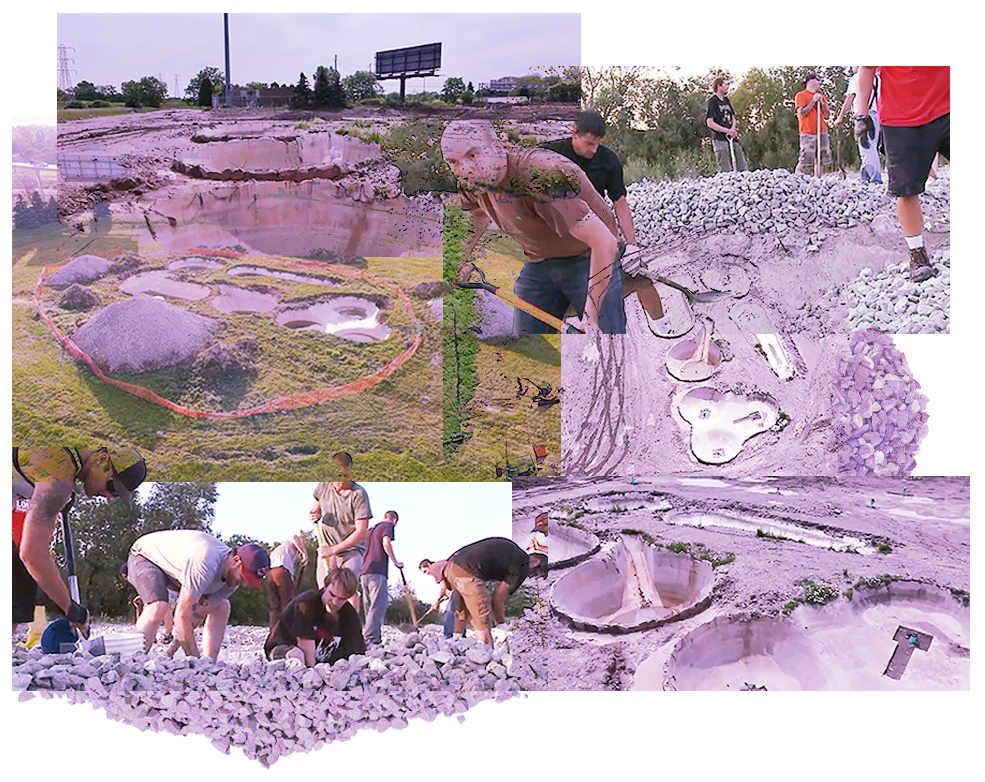
The property changed hands a few times after Steuernagel sold. The Wisconsin Department of Transportation bought it in 2010 and tore down the warehouse that August while preparing the land for development of a freeway project. In the process, the construction crew cracked the concrete caps, revealing an odd series of swimming pools full of stones.
Mike Beer and his friends took notice and rushed to the lot, grabbing tiles and whatever scraps of detritus they could carry as memorabilia; a complete demolition of The Turf’s remains seemed inevitable. This moment was just a bit of dumb luck, one last fateful glimpse into a past soon forgotten.
As the summer sun hung heavy in the sky, they decided to start digging, scooping rocks out of the Lip Slide Gully with their bare hands. Over several days, a growing cross-generational contingent of skateboarders showed up and stuck shovels into the hard-packed gravel. A local Fox News affiliate covered the impromptu excavation, which alerted the Department of Transportation, who kicked the skateboarders out and put everything they’d dug out right back in.
However, that news report sparked a groundswell of support for a Save The Turf campaign, including buy-in from Greenfield Mayor Mike Neitzke, who pledged to help restore the park. That promise stretched on for nearly a decade and countless hours of community engagement and volunteer hours by the Turf Council, before Mayor Mike, who leads Greenfield to this day, was able to purchase the land for a symbolic $1 from the Department of Transportation, contingent on the land becoming a public park.
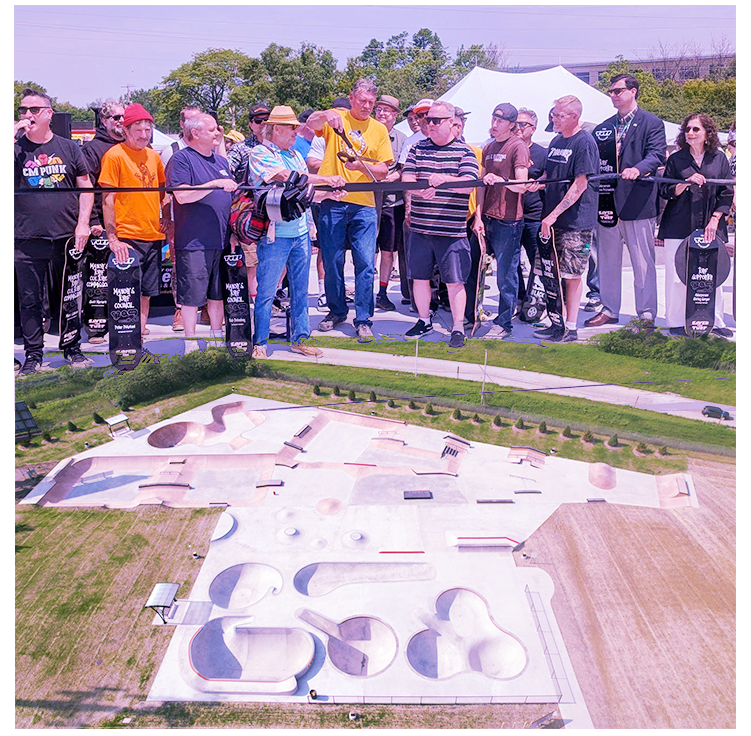
On June 7, 2025, The Turf officially reopened. The old bowls were reconstructed, a new one built among them, along with a modern street course. It is a beautiful facility, one that looks every bit of its reported $2 million price tag. Mayor Mike has said that he wants it to be the best skatepark in the Midwest, if not the United States — a full-blown attraction.
“At the grand opening… we had people from Mexico, Canada, Arizona, California, Florida, Iowa, South Carolina, Massachusetts. These are just the ones that I know of that I talked to.” Says Bob Petoskey.
Petoskey, now 61, has seen The Turf in all its forms. From a hole in the earth during its initial construction to its most recent resurrection 46 years later. For him, this is more than a piece of public infrastructure; it’s history, not ancient, no longer buried, but a present and living thing.
“The park truly does mean that much to me. I am who I am, and I have the incredibly blessed life that I have, because I was a skateboarder. Because I worked at the park. Because I understood the value. And that is what the park brings to kids going forward.”
WEST VANCOUVER
History is hard to hold onto. If not duly maintained, memory and meaning become piecemeal, prone to breaking off and getting lost. Details buried.
Five days is all that separates Canada’s oldest "skatepark" from its second-oldest. On August 20, 1977, the town of Kirkland, Quebec, a suburb of Montreal, unveiled a simple asphalt track intended for skateboarding in Parc Holleuffer. It cost $1,700. Five days later, on August 25, 1977, the city of West Vancouver officially opened Inglewood Skatepark.
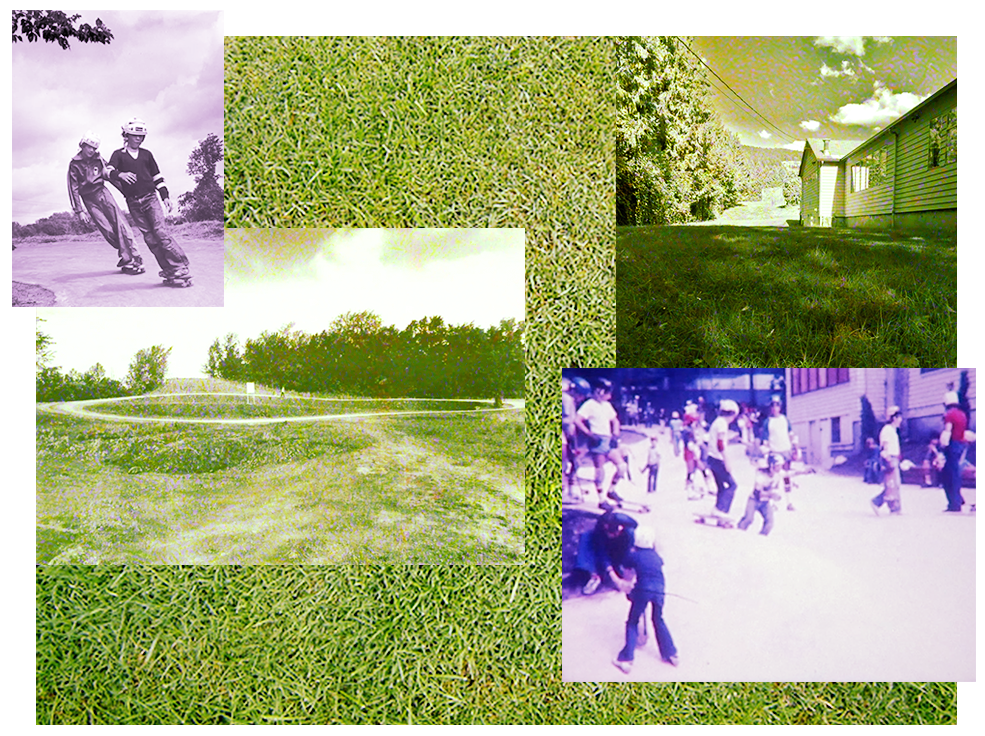
Both have since vanished. Football pitches, tennis courts, and a baseball diamond now populate Parc Holleuffer. Inglewood rests under a green stretch of grass on the property of West Vancouver Secondary School.
Federally funded for approximately $18,400 and built on a parcel of land donated by the local school board, Inglewood was a fluid, flowing concrete snakerun designed by Calen Sinclaire and championed by Monty Little. Little would become an integral fixture in the Canadian skateboarding scene, going on to successfully lobby for the construction of future skateparks, co-found the Canadian Pro-Am Skateboard Association, and organize the Transworld Skateboard Championships at EXPO ‘86 in Vancouver, an event memorably captured in the film Radical Moves.
Sinclaire was not a skateboarder himself, but an essay on Inglewood’s history, written by artist, educator, and skateboarder Bruce Emmett, notes that he had welcome bona fides.
“As a designer of trimaran boat hulls and sculptural playground structures, Sinclaire’s work existed at the intersection of architecture, industrial design, and art. This made him the ideal candidate to reveal to Canadians a new design typology: the skatepark.”
Despite its initial popularity, Inglewood only remained above ground until February 1984, the city burying the park due to a lack of interest, the cost of upkeep, and various liability issues — the usual maladies faced by parks of that era.
Unlike Kelvin Wheelies or The Turf, Inglewood has stayed buried, six feet of soil separating it from daylight. Like the others, it became urban legend: a skatepark, maybe Canada’s first, depending on your definition of "skatepark," lying dormant beneath the lawn of a local high school. Dormant, in this sense, like Steuernagel entombing The Turf in concrete, also speaks to possibility.
“The decision to bury the park was accompanied by a proviso in the form of a statement found in the West Vancouver Parks and Recreation Advisory Commission meeting minutes,” writes Emmett. “‘In the event that interest in skateboarding is revived at some time in the future, it would be relatively simple to remove the fill.’ This statement has fueled a hope for many that the park will one day be skated again.”
In the 40 years since, interest in skateboarding has been revived, died, and risen once more. The party that hasn’t shown interest is the West Van School District, which told Emmett over a decade ago that they had “no appetite” for unearthing Inglewood.
At the time, Emmett was working on his thesis project at Emily Carr University in Vancouver, the same school where Calen Sinclaire studied sculpture. The subsequent work, which he describes as an “interpretive, artistic investigation with an archaeological spirit,” was built on rigorous research, including the use of ground-penetrating radar on the site where Inglewood lies.
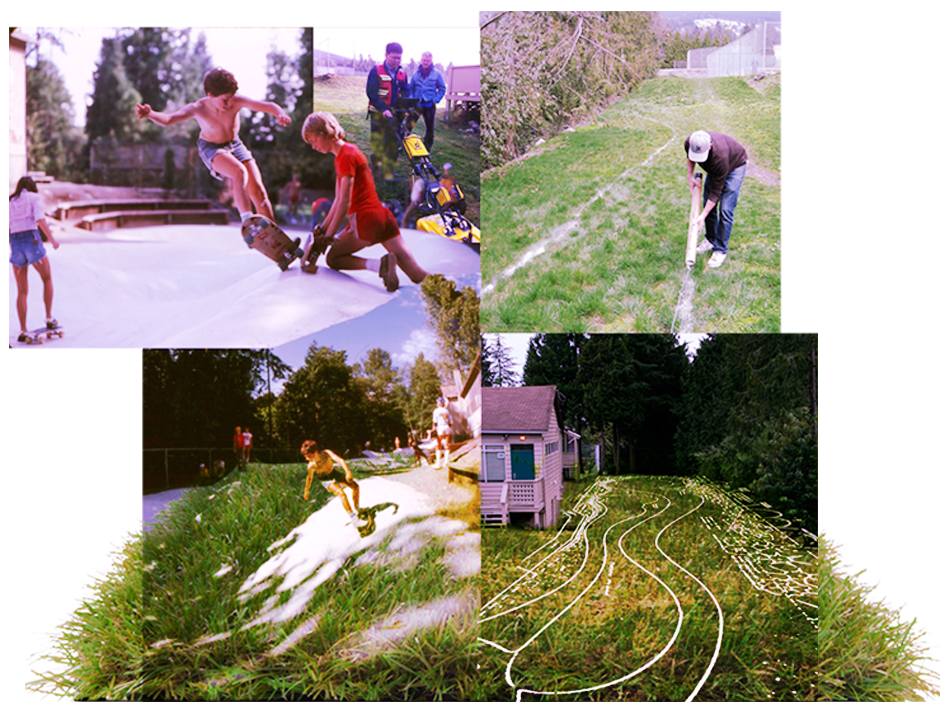
Emmett's project was the first time archaeological survey strategies had been used on a skatepark. It wouldn’t be the last. Emmett went on to collaborate with a local archaeologist, Bob Muckle, on a series of papers and presented them abroad. Together they “[explore] the intersection between art and archaeology. Where Bob sees an archaeological artefact, I see readymade sculpture.”
What they both see, as does Kenny Brophy with his work in Kelvingrove Park, and everyone in Greenfield who started digging out the Lip Slide Gully by hand, is the importance of these spaces and what happens to a community and to history when they are considered expendable.
“I think there's actually something destabilizing about that,” says Brophy. “We live in a world where the ground's moving under our feet all the time… It's quite good to step back and say these things matter, [these things] that we build and then dispose of and destroy immediately. We shouldn't just move on and accept that.
“These are special places used by people in really communal ways. They're emotionally important to people. They create communities. Then fashions change, and they want to bury [them]. We should hang on to these exciting and interesting things… we should celebrate them.”
That’s part of what this work is: a celebration. It shows that history, this delicate and mercurial thing we have been conditioned to let go of, has meaning. That it matters. The details, even the minute and tedious, are parts of the whole. Celebrating can also lead to action, as shown with The Turf's resurrection. When it comes to Inglewood, “My cataloguing and storytelling-and-gathering is presently our only option,” says Emmett.
Still, that option leads somewhere. Emmett has gone on to take part in international confabs alongside Patrick Quinn and Iain Borden, professors at University College London, who are at the forefront of preserving and studying skateboarding heritage. Borden recently received a two-year British Academy Grant to document concrete and asphalt skateparks from the ‘70s and ‘80s across the United Kingdom.
In the UK, an effort to conserve and recognize the impact and import of parks from that era has seen success, with The Rom and Livingston receiving “heritage listing.” Elsewhere, as with Automobilen in Falkenberg, Sweden, those battles for understanding continue.
“[Accepting] that these things are dead and buried and of the past, and there's no value to them because they're only modern things, and we'll only worry about stuff if it's 100 or 500 years old, is the wrong way to look at it,” says Brophy. “Everything around us now is so disposable. We build buildings that [won’t] last for centuries, like buildings used to. We've built obsolescence into all of our technology.
“Part of this is about pushing back and saying, actually, let's imagine a world where things matter and aren’t just disposable… It’s the mad churn of capitalism. We should fight back against that.”
Ultimately, that is what these grassroots campaigns, art projects, and government-funded studies are: a counter to an encroaching, culture-devouring meaninglessness that spreads like a shadow. The skatepark and the people who use it, as unlikely as it may seem, are proof of life. Their history a light.
Through tears, Bob Petosky says that his park, one of countless others, “truly means more than I think the average individual is ever going to fathom.”